 ultimate-guide
How to Scale SEO for Mid-Sized Business: A 2026 Guide
Table of Contents
- Why Mid-Sized Businesses Need a Scaling Strategy for SEO
- Align SEO Goals with Revenue and Business Objectives
- Technical SEO Audit Checklist for Mid-Sized Sites
- Content Strategy and Scaling Production Across Product Lines
- SEO Automation Tools for Scaling Your Workflow
- SEO Budget for Mid-Sized B2B Companies: What to Allocate
- In-House vs Agency SEO for Mid-Market: Making the Right Choice
- Managing Change and Cross-Departmental SEO Integration
- Measuring Performance and Proving ROI to Leadership
- Conclusion: Start Scaling Your SEO Today
Last Updated: August 5, 2026
Why Mid-Sized Businesses Need a Scaling Strategy for SEO
Mid-sized companies face a unique constraint: enough complexity to demand sophisticated strategy, but not enough resources to throw at every problem. Your product line is expanding, content needs are multiplying, and your team is stretched thin. Meanwhile, competitors are investing heavily in organic acquisition.
The core challenge isn't learning SEO tactics, it's building a repeatable system that grows with your business without exploding your budget or burning out your team. Most mid-sized businesses treat SEO as a side project, guaranteeing stagnation. Scaling SEO requires intentional architecture: clear goals tied to revenue, automation where it matters, and ruthless prioritization of what moves the needle.
Companies that scale SEO successfully don't work harder, they work smarter. They automate keyword research and content optimization. They align SEO with sales and product teams instead of treating it as marketing-only. They measure what matters: revenue attribution and customer acquisition cost, not rankings or traffic.
GrandRanker helps mid-sized companies tackle this exact problem by automating keyword research, content creation, optimization, and publishing, so your team can focus on strategy and revenue impact instead of drowning in tactical execution.
Align SEO Goals with Revenue and Business Objectives
SEO only matters if it moves revenue. Too many mid-sized businesses measure success by vanity metrics: rankings, traffic volume, domain authority. None of that matters if it doesn't convert to customers or revenue growth.
Start by defining what SEO success looks like for your business. Is the goal lead generation for your B2B sales team? Direct e-commerce revenue? Market expansion into a new geographic region? Each goal demands a different SEO strategy. A SaaS company chasing enterprise contracts needs to dominate high-intent keywords with long content that builds trust. An e-commerce brand needs velocity: hundreds of product-level pages ranking for long-tail keywords.
Work backward from your revenue target. If you need to acquire 100 new customers this quarter and your average customer lifetime value is $50,000, calculate the conversion rate at each stage: how many visitors convert to leads, how many leads convert to customers. This gives you the organic traffic target you actually need.

Document this in a simple one-pager: revenue goal → customer acquisition target → conversion rates → required organic traffic. Share it with leadership. This becomes your North Star. Every content decision, every optimization, every resource allocation flows from this number.
Technical SEO Audit Checklist for Mid-Sized Sites
Technical SEO is foundational. You can have brilliant content and perfect keyword strategy, but crawl errors, indexation problems, or performance issues leave rankings and traffic on the table.
A technical SEO audit for a mid-sized site needs to cover:
- Crawlability and indexation: Are all important pages crawlable? Check your robots.txt, sitemaps, and noindex tags. Identify any pages that should be indexed but aren't.
- Site architecture: Is your internal linking structure logical? Can Google easily discover all important pages? For multi-product businesses, ensure each product line has clear navigation.
- Page speed: Core Web Vitals matter. Test your pages with PageSpeed Insights and identify bottlenecks. Images, render-blocking JavaScript, and server response time are common culprits.
- Mobile usability: Is your site mobile-first? Google indexes the mobile version. A broken mobile experience tanks rankings.
- Structured data: Implement schema markup where relevant: product schema, organization schema, breadcrumb schema. This helps Google understand your content and improves click-through rates.
- HTTPS and security: Ensure your entire site is on HTTPS. Mixed content warnings hurt rankings.
- Duplicate content: Identify and fix duplicate or near-duplicate content. Use canonical tags where appropriate.
Set aside a quarter to conduct a comprehensive audit and fix the biggest issues first. Prioritize by impact: fixing crawl errors that prevent indexation is more urgent than optimizing a page already ranking well.
Content Strategy and Scaling Production Across Product Lines
Creating one blog post per week is manageable. Creating enough content to rank for hundreds of keywords across multiple product lines requires a system.
Start by mapping your target keywords to your business structure: which keywords serve which customer segments, which products, which revenue goals? For a mid-sized SaaS company with three product lines operating in two markets, that might be 500-1,000 keywords. For an e-commerce brand with 50 product categories, it could be 5,000+.
Next, establish content velocity. If you need to rank for 500 keywords and you're publishing one post per week, you're looking at a decade of work. You need to increase velocity through hiring more writers, using AI-powered content creation, or both. Many mid-sized teams find that combining AI-generated content with human editing delivers the speed they need without sacrificing quality.
For mid-sized businesses, content velocity is often the biggest bottleneck. You don't have enterprise budgets, but you can't move at a solopreneur's pace. Automation is the answer. GrandRanker automates keyword research and content creation, letting your team focus on editing and strategy instead of starting from a blank page every time.
Establish a content calendar aligned with your business cycles and keyword strategy. Prioritize high-intent keywords that drive revenue first. Then fill in long-tail and informational keywords that build authority and capture early-stage search intent. This creates a flywheel: your high-value content ranks and drives leads, while foundational content builds domain authority.
SEO Automation Tools for Scaling Your Workflow
Manual processes don't scale. If you're manually researching keywords in spreadsheets, writing outlines by hand, and optimizing each page individually, you're working at a pace that can't compete with automated competitors. But automation for automation's sake creates bloat: too many tools, too many logins, and spiraling monthly bills.
The key is automating the right processes, the ones that consume the most time and produce repeatable outputs.
Keyword research and opportunity identification is the highest-ROI automation target. Manual keyword research is time-consuming and inconsistent. Automation tools identify search volume, intent, competition, and ranking difficulty at scale, then surface the highest-opportunity keywords based on your business goals. Instead of your team spending 20 hours per week on keyword research, you run a weekly scan and review the top 50 opportunities. This alone frees up 15+ hours per week.
Content brief generation and outlining is the second priority. Once you've identified target keywords, creating detailed content briefs is repetitive work that automation handles well. Tools generate structured briefs that your writers use as a starting point, cutting outline creation time from 2 hours per piece to 15 minutes of review.
Content optimization and gap analysis happens after writers deliver first drafts. Automated tools scan your content against top-ranking competitors, identify missing sections, suggest keyword placement, and flag readability issues. For a team publishing 20 pieces monthly, this saves 10+ hours of manual work.
Technical monitoring and alerting should be continuous, not manual. Tools that crawl your site weekly, track Core Web Vitals, monitor for crawl errors, and alert you to indexation drops catch problems before they tank rankings. Continuous monitoring costs less in tool fees than it costs in lost rankings.
Reporting and attribution is often the most painful manual process. Consolidating data from Google Search Console, Google Analytics, your CRM, and revenue system into a single dashboard takes hours monthly. Automation tools pull this data automatically and calculate attribution. Instead of spending 8 hours building monthly reports, you review a pre-built dashboard.
Start with one bottleneck. For most mid-sized teams, that's keyword research + content brief generation. These consume the most time and produce the most consistent output. Automate those first. Once your team is comfortable and seeing ROI, add the next layer: optimization and monitoring.
Measure automation ROI: Before implementing a tool, calculate the time it saves. If keyword research takes 20 hours per week and a tool reduces that to 5 hours, that's 15 hours freed up. At $75/hour for a mid-level marketer, that's $58,500 annually in labor savings. If the tool costs $2,000 monthly ($24,000 annually), the ROI is 2.4x in year one. Track this for every tool. If a tool doesn't save at least 5 hours per week or improve output quality measurably, it's not worth the cost.
Integration and workflow: The best automation setup connects tools so data flows without manual handoff. Your keyword research tool feeds into your content brief generator. Your CMS publishes directly from your optimization platform. Your analytics platform automatically attributes revenue to keywords. This requires some setup, usually a few hours with a developer or Zapier, but eliminates manual data entry that kills productivity.
The goal isn't to eliminate humans from SEO. It's to eliminate humans from repetitive, low-judgment work so they can focus on strategy, creative direction, and revenue impact.
SEO Budget for Mid-Sized B2B Companies: What to Allocate
SEO budget for mid-sized B2B companies varies depending on your revenue, competitive landscape, and growth targets. Start with your revenue goal and work backward. If you need to generate $1M in new revenue this year from organic channels and your average deal value is $25,000, that's 40 new customers. Working backward through your funnel gives you the organic traffic target.
Now estimate the cost to achieve that traffic:
- Content creation (freelance writers, AI tools, editing): Usually the biggest line item. Budget for 20-50 pieces monthly depending on your target keyword volume.
- Tools and software (keyword research, analytics, content optimization, publishing): Pricing depends on quantity, dates, and delivery. Please refer to GrandRanker's website for current pricing.
- SEO specialist time (in-house or agency): Budget 1-2 full-time equivalents or equivalent agency hours.
- Technical infrastructure and hosting improvements: Usually a one-time cost, then ongoing maintenance.
Many mid-sized B2B companies allocate 5-15% of their marketing budget to SEO. That might be $50,000-$200,000 annually. The key is tying that budget to revenue outcomes, not arbitrary percentages.
Be transparent with leadership about what that budget buys. Show the math: X budget → Y content pieces → Z organic traffic → W qualified leads → V revenue. When SEO is tied to business outcomes, it's much easier to justify ongoing investment.
In-House vs Agency SEO for Mid-Market: Making the Right Choice
Most mid-sized businesses face this decision: hire an in-house SEO specialist or partner with an agency. There's no universally correct answer.
In-house SEO specialists bring deep knowledge of your business, products, and customers. They move quickly and build long-term relationships with your team. The downside is limited perspective and blind spots.
Agencies bring breadth of experience across multiple industries and clients. They have specialized teams: strategists, content creators, technical experts. The downside is less intimacy with your business and transactional relationships.
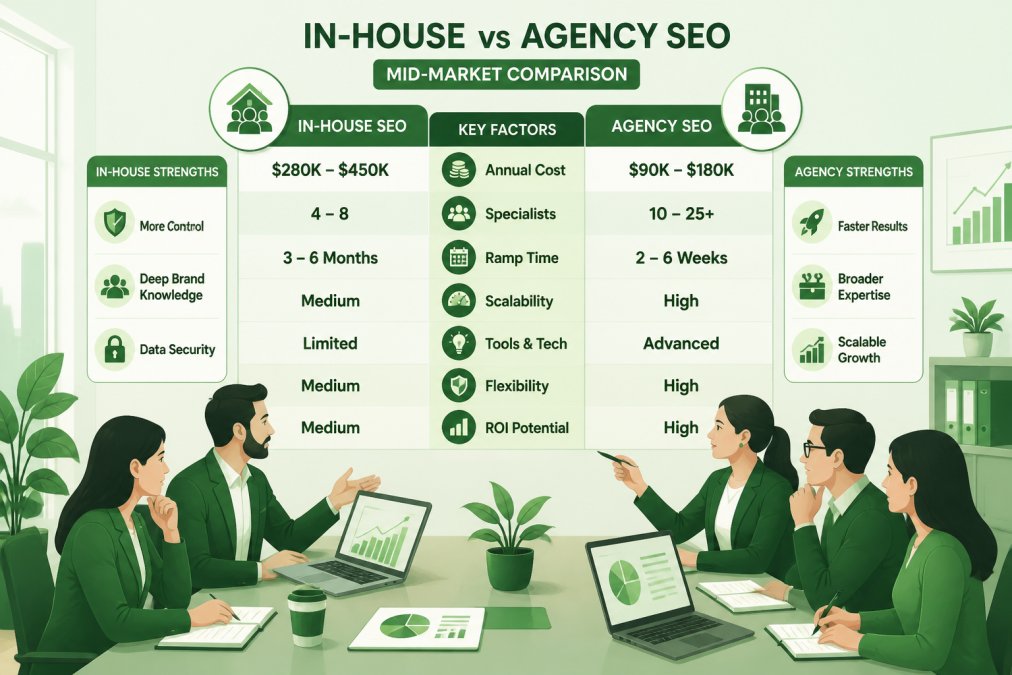
For mid-sized businesses, a hybrid model often works best. Hire one in-house SEO specialist or manager who owns strategy, vendor relationships, and execution oversight. Partner with an agency or freelancers for specialized work: technical audits, content creation, link building. This gives you the depth of an in-house expert with the breadth and flexibility of external resources.
Consider your timeline too. If you need results in 90 days, an agency with proven processes might move faster. If you're building for the long term, in-house investment pays off over time.
Managing Change and Cross-Departmental SEO Integration
SEO doesn't live in marketing. It touches product, sales, customer success, and engineering. Scaling SEO requires alignment across these teams, but alignment doesn't happen through memos. It happens when other departments see SEO as solving their problems.
The core issue is incentive misalignment. Your product team is measured on feature velocity, not search rankings. Your sales team is measured on pipeline, not lead quality. Your customer success team is measured on retention, not content contribution. When you ask these teams to prioritize SEO work, you're asking them to do something that doesn't directly impact their metrics.
Map SEO dependencies and identify resistance patterns:
-
Product team: Controls URL structure, site architecture, mobile experience, page speed. Resistance: "SEO changes slow down our sprints." Benefit: More organic traffic reduces customer acquisition cost.
-
Sales team: Controls messaging, positioning, content requests. Resistance: "We need content that converts, not blog posts." Benefit: High-intent organic leads close at higher rates and lower CAC than paid leads.
-
Customer success team: Controls support tickets, customer questions, churn reasons. Resistance: "We're too busy handling support tickets." Benefit: Customer questions surface high-value content opportunities that drive new customer acquisition.
-
Engineering team: Controls site performance, infrastructure, technical implementation. Resistance: "SEO requirements add complexity to our roadmap." Benefit: Better site performance improves user experience and conversion rates.
Overcome resistance through incentive alignment. Don't ask teams to care about SEO. Show how SEO helps them achieve their own goals.
For product: "If we rank for 'how to use [feature]' and 'best practices for [use case],' we reduce onboarding friction and improve activation rates."
For sales: Share data: "Organic leads convert at 8% vs. 2% for paid search. Our CAC from organic is $500 vs. $2,000 from paid." Ask sales what questions prospects ask during discovery calls. Those become content topics.
For customer success: "The top 10 support tickets this month could have been prevented by content about [topic]." Ask customer success to flag questions they answer repeatedly. Those become content priorities.
For engineering: "A 1-second improvement in page load time increases conversion rate by 7% and reduces bounce rate by 11%." Connect Core Web Vitals to revenue, not just Google's algorithm.
Create an SEO steering committee that meets monthly: one representative from product, sales, customer success, engineering, and marketing. This is a decision-making forum where SEO strategy gets integrated into how your business operates.
The agenda:
-
Review organic performance and revenue impact (10 minutes). Show traffic, leads, revenue, CAC.
-
Identify cross-departmental blockers (15 minutes). What decisions from other teams are slowing down SEO? What technical debt is hurting rankings?
-
Align on quarterly priorities (20 minutes). Which keywords and content pieces will drive the most revenue? Which product changes are coming? Prioritize work that serves multiple departments.
-
Assign ownership and accountability (10 minutes). Who owns content creation? Who owns technical implementation? Make it explicit.
This structure forces cross-departmental thinking. Product can't change URLs without considering SEO impact. Sales can't ignore organic leads. Engineering can't deprioritize site speed.
Build SEO literacy without creating experts. Your product manager doesn't need to be an SEO expert, but they need to understand that URL changes and site architecture decisions have search implications. Invest in lightweight quarterly training: 30-minute sessions for each department showing real examples from your business and revenue impact.
Establish a decision framework for competing priorities. When conflicts arise, ask: "What's the revenue impact?" If a product redesign will increase conversion rate by 5%, that's worth fixing 200 broken links. If a new pricing page will cannibalize $50K in annual revenue, it's not worth it. When you measure everything against revenue, alignment becomes easier.
Measuring Performance and Proving ROI to Leadership
This is where most mid-sized businesses fail to scale SEO. They can't prove ROI, so leadership cuts the budget. Then rankings drop, traffic declines, and the cycle repeats.
Start by defining what you're measuring. Vanity metrics like rankings and traffic are fine for internal tracking, but leadership cares about revenue. Set up proper attribution. Which leads came from organic search? Which customers? What's their lifetime value?
This requires connecting your SEO data to your CRM and revenue system. Use UTM parameters consistently. Tag all organic traffic with a source. Track which keywords brought in which leads. Calculate customer acquisition cost for organic vs. other channels.
Create a monthly dashboard that shows:
- Organic traffic and traffic growth
- Keyword rankings and ranking changes
- Leads generated from organic search
- Customer acquisitions from organic
- Revenue attributed to organic
- Customer acquisition cost from organic
- Return on SEO investment
Share this with leadership monthly. Show the trend. "Organic revenue is up 30% quarter-over-quarter. We're acquiring customers at a 40% lower cost than paid channels." That's the language that drives budget decisions.
Tie every metric back to business outcomes. Agencies often report on rankings and traffic because those are easy to track. But leadership doesn't care if you ranked for 100 new keywords if none of them drive revenue.
Scaling SEO for mid-sized business is about building systems, not working harder. It's about aligning your organization around revenue-driven goals, automating the repetitive work, and measuring what actually matters. Start with your revenue target. Work backward to the SEO strategy that supports it. Automate keyword research and content creation. Integrate SEO across your organization. Measure revenue impact.
GrandRanker helps mid-sized businesses execute this strategy by automating keyword research, content creation, and optimization, so your team can focus on strategy and revenue impact. Start your free trial and see how automation can accelerate your SEO growth while your team focuses on what matters most.
| Scaling Component | Key Action | Expected Timeline |
|---|---|---|
| Revenue alignment | Define customer acquisition target from SEO | Week 1 |
| Technical audit | Identify and fix crawl, indexation, and performance issues | Month 1 |
| Content strategy | Map target keywords to products and customer segments | Week 2-3 |
| Automation setup | Implement keyword research and content creation tools | Month 1 |
| Team alignment | Establish cross-departmental communication channels | Week 2 |
| Performance tracking | Connect SEO data to CRM and revenue systems | Month 2 |
Frequently Asked Questions
How much should a mid-sized business budget for SEO?
SEO budget for mid-sized B2B companies typically ranges from 15% to 30% of total marketing spend, depending on competitive landscape and growth stage. Allocate funds across keyword research tools, content creation, technical audits, and automation platforms. Start by calculating your customer acquisition cost (CAC) and lifetime value (LTV), if SEO's potential ROI exceeds other channels, increase allocation. Monitor performance metrics quarterly and adjust based on conversion rate optimization results and revenue attribution data.
What KPIs should I track to measure SEO scaling success?
Track organic acquisition (traffic from search), SERP visibility for target keywords, conversion rate optimization metrics, and revenue attribution from organic channels. Monitor domain authority growth, backlink profile expansion, crawl budget efficiency, and content velocity (pages published per month). For B2B, measure marketing-qualified leads (MQLs) and pipeline influence. Use performance metrics dashboards to show leadership how SEO drives qualified traffic and revenue, not just vanity metrics like page views.
Can I really automate SEO without losing brand voice and expertise?
Yes, with the right SEO automation tools for scaling. Automation handles repetitive tasks, keyword mapping, technical audits, internal linking structure optimization, and content briefs, freeing your team for strategic work. Your experts review and refine AI-generated content, ensuring it matches your brand voice and industry terminology. The key is using automation for velocity and consistency while keeping humans in control of quality, messaging, and competitive analysis. This hybrid approach maintains differentiation while scaling content production.
When should we switch from freelancers to a full in-house team or agency?
Move from freelancers to in-house vs agency SEO for mid-market when you publish 20+ pieces monthly, manage multiple product lines, or need ongoing technical SEO work. In-house works if you have consistent budget and can retain talent; agencies suit variable workloads and specialized expertise. Many mid-sized companies use a hybrid: in-house for strategy and brand oversight, agencies for technical audits and backlink building, freelancers for content execution. The decision depends on your resource allocation capacity and whether you need deep product knowledge or external authority.
This article was written using GrandRanker