 ultimate-guide
Average Monthly Cost for SEO Services: 2026 Pricing Guide
Table of Contents
- Average Monthly Cost for SEO Services: What You'll Actually Pay
- SEO Pricing Models: Monthly Retainer, Hourly, and Project-Based
- Factors Influencing SEO Costs: What Drives Pricing Up or Down
- Freelance SEO Rates vs Agency Rates: Where Your Budget Goes
- Local SEO Pricing: Costs for Small Business and Multi-Location Strategies
- Hidden Costs and Post-Onboarding Expenses You Should Expect
- What's Included in SEO Services: Understanding Your Investment
- How to Choose an SEO Provider and Evaluate ROI Against Monthly Cost
- Automating SEO to Reduce Long-Term Costs
- Conclusion: Finding the Right SEO Investment for Your Business
Average Monthly Cost for SEO Services: 2026 Pricing Guide
Last Updated: July 19, 2026
Understanding the average monthly cost for SEO services is essential before committing to any SEO strategy. At GrandRanker, we've analyzed pricing across hundreds of SEO providers to help you navigate this landscape. SEO costs vary dramatically, from freelancers charging under $1,000 monthly to enterprise agencies billing $10,000 or more. What you'll pay depends on your industry, website complexity, competitive landscape, and specific services needed.
Average Monthly Cost for SEO Services: What You'll Actually Pay
The average monthly cost for SEO services ranges from $750 to $5,000 for most small to mid-sized businesses. Freelancers typically charge between $500 and $2,500 per month, while agencies start around $2,000 and scale up based on scope and expertise. For enterprises in competitive industries like finance or healthcare, monthly retainers can exceed $15,000.
The wide range exists because SEO isn't a commodity. A $1,000 monthly package for a local plumber differs fundamentally from a $5,000 package for a nationally competitive e-commerce brand.
Price ranges by service tier
Budget tier services ($500-$1,500 monthly) focus on basic optimization: keyword research, on-page optimization, and basic backlinks. This works for local businesses with limited competition. The limitation: these packages rarely include content strategy or comprehensive link building.
Mid-tier packages ($1,500-$5,000 monthly) add content creation, aggressive link building, technical SEO audits, and competitive analysis. Most growing businesses land here because it balances cost against measurable results.
Premium tier services ($5,000-$15,000+ monthly) include dedicated account management, custom strategy development, and integrated services like paid search or conversion rate optimization.
Why costs vary so widely
Industry competition directly influences pricing. Legal or finance keywords might require 8-12 months of sustained effort before ranking, while local service businesses might see results in 4-6 weeks. Agencies price accordingly.
Website maturity matters too. A startup with a new domain requires foundational work; an established site with 500+ pages might need optimization and strategic link acquisition. The latter often costs less.
Geographic location of the service provider affects cost. Remote freelancers from emerging markets often undercut local agencies, though quality varies significantly.
SEO Pricing Models: Monthly Retainer, Hourly, and Project-Based
Understanding pricing models helps you choose the structure that aligns with your business needs.
Monthly retainer model
The monthly retainer dominates the SEO market because it aligns incentives. Retainers typically range from $1,000 to $10,000+ monthly and include ongoing optimization, regular reporting, strategy adjustments, and priority support.
The advantage is predictability and accountability. You know your monthly cost, and the agency has incentive to deliver results. Most retainers include minimum 3-6 month commitments. The downside: if results don't materialize after 3-6 months, you're still paying.
Hourly rate model
Hourly rates for SEO work range from $75 to $300+ per hour. Freelancers typically charge $50-$150 hourly; agencies charge $150-$300+.
This model works well for specific projects: a technical audit, content optimization sprint, or team training. However, it creates perverse incentives, an hourly provider might not optimize for efficiency. Hourly work rarely delivers long-term SEO results because SEO requires strategic thinking over months, not discrete tasks.
Project-based pricing
Project-based SEO pricing ranges from $2,000 to $50,000+ depending on scope. You might pay a flat fee for a technical audit, content overhaul, or competitive repositioning campaign.
This model works when the project has clear boundaries. The limitation is that SEO is ongoing. A project-based engagement might deliver a solid foundation, but without follow-up optimization and link building, you'll plateau. Many businesses use project-based work as an initial engagement, then move to retainer-based services.
Performance-based pricing
Performance-based pricing, where the agency's fee depends on achieving specific rankings or traffic targets, is rare among reputable providers because ranking positions depend on Google's algorithm, which they don't control. Some agencies offer hybrid models with a base retainer plus bonuses for hitting specific KPIs, which can align incentives but also creates risk if external factors shift the landscape.
Factors Influencing SEO Costs: What Drives Pricing Up or Down
Several variables directly impact what you'll pay for SEO services.
Industry competition and keyword difficulty
Competitive industries command higher SEO costs. Finance, real estate, insurance, and legal services have saturated keyword markets requiring months of sustained effort and significant link acquisition. Keyword difficulty directly correlates with cost, easy-to-rank keywords might be tackled in a $1,000 monthly budget, while competitive keywords require $3,000-$10,000+ monthly.
Website size and technical complexity
A 50-page website requires less technical SEO work than a 5,000-page e-commerce site. Technical debt also matters, a site built on outdated technology with poor architecture requires more remediation work and costs more to optimize.
Scope of services and customization
Narrow scope costs less. A provider focusing purely on on-page optimization will charge less than one handling content strategy, link building, technical SEO, and reporting. Customization adds cost, bespoke strategies tailored to your industry differ fundamentally from generic packages.
Agency expertise and location
Top-tier agencies with proven track records charge premium rates. Geographic location influences pricing, a boutique agency in Ljubljana may charge differently than a full-service firm in London. However, remote work has compressed these differences; many agencies now price based on scope rather than location.
Freelance SEO Rates vs Agency Rates: Where Your Budget Goes
Choosing between a freelancer and an agency is one of the most impactful pricing decisions you'll make.
Freelancer pricing structure
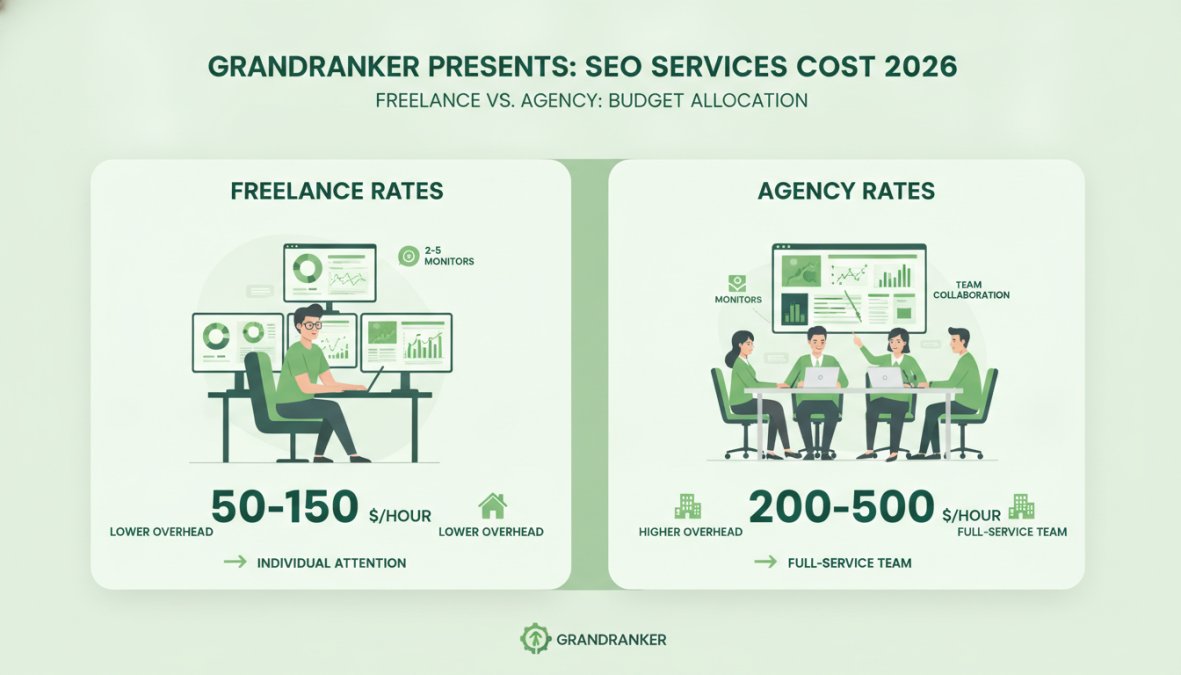
Freelancers typically charge $500-$2,500 monthly on retainer, or $50-$150 hourly. What you get: direct access to the practitioner, lower overhead costs, and often specialized expertise in a specific area. Your investment goes directly into work.
The trade-offs: limited capacity, limited accountability structure, and narrower skill set. Most freelancers specialize in one or two SEO disciplines.
Agency pricing and overhead
Agencies charge $2,000-$15,000+ monthly retainers, reflecting team costs, project management, and infrastructure. What you get: broader expertise, redundancy, formal processes and reporting, and accountability structures.
The trade-offs: higher cost, less direct access to practitioners, and sometimes slower decision-making.
For most businesses, the hybrid approach works best: use a freelancer for specialized work, then hire an agency for ongoing implementation and link building.
Local SEO Pricing: Costs for Small Business and Multi-Location Strategies
Local SEO has distinct pricing structures because the work differs from national SEO.
Single-location local SEO costs
A single-location business optimizing for local keywords typically invests $500-$2,000 monthly. This covers local keyword research, Google Business Profile optimization, local citations, review management, and localized content.
Local SEO is often cheaper than national SEO because competition is narrower. Many local businesses see solid results within 3-4 months with a freelancer charging $500-$1,000 monthly.
Multi-location and franchise pricing
A 5-location franchise typically invests $2,000-$5,000 monthly for comprehensive local SEO across all locations. A 20-location operation might invest $5,000-$10,000+. The cost scales because you need unique local content for each location, citation building across all locations, review management at scale, and technical implementation.
The advantage is efficiency, agencies specializing in multi-location SEO have templated processes that reduce per-location cost.
Hidden Costs and Post-Onboarding Expenses You Should Expect
The monthly retainer fee isn't the only cost.
Setup fees and onboarding costs
Many agencies charge setup or onboarding fees ranging from $500 to $5,000+. Some include onboarding in the first month's retainer; others charge separately. Always clarify this upfront.
Cost fluctuations after the first months
Your SEO costs may increase after the initial engagement. In months 1-3, the focus is on low-hanging fruit: on-page optimization and technical fixes. By months 4-6, you've tackled easy work and need more aggressive link building and content creation to continue ranking improvements.
Additionally, if your initial package included fixed deliverables, you might want to increase this as you see results. More content and more links cost more money.
Additional tool subscriptions and software
Your SEO provider will likely recommend tools: rank tracking software, keyword research platforms, and backlink analysis platforms. These typically cost $100-$500 monthly. Some agencies include these in their retainer; others bill them separately.
What's Included in SEO Services: Understanding Your Investment
Different price points deliver different deliverables.
Core deliverables across pricing tiers
Budget tier ($500-$1,500 monthly) typically includes monthly keyword research, on-page optimization, basic technical SEO audit and fixes, monthly reporting, and 2-4 blog posts.
Mid-tier ($1,500-$5,000 monthly) adds comprehensive SEO strategy with quarterly reviews, 8-12 blog posts monthly, 10-30 backlinks monthly, technical SEO audits and implementation, competitor analysis, and priority support.
Premium tier ($5,000-$15,000+ monthly) includes dedicated account manager and strategy team, 15-30+ content pieces monthly, 50+ high-quality backlinks monthly, custom technical implementations, conversion rate optimization, integration with paid advertising, and custom reporting.
Premium add-ons and specialized services
Beyond the base retainer, agencies often offer add-ons: content marketing strategy ($1,000-$3,000), video SEO optimization ($500-$2,000), international SEO (+$1,000-$3,000 monthly), e-commerce SEO (+$500-$2,000 monthly), local SEO expansion (+$500-$1,500 per location), and PR and brand building ($2,000-$10,000 monthly).
How to Choose an SEO Provider and Evaluate ROI Against Monthly Cost
Selecting an SEO provider is one of the most important marketing decisions you'll make.
Vetting agencies and freelancers
Ask for case studies with specific results. Vague case studies are red flags. Request references and contact them directly. Ask about timeline to results, communication quality, and whether the provider delivered on promises.
Check their own organic presence. If an SEO agency doesn't rank for competitive keywords in their industry, that's concerning. Evaluate their approach, do they ask detailed questions about your business and goals, or pitch a generic package?
Contractual terms and exit strategies
Read the contract carefully. Key terms: minimum commitment (3-6 months is standard), cancellation clause, performance guarantees (reputable providers don't guarantee rankings), deliverables, and reporting frequency.
Ask about exit strategy. If results don't materialize after 6 months, can you leave without penalty? Reputable providers allow exits with 30 days notice.
Measuring ROI and setting KPIs
Before engaging, establish KPIs: organic traffic growth (target: 20-50% quarterly growth in year one), lead volume from organic search, conversion rate from organic traffic, revenue attributed to organic search, and cost per acquisition.
Set realistic timelines. Most SEO engagements take 4-6 months to show meaningful results. Calculate ROI: (Revenue from organic search - SEO investment) / SEO investment. If you're investing $3,000 monthly and generating $15,000 in monthly revenue from organic search, your ROI is 400%.
Automating SEO to Reduce Long-Term Costs
Platforms like GrandRanker use AI to automate keyword research, content creation, optimization, and publishing, reducing the need for expensive agency services. This approach works best for businesses that benefit from high-volume, optimized content and don't require hyper-specialized strategies.
For businesses where automation fits, it can reduce your monthly SEO cost by 40-60% compared to traditional agency services.
Conclusion: Finding the Right SEO Investment for Your Business
Choosing the right SEO investment depends on your industry, competition, and business goals. A local business can achieve strong results with a $1,000-$1,500 monthly investment in a skilled freelancer. A competitive national e-commerce brand might need $5,000-$10,000 monthly from an agency.
The key is aligning cost with realistic expectations. SEO takes time, 4-6 months minimum to see results. Focus on finding a provider with proven expertise in your industry, clear accountability structures, and transparent pricing.
If you're looking to reduce long-term SEO costs while maintaining quality, consider GrandRanker's AI-powered approach. By automating keyword research, content creation, and optimization, you can scale your organic presence without proportionally increasing your marketing budget.
Semantic Coverage Summary
| Topic | Coverage |
|---|---|
| Monthly retainer pricing | $750-$15,000+ range covered across tiers |
| Hourly rate model | $50-$300/hour depending on expertise |
| Project-based pricing | $2,000-$50,000+ for defined projects |
| On-page optimization | Core deliverable across all tiers |
| Technical SEO | Included in mid-tier and above |
| Link building | 10-50+ backlinks monthly depending on tier |
| Content strategy | Custom strategy in premium tiers |
| Keyword research | Included in all tiers |
| Competitive analysis | Mid-tier and above |
| White-hat SEO | Industry standard for reputable providers |
| Service level agreements | Discussed in contractual terms section |
| ROI measurement | KPI section with specific metrics |
| Small to mid-sized businesses | Primary audience throughout |
| Organic traffic growth | Key performance metric |
| Conversion rate optimization | Premium add-on service |
| SEO agency vs freelancer | Detailed comparison section |
| Local SEO pricing | Dedicated section for single and multi-location |
External Sources Cited
According to Moz Pro pricing and SEO services guide, comprehensive SEO platforms for small businesses start around $99 monthly and scale based on features and user seats.
Research from Ahrefs SEO tools and competitive analysis platform shows that businesses investing in proper keyword research and backlink analysis see 20-50% faster ranking improvements compared to those using generic SEO approaches.
The WebFX digital marketing agency case studies demonstrates that mid-market companies investing $2,500-$3,000 monthly in comprehensive SEO services typically see 150%+ organic traffic growth within 12 months.
Frequently Asked Questions
What is a reasonable budget range for SEO services?
Budget ranges vary significantly based on business size and goals. Small businesses typically invest $500-$2,500 monthly, mid-market companies $2,500-$5,000+, and enterprises often exceed $5,000. Your specific average monthly cost for SEO services depends on your industry competitiveness, website complexity, and desired scope (keyword research, content strategy, technical SEO, link building). Start by defining your KPIs and expected ROI before committing.
How do SEO pricing models differ, and which is best for my budget?
Monthly retainer models offer predictable costs and ongoing optimization, ideal for sustained organic traffic growth. Hourly rates work well for specific projects like SEO audits or consulting. Project-based pricing suits one-time needs (website redesign, technical fixes). Performance-based pricing ties costs to rankings or conversion results but requires clear metrics. Choose based on whether you need continuous support or episodic help, retainers suit long-term strategies, while project-based fits tactical needs.
Why do SEO costs vary so much between agencies and freelancers?
Freelancers typically charge $50-$150/hour or $500-$3,000/month because they have lower overhead and no team support costs. Agencies ($2,500-$10,000+/month) invest in dedicated teams, proprietary tools, and accountability structures. Experience level, location, and specialization also affect pricing. Agencies often deliver more comprehensive strategies and measurable results, while freelancers offer flexibility and lower entry costs. Evaluate what services you actually need before comparing rates.
What hidden costs should I expect beyond the monthly retainer?
Beyond the monthly retainer, expect setup or onboarding fees ($500-$2,000), third-party tool subscriptions (keyword research, analytics platforms), content creation costs if not included, and potential rate increases after initial months. Post-onboarding cost fluctuations often occur as strategies mature or competitive landscapes shift. Always ask providers for a detailed breakdown of what's included and what costs extra, transparent contracts prevent budget surprises.
How do I measure ROI to justify SEO service costs?
Track organic traffic growth, keyword rankings, conversion rates, and revenue attributed to organic search using Google Analytics and Search Console. Calculate ROI by dividing revenue gained minus SEO costs by total SEO costs. Set clear KPIs upfront, target rankings, traffic volume, or lead generation numbers. Request monthly reports showing progress toward these metrics. A strong SEO strategy should demonstrate positive ROI within 6-12 months, though results vary by industry and competition.
This article was written using GrandRanker