 ultimate-guide
Improve Google Rankings for Small Business: 9 Tactics That Work
Table of Contents
- Why Small Businesses Struggle to Improve Google Rankings
- Claiming and Optimizing Your Business Profile on Google
- Google Business Profile Optimization Tips for Local Visibility
- NAP Consistency: The Foundation for Local Search Engine Visibility
- Managing Customer Reviews to Build Online Reputation
- Local SEO Checklist for Small Business Growth
- Best SEO Tools for Small Business Owners to Track Progress
- How Long Does SEO Take to Work for Small Businesses
- Measuring ROI: Tracking Which SEO Efforts Actually Drive Customers
- Building Local Authority Through Citations and Backlinks
Last Updated: August 3, 2026
Why Small Businesses Struggle to Improve Google Rankings
Most small business owners think the problem is simple: they're not visible on Google, so they need more traffic. The real challenge runs deeper. Improving Google rankings for small business requires understanding that search engines reward authority, consistency, and user experience, three things that demand ongoing attention, not one-time fixes.
Small businesses in Ljubljana and beyond face a specific disadvantage. They compete against established brands with larger budgets, more backlinks, and dedicated SEO teams. Yet the data tells a different story about what actually moves the needle. According to Moz's 2026 SEO Ranking Factors Study, local search signals and citation consistency matter far more than raw domain authority for businesses with limited online presence. The gap between knowing what to do and actually doing it is where most small businesses fail. They lack the systems, tools, or bandwidth to execute consistently. This guide walks through nine concrete tactics that directly address how to improve google rankings for small business, starting with the fundamentals that deliver the fastest results.
Claiming and Optimizing Your Business Profile on Google
Your Google Business Profile is the foundation for local search visibility. It's also where most small businesses leave money on the table. When you claim and optimize this profile properly, you directly improve Google rankings for small business search queries in your area.
Verify Your Business Information
Start by claiming your profile if you haven't already. Go to Google Business Profile, search for your business, and claim ownership. Google will send a verification code by mail, email, or phone, choose the fastest option available in Ljubljana or your service area.

Verification takes 1-7 days depending on your method. Once verified, you control what appears when someone searches your business name. This is non-negotiable. Unverified profiles can show incorrect information, which damages both your search rankings and customer trust.
Complete Your Profile Data
Incomplete profiles rank lower than complete ones. Google treats a 100% complete profile as a stronger local signal than a 60% complete profile, even if the business itself is identical.
Fill in every field:
- Business name (must match your legal registration exactly)
- Address and service area
- Phone number (local number preferred)
- Website URL (must be live and relevant)
- Business category (choose the primary one that matches your actual business)
- Business hours (update for holidays and seasonal changes)
- Description (120-180 characters describing what you do)
- Attributes (parking, wheelchair access, outdoor seating, etc. as relevant)
- Photos (minimum 10, maximum 300)
- Videos (at least 2-3 showing your business in action)
The description field is often overlooked. Write it for humans first, search engines second. "We offer digital marketing services in Ljubljana" is weak. "GrandRanker helps small businesses rank on Google through AI-powered SEO automation" is stronger because it shows specificity and benefit.
Google Business Profile Optimization Tips for Local Visibility
A claimed profile is the starting point. Optimization is what moves you up the local pack. These tactics directly improve your visibility when people search for services in your area.
Add High-Quality Photos and Videos
Photos and videos are weighted heavily in local search rankings. Profiles with 10+ photos rank higher than those with fewer. More importantly, they convert better, when someone sees your actual location, team, or work, they're more likely to call or visit.
Take photos that show:
- Your storefront or office exterior (clear signage visible)
- Interior workspace or customer area
- Your team at work
- Products or services being delivered
- Customer testimonials or reviews displayed
- Before/after examples (if relevant to your business)
Videos should be 15-60 seconds. Show your business in action, not a static shot. A video of your team greeting customers or demonstrating a service performs better than a generic welcome video. Upload videos directly to your profile, don't just link to YouTube.
:::pro Update photos seasonally. A fresh photo every 4-6 weeks signals to Google that your business is active. Even if it's just a new angle of the same location, the recency boost helps rankings. :::
Post Regular Updates and Offers
Google Business Profile posts appear in local search results and Google Maps. They're a direct ranking signal and a conversion tool. Posts with offers or events see 10-15% higher click-through rates than informational posts.
Post at least twice per month. Cover:
- Limited-time offers or promotions
- New products or services
- Events or workshops
- Team highlights or milestones
- Seasonal updates relevant to Ljubljana's market
Each post should be 100-300 characters, include a call-to-action (Book Now, Learn More, Call Today), and link to a relevant page on your website. Posts expire after 30 days, so consistency matters more than perfection.
NAP Consistency: The Foundation for Local Search Engine Visibility
NAP stands for Name, Address, Phone. If your business information appears differently across the web, search engines treat it as separate businesses. This fragmentation kills your rankings.
Audit your NAP consistency across:
- Google Business Profile
- Your website (header, footer, contact page)
- Local directories (Yelp, Apple Maps, local Ljubljana business directories)
- Social media profiles (Facebook, LinkedIn, Instagram)
- Industry-specific directories
- Anywhere else you've listed your business
Your name should be identical everywhere. If you're "GrandRanker SEO Services" on your website but "GrandRanker" on Yelp, that's a mismatch. Your address should include the same formatting (street abbreviations, apartment numbers, etc.). Your phone number should use the same format everywhere.
Fix inconsistencies immediately. Then, when you update information (moving offices, changing phone numbers), update everywhere simultaneously. Set a quarterly audit to catch new inconsistencies.
Managing Customer Reviews to Build Online Reputation
Reviews are a direct ranking factor for local search. Profiles with more reviews, higher average ratings, and recent reviews rank higher. They also drive conversions, 57% of customers say they read reviews before making a purchase decision.
The goal isn't to get perfect reviews. It's to get consistent, authentic reviews that show your business is real and active.
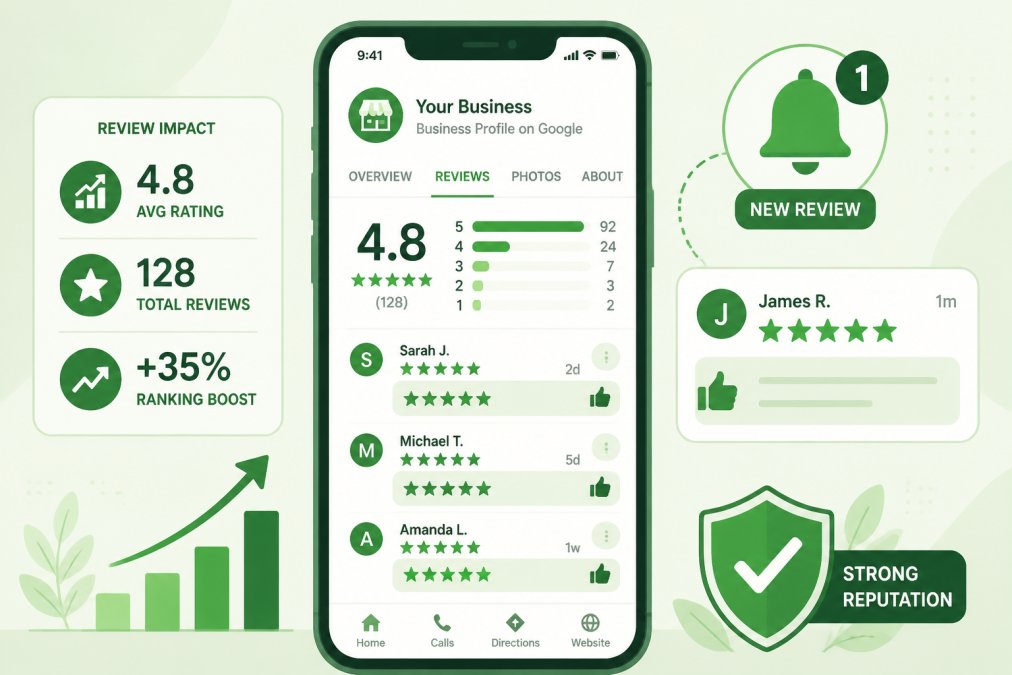
Ask for reviews systematically. After a purchase or service completion, send a follow-up email or text with a direct link to your Google review page. Make it easy, one click should take customers to the review form, not a generic Google search.
Respond to every review, positive or negative, within 48 hours. Thank customers for positive reviews by name. For negative reviews, stay professional, acknowledge the concern, and offer to resolve it offline. Your responses are visible to potential customers and influence their perception of your business.
Responding to Negative Reviews Strategically
Negative reviews happen. How you respond matters more than the review itself. A business that responds thoughtfully to criticism appears more trustworthy than one that ignores complaints.
When responding to a negative review:
- Don't get defensive or argue
- Acknowledge the specific issue
- Apologize if your business failed to deliver
- Offer a concrete solution (refund, redo, discount on next service)
- Invite them to discuss offline ("Please call us at [number]")
- Keep it brief (2-3 sentences)
Example: "We're sorry your experience didn't meet expectations. This isn't the standard we set for ourselves. Please call us at [number] so we can make this right."
Potential customers read negative reviews AND your response. A thoughtful response actually increases trust more than having only positive reviews.
Local SEO Checklist for Small Business Growth
This checklist covers the foundational tasks that move the needle on local rankings. Work through these in order, they build on each other.
| Task | Frequency | Impact | Timeline |
|---|---|---|---|
| Claim and verify Google Business Profile | One-time | Critical | 1-7 days |
| Complete all profile fields (100%) | One-time | Critical | 1 day |
| Upload 10+ photos to profile | One-time | High | 1 week |
| Fix NAP inconsistencies across web | One-time | Critical | 1-2 weeks |
| Post to Google Business Profile | 2x per month | Medium | Ongoing |
| Request reviews from customers | Ongoing | High | Ongoing |
| Respond to all reviews | Ongoing | High | Within 48 hours |
| Update business hours for holidays | Seasonal | Medium | As needed |
| Audit local citations | Quarterly | Medium | 1 week |
Mobile Optimization and Page Speed
Google's algorithm prioritizes mobile experience. If your website isn't fast on mobile, you won't rank well for local searches. Most customers search on phones, so this directly affects conversions too.
Test your website speed at Google PageSpeed Insights. Aim for a score above 80 on mobile. Common issues that slow mobile sites:
- Large uncompressed images (compress to under 100KB per image)
- Too many third-party scripts (tracking pixels, ads, widgets)
- Render-blocking CSS or JavaScript
- No caching strategy
Mobile optimization also means responsive design. Your site should adapt to different screen sizes without requiring horizontal scrolling. Test on actual phones, not just desktop browser emulation.
Local Keyword Research and Targeting
You don't need to rank for "SEO services." You need to rank for "SEO services in Ljubljana" or "digital marketing near me." Local keywords have lower search volume but higher intent and lower competition.
Find local keywords by:
- Start with your primary service ("SEO services")
- Add your location ("SEO services in Ljubljana")
- Add intent modifiers ("best", "near me", "affordable")
- Check search volume in Google Keyword Planner
Target these keywords in:
- Your Google Business Profile description
- Your website's title tags and meta descriptions
- Your homepage and service pages
- Your blog content
Example: Instead of "We offer SEO services," write "Best SEO services in Ljubljana for small businesses, improve your Google rankings in 90 days."
Best SEO Tools for Small Business Owners to Track Progress
You can't improve what you don't measure. These tools help you track rankings, monitor your profile, and identify opportunities. Most have free tiers suitable for small businesses.
Google Business Profile itself provides basic insights, views, actions (calls, directions, website clicks), and customer questions. Check this weekly to see what's working.
For deeper analysis, GrandRanker automates the tracking that typically requires hours of manual work. The platform handles keyword research, content optimization, and publishing, letting you focus on running your business while rankings improve automatically.
Other tools worth considering:
- Google Analytics (free): Track website traffic, user behavior, conversion paths
- Semrush (paid, free tier available): Monitor rankings, track competitors, audit your site
- Ahrefs (paid, free tier available): Analyze backlink profile, find link-building opportunities
- Bright Local (paid): Manage local citations, monitor reviews, track local rankings
Start with free tools. As you grow and need more automation, invest in paid platforms.
How Long Does SEO Take to Work for Small Businesses
This is the question every small business owner asks. The honest answer: it depends, but you should see initial results within 60-90 days if you're executing the tactics in this guide.
Local SEO moves faster than national SEO because competition is lower. A small business in Ljubljana optimizing their profile and building local citations can rank in the local pack within 2-3 months. A business targeting national keywords might take 6-12 months.
The timeline depends on:
- How complete your profile is (bigger gaps = faster improvements)
- How many reviews you have (more reviews = faster rankings)
- How strong your local citations are (more citations = faster boost)
- How much content you're publishing (more relevant content = faster growth)
- How competitive your keywords are (less competition = faster results)
Expect this progression:
- Weeks 1-4: Profile optimization, citation cleanup, review requests
- Weeks 4-8: First ranking improvements, increased visibility in local pack
- Weeks 8-12: Measurable traffic increase, lead generation starting
- Months 3-6: Consistent top-3 rankings for local keywords, predictable lead flow
If you're not seeing any movement after 90 days, something's wrong. Either your profile isn't optimized, your keywords aren't local enough, or your competition is too strong. Audit and adjust.
Measuring ROI: Tracking Which SEO Efforts Actually Drive Customers
Ranking higher means nothing if it doesn't drive customers. You need to track which SEO efforts actually generate leads and revenue.
Set up conversion tracking in Google Analytics. Create goals for:
- Phone calls (track with call extensions in Google Business Profile)
- Form submissions (contact form, quote request, newsletter signup)
- Purchases (e-commerce transactions)
- Direction requests (directions clicked in Google Maps)
In Google Business Profile insights, track:
- How many people viewed your profile
- How many called your business
- How many requested directions
- How many visited your website
Compare these metrics month-over-month. When you implement a tactic (add photos, request reviews, publish a blog post), did these numbers move?
- Cost: Hours spent on SEO (or tool subscriptions)
- Revenue: Customers acquired from SEO × average customer value
- ROI = (Revenue - Cost) / Cost × 100
Example: You spend 10 hours per month on local SEO. At $50/hour, that's $500. You generate 5 leads per month, 2 convert to customers, each worth $2,000. Revenue = $4,000. ROI = ($4,000 - $500) / $500 × 100 = 700%.
Track this quarterly. If ROI is negative, something needs to change. If it's positive, scale what's working.
Building Local Authority Through Citations and Backlinks
Citations are mentions of your business on other websites. A citation doesn't require a link, just your name, address, and phone number listed on another site. Citations signal to Google that your business is real, established, and trustworthy.
Build citations by:
- List your business on major directories (Yelp, Apple Maps, local Ljubljana directories)
- Get mentioned in local news, blogs, or community websites
- Sponsor local events or charities (they'll list you as a sponsor)
- Partner with complementary businesses (they link to you, you link to them)
- Join local business associations or chambers of commerce
Backlinks (links from other websites to yours) are more valuable than citations. One backlink from a reputable local news site is worth 10 citations from random directories.
Build backlinks by:
- Writing content worth linking to (guides, research, original data)
- Reaching out to local media with newsworthy stories
- Guest posting on complementary business blogs
- Creating tools or resources that other sites want to link to
Start with citations (easier, faster results). Once you have a strong local presence, pursue backlinks.
Improving Google rankings for small business doesn't require expensive consultants or complex strategies. It requires consistency with the fundamentals, a complete profile, authentic reviews, and local authority signals. Most small businesses see measurable improvement within 90 days by executing these nine tactics.
The challenge isn't knowing what to do. It's doing it consistently while running your business. GrandRanker automates the repetitive parts, keyword research, content optimization, and publishing, so you can focus on serving customers while your rankings improve automatically. Start with a free trial and see how much time you reclaim while your organic traffic grows.
Frequently Asked Questions
What's the fastest way to improve Google rankings for a small business?
Start with three foundational actions: claim and verify your Google Business Profile, ensure NAP consistency (Name, Address, Phone) across all online listings, and request customer reviews. These require minimal resources but signal search intent relevance to Google. Mobile optimization and local keyword targeting follow. Most small businesses see initial movement within 4-8 weeks when these are done correctly, though sustained ranking improvement typically takes 3-6 months of consistent effort.
How long does SEO take to work for small business websites?
SEO timelines vary by competition and current state. Local businesses in less competitive markets may rank within 6-12 weeks. Competitive industries or national rankings typically require 3-6 months minimum. The first month focuses on technical fixes and profile optimization; months 2-3 show modest traffic gains; months 4-6 reveal whether your strategy is working. Tracking organic traffic and keyword positions weekly helps you measure progress and adjust tactics before results plateau.
Which SEO tools are best for small business owners with limited budgets?
Google Search Console and Google Analytics are free and essential for tracking search performance and user behavior. Google Business Profile itself is free for local visibility. For paid tools, focus on those offering free tiers: Ubersuggest (free keyword research), Semrush (limited free version), and Moz Local (citation tracking). GrandRanker offers a free trial so you can test AI-driven keyword research and content optimization before committing. Choose tools that integrate with your existing workflow to avoid platform overload.
Can negative reviews hurt my Google rankings, and how do I handle them?
Negative reviews don't directly tank rankings, but they reduce click-through rates from search results and damage conversion potential. Respond to every negative review within 48 hours with a professional, solution-focused reply. Acknowledge the issue, apologize sincerely, and offer to resolve it offline. This signals to potential customers that you care about feedback. Encourage satisfied customers to leave reviews to improve your overall rating. A mix of reviews (including honest negative ones) actually builds credibility better than perfect ratings.
This article was written using GrandRanker