 listicle
Which AI Is Best for Creating Content in 2026? test
Table of Contents
Which AI Is Best for Creating Content in 2026? A Quick Comparison
Top AI Tools for General Writing, Creativity, and Long-Form Content
AI Video Content Creation: Top Tools for Visual Storytellers
Which AI Is Best for Creating Content in 2026? Our Final Verdict
Last Updated: May 5, 2026
Which AI Is Best for Creating Content in 2026? A Quick Comparison
The question "Which AI is best for creating content? 2026" has become one of the most searched queries among marketers, founders, and creators trying to keep pace with a rapidly shifting digital landscape. This guide from GrandRanker cuts through the noise to give you a direct, tool-by-tool answer. The short version: there is no single winner for every use case, but there are clear leaders depending on whether you prioritize SEO, long-form writing, video production, or short-form conversion copy. Below, we break down the best AI tools across each category, flag the trade-offs most reviews skip, and give you a decision framework you can use today.
Here is what most guides get wrong: they treat AI content tools as interchangeable. They are not. A tool that excels at generating SEO-optimized blog posts will often produce flat, generic output for brand storytelling. A tool built for marketing copy will choke on technical long-form research. Matching the right tool to the right job is where the real productivity gain lives.
According to Gartner's 2026 AI in Marketing Report, organizations that align AI tool selection with specific content workflows see significantly higher output quality than those using a single general-purpose assistant for all tasks. That finding shapes every recommendation in this guide.
ToolBest ForStarting PriceFree TierGrandRankerSEO content on autopilotFree trialYesFrase.ioResearch-backed briefs$12.66/moNoWritesonicGEO and AI search visibility$39/moYesSurfer SEOOn-page optimization$79/moNoScalenutAll-in-one for growing teams$30/moYesClaudeNatural long-form writing$20/moYesChatGPT EnterpriseLarge-scale team workflowsCustomNoJasperOn-brand marketing at scale$39/moNoCopy.aiShort-form conversion copy$24/moYes
Best AI Writing Tools for SEO-Driven Content in 2026
SEO-driven content creation is where AI tools have made the most measurable impact for marketers in 2026. The best AI writing tools for SEO do more than generate text: they analyze search intent, identify keyword gaps, and structure content to compete against top-ranking pages. The difference between a tool that writes and a tool that ranks is significant.

A focused content marketer reviewing SEO analytics and blog drafts on a laptop in a clean modern home office setup, warm natural light coming through a window, coffee cup on desk, notebook open beside the keyboard
1. GrandRanker, Best Overall for SEO Content on Autopilot
GrandRanker is an AI-powered SEO platform that automates the entire content pipeline: keyword research, content creation, optimization, and publishing. For founders and small teams who need to grow organic traffic without hiring a full content department, it is the most complete solution available in 2026.
What separates GrandRanker from general-purpose AI writers is its focus on getting you cited by AI assistants like ChatGPT and Google AI Overviews, not just ranking on traditional search. As AI-powered search continues to reshape how people find information, that dual-channel visibility matters more than most teams realize. More than 421 founders are currently growing with GrandRanker, which signals real-world traction rather than just marketing claims.
Key strengths:
Automated keyword research tied directly to content production
Content on Autopilot: find, write, optimize, and publish without manual intervention
Domain Authority Boost through structured, consistent publishing
AI finds YOU first: optimized for citation by ChatGPT, Claude, and Perplexity
GrandRanker offers a free trial and a free plan, with full pricing available on the GrandRanker pricing page. Start free trial to see how much organic traffic you can generate within the first 30 days.
Best ForFounders and solo operators who want to compete on organic search without building a content team. GrandRanker handles the full workflow so you can focus on your core business.
2. Frase.io, Best for Research-Backed Content Briefs
Frase.io approaches content creation from the research end first. Its AI Agent pulls SERP data to generate content briefs that reflect what top-ranking pages actually cover, which means you are writing to fill real topic gaps rather than guessing at what Google wants. The Solo Plan starts at $12.66 per month billed annually, making it one of the most accessible SEO content tools available.
The honest limitation: Frase's AI writing is a complement to its research engine, not a replacement for a dedicated writing assistant. For teams that already have a strong writer and need better brief infrastructure, it is excellent. For teams expecting fully polished output, expect editing time.
3. Writesonic, Best for GEO and AI Search Visibility
Generative Engine Optimization (GEO) is the emerging discipline of making content visible inside AI-generated answers, not just traditional search results. Writesonic built its AI Article Writer 6.0 and GEO tracking features specifically for this problem. It tracks brand mentions across ChatGPT, Perplexity, and Google AI Overviews in real time.
The credit-based model on lower plans can be restrictive for high-volume teams. But for content marketers who need to monitor and improve their AI search presence, Writesonic's GEO dashboard is ahead of most competitors in 2026.
4. Surfer SEO, Best for On-Page Optimization
Surfer SEO's core strength is data-driven on-page analysis. The Content Editor scores your article against top-ranking competitors and suggests specific NLP terms, heading structures, and word count targets to close the gap. The Essential plan starts at $79 per month.
One thing most reviews miss: Surfer's AI writing features (Surfy) are a paid add-on, not included in the base subscription. Budget accordingly. The SERP Analyzer alone is worth the price for teams doing serious competitive content research.
5. Scalenut, Best All-in-One for Growing Teams
Scalenut combines AI writing, keyword clustering, and a proprietary GEO Watchtower that tracks brand mentions in AI-generated answers from ChatGPT, Google AIO, Perplexity, and Claude. The Starter plan begins at $30 per month with a 7-day free trial.
The real value here is workflow consolidation. Instead of paying separately for a keyword tool, a content brief tool, and an AI writer, Scalenut handles all three. The trade-off is that each individual module is slightly less specialized than a dedicated point solution.
Pro TipIf you are evaluating Scalenut vs. Surfer SEO, the decision usually comes down to team size. Scalenut's Pro Plan caps at 5 users, so larger teams will hit that ceiling quickly. Surfer scales better for agencies.
Top AI Tools for General Writing, Creativity, and Long-Form Content
Most guides lump all AI writing tools into one category. That is a mistake. General writing AI tools operate differently from SEO-specific platforms: they prioritize coherence, voice, and creative range over keyword density and SERP data.
6. Claude (Anthropic), Best for Natural, Nuanced Long-Form Writing
Claude produces long-form content that reads like a human wrote it. That sounds like a low bar until you compare it to output from tools that drift into repetitive phrasing or lose the thread halfway through a 3,000-word article. Claude's 200k context window means it can hold the entire arc of a long piece in working memory, which produces noticeably more coherent drafts.
The free version is genuinely useful. The Pro plan at $20 per month gives priority access and higher usage limits. For content creators who write research-heavy essays, detailed guides, or nuanced brand narratives, Claude is the most reliable choice in 2026.
What most reviews miss: Claude tends to require more explicit prompting than tools with structured templates. If you hand it a blank prompt and expect a polished article, you will get something mediocre. Give it a detailed brief and it consistently outperforms competitors on voice and coherence.
Screenshot of claude.ai
7. ChatGPT Enterprise, Best for Large-Scale Team Workflows
ChatGPT Enterprise is built for organizations that need to deploy AI across departments while maintaining data security and administrative control. SOC 2 compliance, SSO, and encryption make it viable for corporate environments where consumer-grade tools are blocked by IT policy.
The flexibility is unmatched for brainstorming, drafting, and iterating across many content formats. The significant caveat: pricing is custom and negotiated annually, with estimates suggesting a substantial minimum commitment for larger teams. This is not a tool for small businesses or individual creators.
Screenshot of openai.com
8. Jasper, Best for On-Brand Marketing Content at Scale
Jasper's Brand Voice feature is its clearest differentiator. Marketing teams that need to produce high volumes of content across multiple channels without drifting off-brand will find Jasper's structured approach genuinely useful. The Creator plan starts at $39 per month billed annually.
The honest trade-off: Jasper's output often requires human editing for factual accuracy and nuance. It is a production accelerator, not a research tool. Teams that treat it as a first-draft engine and build in an editing step get the best results.
Screenshot of jasper.ai
9. Copy.ai, Best for Short-Form and Conversion Copy
Copy.ai excels at exactly what its name implies: copy. Email subject lines, ad headlines, product descriptions, and sales outreach sequences are where it consistently delivers. The free plan is genuinely functional, and the Chat plan starts at $24 per month billed annually.
The limitation is equally clear: long-form output from Copy.ai tends to become repetitive past the 800-word mark. Use it for short-form conversion copy and workflow automation. Do not expect it to replace a dedicated long-form writing tool.
Screenshot of copy.ai
Free AI Content Creation Tools Worth Using in 2026
Free AI content creation tools have improved dramatically. Several platforms now offer genuinely useful free tiers rather than crippled demos designed purely to upsell.
The best free options in 2026 include:
GrandRanker Free Plan: Covers keyword research and content creation basics, with a free trial that gives you access to the full platform before committing
Claude Free: Solid for long-form drafting with usage limits
Copy.ai Free: Permanent free plan with limited word count, best for short-form copy
Scalenut Free Trial: 7-day trial with full feature access
Canva AI Free: Magic Design and AI image generation for visual content creators who need design alongside copy
Watch OutFree tiers from most AI writing tools restrict access to advanced SEO features, brand voice training, and GEO tracking. If organic search visibility is your primary goal, a free tier will get you started but will not get you to page one without upgrading.
A common mistake is spending weeks testing free tools when the limiting factor is not the tool but the content strategy. Free tools work well for experimentation. For systematic content production, a paid platform with workflow automation pays for itself quickly.
AI Video Content Creation: Top Tools for Visual Storytellers
Video content creation has seen the most dramatic AI advancement in 2026. Tools that required professional production teams two years ago now produce broadcast-quality output from text prompts.
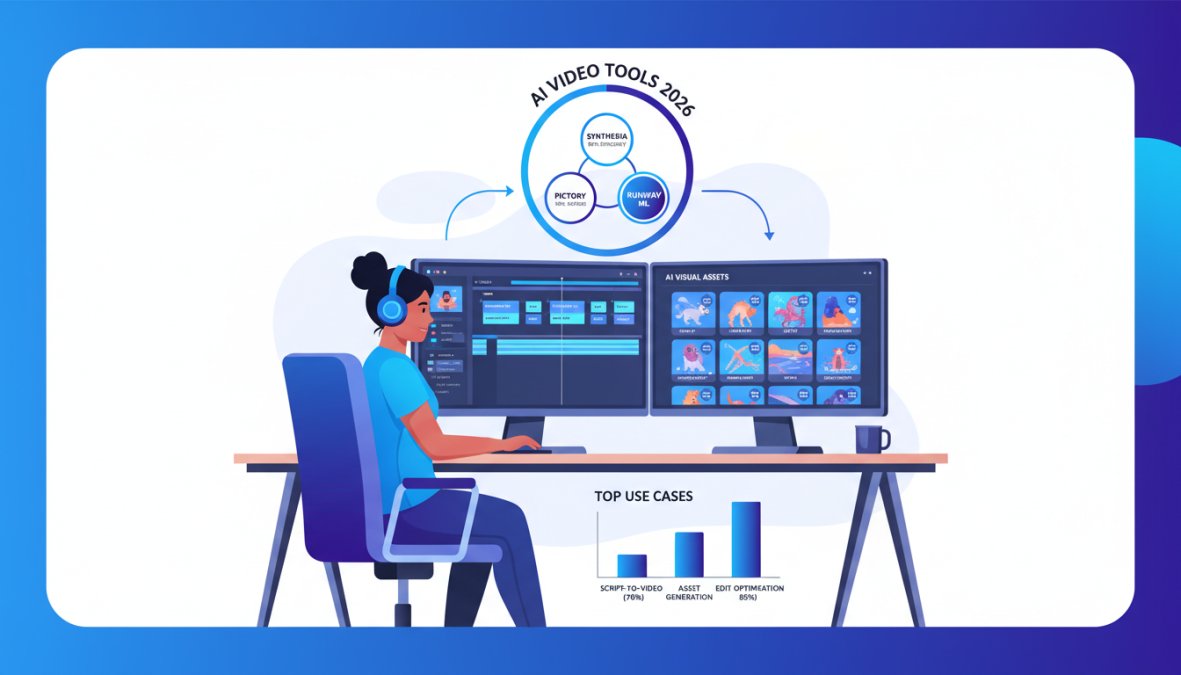
A video content creator sitting at a professional desk with dual monitors showing video editing software and AI-generated visual assets, professional LED lighting setup, microphone visible, dark background with warm desk lamp glow
The leading platforms for AI video content creation in 2026:
Sora (OpenAI): Text-to-video generation that produces cinematic-quality clips. Best for brands that need original video assets without a production budget.
Veo (Google): Google's video generation model, integrated into the broader Gemini ecosystem. Strong for creators already working within Google's suite of tools.
Synthesia: AI avatar-based video creation for training content, product demos, and corporate communications. Particularly strong for multilingual content since avatars can speak in dozens of languages without reshooting.
11 Labs: The leading platform for AI audio generation and voice cloning. Podcasters and video creators use it to generate voiceovers, translate content, or create consistent narrator voices at scale.
Tagshop AI: Focused on social commerce video content, turning product images and user-generated content into shoppable video assets.
The production value gap between AI-generated and human-produced video is closing faster than most marketers expected. According to McKinsey's 2026 State of AI Report, video content creation is among the top three areas where organizations are accelerating AI adoption this year.
How to Choose the Right AI for Your Content Workflow
The right AI content tool depends on three variables: your primary content type, your team size, and whether your distribution channel prioritizes traditional search or AI-powered search.
Use this decision framework:
If your primary goal is SEO and organic traffic: Start with GrandRanker for full-pipeline automation, or Writesonic if GEO tracking is your priority.
If you produce high volumes of brand-consistent marketing content: Jasper's Brand Voice and template library are purpose-built for this workflow.
If you write research-heavy long-form content: Claude handles nuanced, extended writing better than any other general-purpose assistant in 2026.
If you need short-form conversion copy quickly: Copy.ai's free plan covers most use cases. Upgrade when you need workflow automation.
If video is your primary format: Synthesia for avatar-based content, Sora for cinematic clips, and 11 Labs for audio.
If you are an enterprise with security requirements: ChatGPT Enterprise is the only option with SOC 2 compliance and enterprise-grade administrative controls.
Key TakeawayThe most common mistake teams make is choosing one AI tool for everything. The highest-performing content workflows in 2026 use specialized tools for different content types: one for SEO research and drafting, one for brand copy, and one for visual assets.
Ethical Considerations: Originality, Bias, and Human Connection
AI content tools introduce real ethical considerations that most vendor comparison guides ignore entirely.
Originality: AI models are trained on existing content, which means output can reflect patterns from source material in ways that reduce genuine originality. Jasper claims 99% original output, but originality in the creative sense (novel ideas, fresh perspectives) is different from originality in the plagiarism sense. Human editorial oversight is not optional for quality content.
Bias: AI models reflect the biases present in their training data. Content targeting diverse audiences requires human review to catch cultural assumptions, representation gaps, and framing issues that AI tools will not flag automatically.
Human connection: According to Edelman's 2026 Trust Barometer, audiences increasingly value authentic human perspectives over polished AI-generated content. The most effective content strategy in 2026 uses AI to handle research, drafting, and optimization while preserving human voice, experience, and judgment at the editorial layer. AI-generated content that reads like AI-generated content erodes trust. The goal is not to hide the AI: it is to use it where it adds speed and scale while keeping humans where they add authenticity and credibility.
Which AI Is Best for Creating Content in 2026? Our Final Verdict
Answering "Which AI is best for creating content? 2026" requires acknowledging that "best" is always relative to your specific workflow. That said, clear editorial picks emerge from this analysis.
Best overall for SEO content: GrandRanker. The full-pipeline automation, dual-channel visibility (Google and AI assistants), and domain authority focus make it the most complete solution for founders and marketers who need organic traffic without building a content team from scratch.
Best for long-form writing quality: Claude. Nothing else produces comparably natural, coherent output at the same price point.
Best for marketing teams at scale: Jasper. The Brand Voice feature and template library are genuinely purpose-built for high-volume marketing content.
Best for AI video content creation: Synthesia for structured video, Sora for creative video generation.
Best free AI content creation tools: Claude's free tier for writing, Canva AI for visual content.
The creator economy in 2026 is not choosing between AI and human creativity. It is choosing which AI tools to pair with human judgment. The teams getting the best results treat AI as infrastructure: fast, scalable, and tireless, but requiring skilled operators to direct it toward work that actually connects with audiences.
For content that needs to rank on Google AND get cited by AI assistants, the combination of GrandRanker's automated SEO pipeline with Claude's long-form writing quality covers the vast majority of content workflows.
Growing organic traffic through content is one of the highest-ROI investments a founder can make, and also one of the most time-intensive without the right infrastructure. GrandRanker automates keyword research, content creation, optimization, and publishing so your content consistently gets found on Google and cited by AI assistants like ChatGPT. With 421+ founders already growing on autopilot, the platform is built for exactly this problem. Get started with GrandRanker and start converting organic traffic into customers while you focus on your core business.
Frequently Asked Questions
Which AI is best for creating long-form content in 2026?
For long-form content, Claude (Anthropic) stands out for its natural, coherent writing style and 200k context window, making it ideal for in-depth articles and research-heavy pieces. For SEO-focused long-form content, GrandRanker and Writesonic are strong choices, offering automated drafting with built-in optimization. Jasper is also reliable for marketing teams needing consistent brand voice across extended pieces. The best choice depends on whether your priority is writing quality, SEO performance, or workflow automation.
Are there free AI content creation tools worth using in 2026?
Yes. Several capable free AI content creation tools exist in 2026. Claude, Copy.ai, Canva AI, and Scalenut all offer free tiers with meaningful functionality. GrandRanker also provides a free trial, letting you test automated SEO content creation before committing. Free plans typically have usage limits, so they work best for solo creators or those evaluating tools before upgrading. For sustained content production, a paid plan usually delivers better scalability and output quality.
Can AI content creation tools help with SEO in 2026?
Absolutely. Many of the best AI writing tools for SEO now include features like keyword clustering, SERP analysis, content briefs, and generative engine optimization (GEO) to help your content rank on both Google and AI assistants like ChatGPT and Perplexity. Tools like GrandRanker, Frase.io, Writesonic, Surfer SEO, and Scalenut are purpose-built for this. They streamline research, drafting, and optimization into a single workflow, making it significantly easier to produce content that drives organic traffic.
Which AI tools are best for video content creation in 2026?
For AI video content creation in 2026, tools like Sora (OpenAI), Veo (Google), Synthesia, and 11 Labs lead the space for video generation, AI avatars, and audio generation respectively. These multimodal platforms allow content creators to produce high production value video without traditional filming setups. Canva AI also supports visual content creation for social media. The right choice depends on your format needs, from short social clips to full AI-generated explainer videos.
What features should I look for in an AI content creation tool in 2026?
Key features to evaluate include: SEO optimization and GEO capabilities, long-form content quality, brand voice consistency, workflow automation, multimodal support (text, image, video), and integration with tools like Google Search Console or WordPress. Also consider whether the tool offers a free plan or trial, pricing scalability, and how well it handles originality to avoid duplicate content issues. For founders and marketers, tools that combine content creation with automated publishing and rank tracking offer the strongest ROI.
This article was written using GrandRanker