 listicle
Which AI Is Best for Creating Content? Top 10 Tools
Table of Contents
- Which AI Is Best for Creating Content? A Quick Comparison
- How We Evaluated These AI Content Creation Tools
- Best AI Writing Assistant Tools for Every Use Case
- Best AI for Blog Writing: Long-Form Content Tools Compared
- Best AI Copywriting Tools for Marketing and Sales Teams
- Best AI SEO Tools: Which AI Helps You Actually Rank?
- Which AI Is Best for Creating Content Based on Your Goals?
- Conclusion
Last Updated: May 4, 2026
Which AI Is Best for Creating Content? A Quick Comparison
Which AI is best for creating content? That question gets asked by founders, marketers, and creators every day, and the honest answer is: it depends entirely on what you're trying to build. This guide from GrandRanker breaks down the top 10 AI content creation tools for 2026, covering writing assistants, blog generators, AI copywriting tools, and best AI SEO tools, so you can make a decision based on your actual workflow, not a vendor's marketing page.
Here's what most comparison guides get wrong: they treat all AI tools as interchangeable word-generators. The real difference between tools that move the needle and tools that waste your budget comes down to three things: output quality for your specific content type, SEO integration depth, and how well the tool fits into your existing production workflow.
According to McKinsey's research on AI adoption in marketing, generative AI is reshaping content production across industries, with productivity gains concentrated among teams that match the right tool to the right task. Below, we'll show you exactly which tool wins for each use case, including a full comparison table and honest takes on where each one falls short.

| Tool | Starting Price | Best For | Free Tier |
|---|---|---|---|
| GrandRanker | Free trial | SEO-driven content on autopilot | Yes |
| Jasper | $39/month | On-brand marketing copy at scale | No |
| Copy.ai | $24/month | Short-form content | Yes |
| Rytr | $9/month | Budget AI writing | Yes |
| Writesonic | $39/month | GEO and AI search visibility | Yes |
| Frase.io | $12.66/month | Research-first blog workflows | No |
| Scalenut | $30/month | Keyword clustering + long-form SEO | No |
| Content at Scale | $39/month | High-volume blog production | No |
| GrowthBar | $36/month | Bloggers needing SEO + copy | No |
How We Evaluated These AI Content Creation Tools
Picking the right AI writing assistant is not about finding the flashiest feature set. The criteria that actually matter are output quality, SEO depth, template variety, pricing model transparency, and how much human editing each tool demands before content is publishable.
Every tool in this list was evaluated against the same framework:
- Output quality: Does the content require heavy editing, or is it close to publish-ready?
- SEO integration: Does the tool actively help you rank, or just generate text?
- Workflow fit: Can it slot into your existing process without rebuilding everything?
- Value at each price tier: Is the free plan genuinely useful, or a bait-and-switch?
- AI search visibility (GEO): Does the tool help you get cited by AI assistants like ChatGPT and Perplexity?
That last criterion is increasingly important. As Gartner's analysis of AI search trends notes, AI-generated answers are now a primary discovery channel for many B2B buyers. Tools that ignore GEO are already behind.
Best AI Writing Assistant Tools for Every Use Case
The best AI writing assistant for your team depends on whether you prioritize speed, brand consistency, SEO performance, or cost efficiency. Here's where each tool genuinely excels.
GrandRanker, Best for SEO-Driven Content on Autopilot
GrandRanker is an AI-powered SEO platform that automates the full content pipeline: keyword research, content creation, optimization, and publishing, so founders can grow organic traffic without managing every step manually.
What separates GrandRanker from other AI writing tools is the end-to-end SEO focus. Most writing assistants generate text. GrandRanker generates content designed to rank on Google and get cited by AI assistants. The platform's "AI finds YOU first" approach means your content is optimized not just for traditional search, but for the AI-answer layer that now sits above organic results.
Pros:
- Fully automated keyword research and content creation
- Built to boost domain authority over time
- Designed specifically for AI search visibility (GEO)
- Free trial available with no commitment required
Best for: Founders and small teams who want organic traffic growth without hiring a full content team.
Jasper, Best for On-Brand Marketing Copy at Scale
For marketing teams that live and die by brand voice, Jasper is the most mature option on the market. The platform supports 30-plus languages, offers 50-plus templates covering blog posts, social media captions, and product descriptions, and integrates directly with Surfer SEO for content scoring.
The brand voice customization is genuinely good. Jasper learns your tone and applies it consistently across campaigns, which matters enormously when you're producing high volumes of marketing copy across multiple channels.
Pros: High content quality, strong team collaboration features, Surfer SEO integration. Cons: No permanent free plan (7-day trial only), one of the pricier tools at $39/month billed annually.
The one thing most Jasper reviews miss: the Surfer SEO integration requires a Pro plan or above, so the headline price understates the real cost for SEO-focused teams.
Copy.ai, Best Free Starting Point for Short-Form Content
Copy.ai offers a permanent free plan with a genuinely useful word limit, making it the lowest-friction entry point for freelancers and small businesses testing AI copywriting tools. The 90-plus template library covers social media posts, product descriptions, sales outreach, and blog outlines.
The chat-based interface is fast and intuitive. For short-form content and quick ideation, Copy.ai delivers results without a learning curve. Long-form output is where it struggles: articles tend toward repetition and require meaningful editing before they're publishable.
Pros: Permanent free plan, fast generation, wide template range, HubSpot integration. Cons: Long-form content needs heavy editing, no social media scheduling.
Rytr, Best Budget AI Writing Assistant
Rytr costs $9 per month and includes a free tier. For freelancers and bloggers who need to overcome writer's block and generate initial drafts quickly, it's the most cost-effective AI writing assistant available.
The 40-plus use cases cover the basics well: emails, product descriptions, social media posts, and outlines. The built-in plagiarism checker is a useful inclusion at this price point.
Pros: Very affordable, easy template system, good for short drafts and ideation. Cons: Struggles with complex long-form content, lacks the advanced SEO features found in professional-tier tools.
Writesonic, Best for GEO and AI Search Visibility
Writesonic's strongest differentiator in 2026 is its GEO (Generative Engine Optimization) feature set. The platform tracks brand mentions in AI-generated answers and provides tools specifically designed to improve how your content appears in AI search results from platforms like Google AI Overviews and ChatGPT.
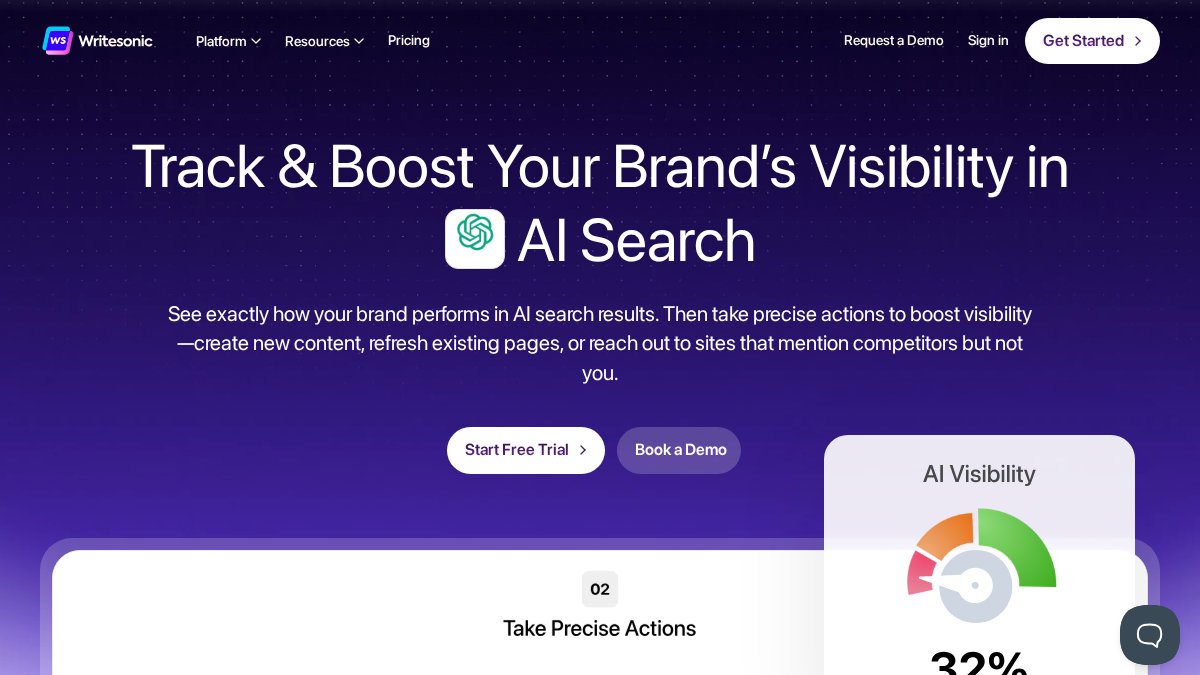
Access to advanced models including GPT-4o and Claude 3.7 Sonnet gives Writesonic flexibility across content types. The credit-based model on lower plans can be a friction point for high-volume teams.
Pros: Strong GEO and AI search visibility tools, wide template library, advanced AI model access. Cons: Credit limits restrict high-volume users on entry plans, advanced features push costs higher.
Best AI for Blog Writing: Long-Form Content Tools Compared
Long-form blog writing demands more than a capable writing assistant. The best AI for blog writing combines research depth, SEO structure, and enough editorial control to produce content that actually ranks.
Frase.io, Best for Research-First Blog Workflows
Most AI writing tools generate content first and add SEO as an afterthought. Frase.io inverts that sequence. The platform starts with SERP analysis and content research, then uses that data to guide AI writing, producing briefs and outlines grounded in what's actually ranking for your target keyword.
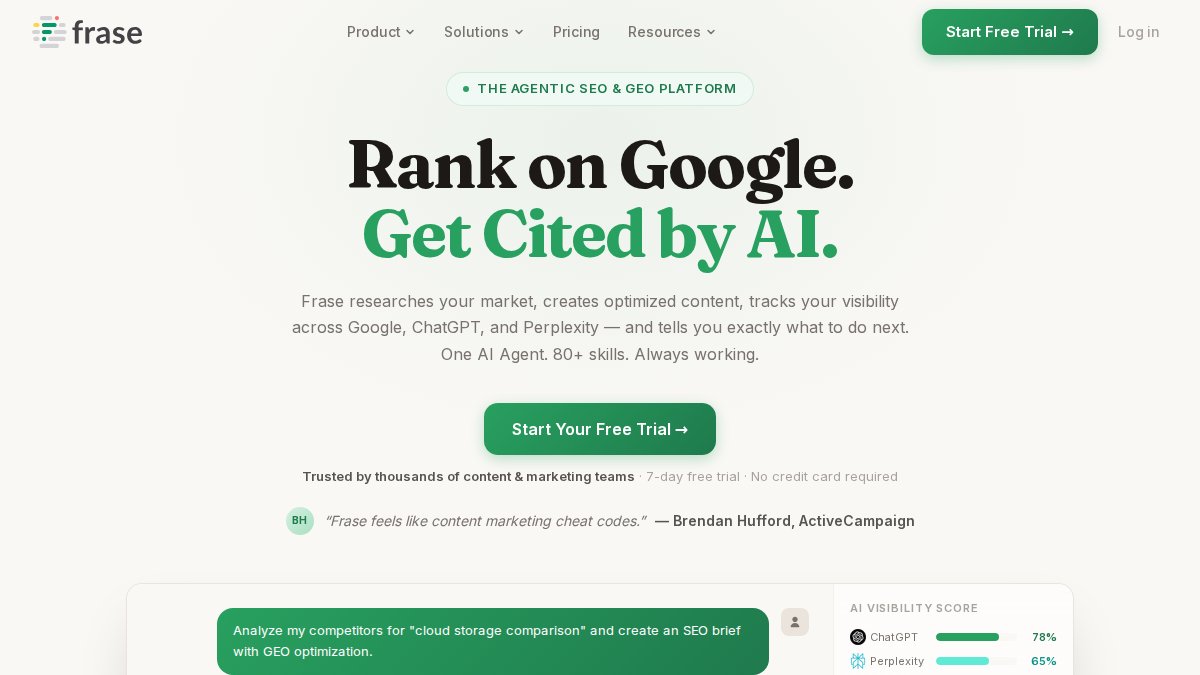
The content optimization layer scores your draft against top-ranking competitors in real time. Starting at $12.66 per month billed annually, Frase.io is competitive on price for what it delivers.
Pros: Research-first workflow, data-driven SEO insights, competitive pricing. Cons: Requires human oversight for brand voice, SEO add-on is an additional cost.
Scalenut, Best for Keyword Clustering and Long-Form SEO
Scalenut's Cruise Mode generates long-form articles quickly, but the real value is in the keyword clustering and topical research layer underneath. Building content around clusters rather than individual keywords is how modern SEO works, and Scalenut makes that process faster than doing it manually.
The GEO Watchtower feature tracks brand mentions in AI-generated answers from ChatGPT and Google AI Overviews, which is increasingly valuable for teams building long-term visibility. Note that Watchtower is only available on higher-tier plans.
Pros: End-to-end workflow from research to optimization, strong keyword clustering, GEO tracking. Cons: Limited team size on some plans, Watchtower has usage-based pricing on higher tiers.
Content at Scale, Best for High-Volume Blog Production
Content at Scale is built for one specific use case: producing large volumes of long-form, SEO-optimized blog posts with minimal manual input. The platform uses multiple AI engines and semantic analysis to generate lengthy articles that aim to read like human-written content.
The AI Humanizer tool is a differentiator for agencies and publishers concerned about AI detection. White-labeling options make it practical for content agencies managing multiple client accounts.
Pros: Specializes in high-volume long-form content, AI detection avoidance features, agency-friendly white-labeling. Cons: Pricing scales quickly for high-volume production, AI detection accuracy has shown mixed results in independent testing.
Best AI Copywriting Tools for Marketing and Sales Teams
AI copywriting tools for marketing and sales teams need to do more than generate text. They need to produce conversion-focused copy fast, integrate with existing marketing stacks, and maintain brand consistency across campaigns.
GrowthBar, Best for Bloggers Who Need SEO + Copy in One Place
GrowthBar combines AI writing powered by ChatGPT-4 with keyword research, competitor analysis, and a Chrome extension that surfaces SEO data directly in search results. For bloggers who want a single tool rather than a writing tool plus a separate SEO tool, GrowthBar closes that gap effectively.
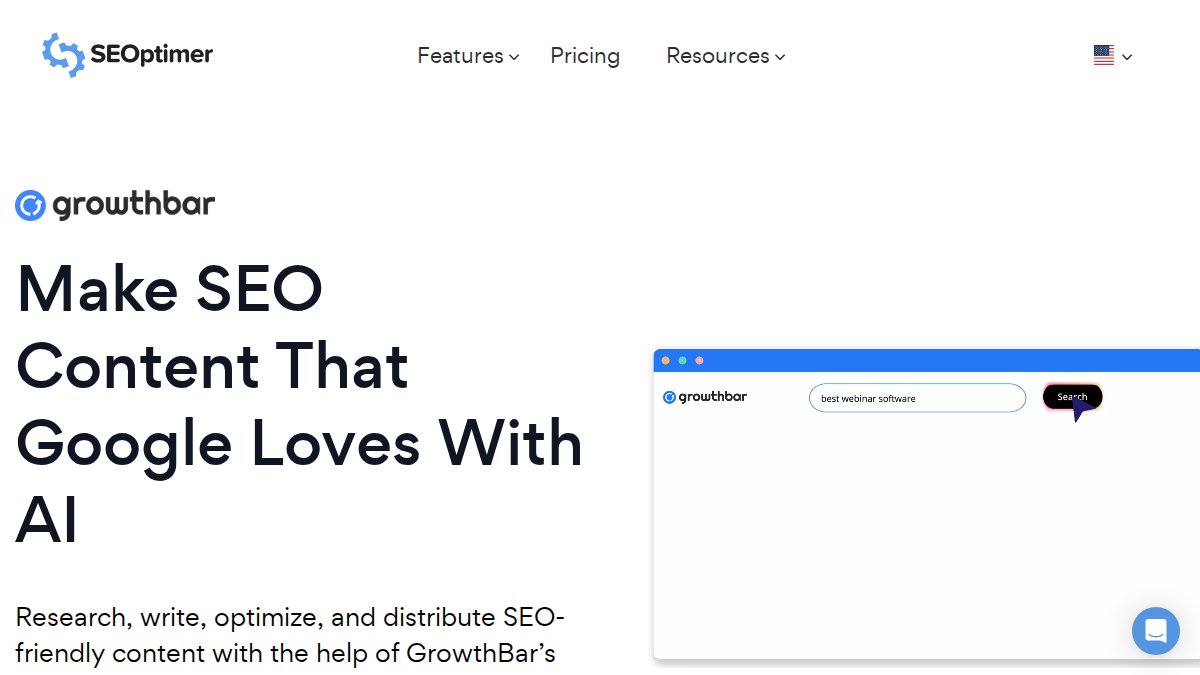
Support for 20 languages makes it practical for global content teams. The interface is fast and the content generation workflow is straightforward. Where it falls short is customization: teams with specific brand voice requirements or complex content structures will hit the limits of what GrowthBar can configure.
Pros: Integrated AI writing and SEO tools, fast generation, multi-language support, Chrome extension. Cons: Limited customization compared to dedicated platforms, content quality typically requires editing.
Best AI SEO Tools: Which AI Helps You Actually Rank?

The best AI SEO tools go beyond keyword suggestions. They integrate content creation, on-page optimization, and search visibility tracking into a single workflow. According to Search Engine Journal's analysis of AI-driven SEO strategies, teams that combine AI content generation with structured SEO workflows consistently outperform those using either approach in isolation.
Here's how the top options stack up on the criteria that actually drive rankings:
- GrandRanker: Full-stack SEO automation including keyword research, content creation, and AI search visibility. Designed to get you cited by AI assistants alongside traditional Google rankings.
- Writesonic: Strong on GEO tracking and AI search optimization, with solid long-form generation capabilities.
- Scalenut: Best for keyword clustering and topical authority building, with GEO Watchtower for AI visibility tracking.
- Frase.io: Research-first approach makes it the strongest option for SERP-grounded content strategy.
- GrowthBar: Practical integrated option for bloggers who want SEO and writing in one tool without managing two platforms.
The thing nobody tells you about AI SEO tools: the technical optimization features only matter if the content brief is built on real search intent data. Tools that skip the research layer and jump straight to generation consistently produce content that ranks poorly, regardless of how sophisticated the writing AI is.
Which AI Is Best for Creating Content Based on Your Goals?
Which AI is best for creating content ultimately comes down to matching the tool to your specific output requirements and growth stage. Here's a direct decision framework:
If your primary goal is organic traffic growth with minimal manual effort: GrandRanker is the clear choice. The automated keyword research, content creation, and publishing pipeline is built specifically for founders who need SEO results without a dedicated content team.
If you're a marketing team producing high-volume branded campaigns: Jasper's brand voice capabilities and team collaboration features justify the higher price point.
If you're starting out and need to test AI content tools without budget risk: Copy.ai's free plan is the lowest-friction starting point for short-form content.
If long-form blog SEO is the core use case: Frase.io's research-first workflow or Scalenut's keyword clustering approach both outperform general-purpose writing tools for this specific need.
If AI search visibility (GEO) is a strategic priority: Writesonic and Scalenut both offer dedicated GEO tracking features that most tools in this category still lack.
The common mistake teams make is choosing the tool with the most features rather than the tool that fits their actual workflow. A simpler tool used consistently will outperform a sophisticated one that creates friction every time you open it.
Conclusion
Choosing the right AI content tool is genuinely one of the highest-use decisions a growing team can make, but the volume of options makes it easy to end up with a tool that doesn't fit the actual job. The frameworks and comparisons above should cut through that noise.
If your goal is to grow organic traffic and get found by both Google and AI assistants without building a full content operation, GrandRanker automates the entire pipeline from keyword research through publishing. With 421-plus founders already growing with the platform, and features specifically designed to boost domain authority and get you cited by every major AI assistant, it's the most complete solution for SEO-driven content on autopilot. Start your free trial with GrandRanker and start turning search into a reliable customer acquisition channel.
Frequently Asked Questions
Which AI is best for creating content for SEO?
For SEO-focused content creation, tools that combine AI writing with keyword research and optimization tend to perform best. GrandRanker automates the full SEO workflow including keyword research, content creation, and publishing. Surfer SEO and Frase.io are strong choices for on-page optimization and content briefs. Scalenut adds GEO tracking to monitor your brand's visibility in AI-generated answers from platforms like ChatGPT and Google AIO.
Can an AI writing assistant write an entire blog post?
Yes, modern AI writing assistants like Jasper, Writesonic, and Content at Scale can generate full long-form blog posts from a prompt or keyword. However, the output quality varies. Tools like Frase.io and GrandRanker go further by grounding drafts in SERP research, making the content more strategically useful. Human review is still recommended to ensure accuracy, brand voice consistency, and authentic storytelling that AI alone may miss.
What are the best free AI tools for content creation?
Several strong AI copywriting tools offer free plans. Copy.ai has a permanent free tier suitable for short-form content and social media posts. Rytr also offers a free plan ideal for freelancers and bloggers on a budget. GrandRanker and Writesonic both provide free trials so you can test their full feature sets before committing. For pure writing assistance, Google's Gemini and Anthropic's Claude offer free tiers worth exploring.
What features should I look for in an AI content creation tool?
The most important features depend on your use case. For blog writing, prioritize tools with SEO optimization, content briefs, and long-form drafting. For marketing copy, look for templates, tone suggestions, and brand voice controls. Teams should evaluate collaboration features and workflow automation. If ranking on Google and getting cited by AI assistants matters, choose platforms like GrandRanker that combine content creation with automated SEO and AI search visibility tracking.
Is AI-generated content good for SEO?
AI-generated content can rank well when it is accurate, well-structured, and genuinely helpful to readers. Google's guidance focuses on content quality rather than how it was produced. The risk lies in publishing thin, repetitive, or unedited AI drafts. Using AI tools that incorporate real SERP data, semantic optimization, and structured content, like GrandRanker, Surfer SEO, or Frase.io, significantly improves the chances that AI-assisted content performs well in search results.
This article was written using GrandRanker