 ultimate-guide
SEO Timeline for Mid-Sized Business Growth: 2026 Guide
Table of Contents
- Why SEO Timeline Matters for Mid-Sized Businesses
- How Long Does SEO Take to Show Results: Realistic Expectations
- Months 1-3: Foundation and Early Signals
- Months 3-6: Momentum and Measurable Progress
- Months 6-12: Scaling Content and Domain Authority Growth
- SEO ROI for Mid-Sized Business: What to Measure
- Factors That Speed Up or Slow Down Your SEO Timeline
- The Plateau Phase and Long-Term Sustainability
- Common SEO Timeline Myths vs. Reality
- Accelerating Your SEO Timeline with Resource Allocation
Last Updated: August 9, 2026
Why SEO Timeline Matters for Mid-Sized Businesses
For mid-sized businesses, understanding the SEO timeline isn't just theoretical, it's the difference between sustainable competitive advantage and wasted marketing budget. Most founders underestimate how long organic growth takes, then abandon their strategy before it compounds.
SEO doesn't work like paid advertising. You don't pay and see traffic tomorrow. Instead, you're building domain authority, earning backlinks, and establishing topical relevance over months. For mid-sized companies competing against both startups and enterprises, that timeline becomes a strategic asset if you understand it.
Why? Because most competitors quit too early. They launch a content initiative, see modest results in month two, and pivot to paid channels. Teams that understand the realistic timeline and allocate resources accordingly see better outcomes than those chasing quick wins.
This guide walks you through what actually happens month by month, what metrics matter at each phase, and how to accelerate growth without burning out your team.
How Long Does SEO Take to Show Results: Realistic Expectations
SEO typically shows meaningful results between 3-6 months for mid-sized businesses, with sustainable domain authority growth continuing through month 12 and beyond. This assumes consistent effort on technical SEO, on-page optimization, and content creation.
Month one might show crawl improvements and indexation fixes. Month two brings the first organic traffic signals, often 5-15 additional sessions from long-tail keywords. By month four, you're seeing measurable organic traffic growth. By month eight, properly executed SEO becomes a reliable traffic source.
The timeline varies based on industry competitiveness, keyword difficulty, and search intent. A niche SaaS company might see traction in three months, while a mid-market e-commerce business competing in saturated categories might need nine months before organic traffic becomes meaningful.
The most important expectation: organic growth is not linear. You'll see small improvements, then plateaus, then sudden jumps as your domain authority accumulates and your content library reaches critical mass. Teams that expect steady month-over-month growth get discouraged. Teams that expect volatility and focus on the trend line stay committed.
Months 1-3: Foundation and Early Signals
The first quarter is about laying foundations that everything else depends on. This is when you fix technical SEO problems, establish your content strategy, and begin earning initial organic signals.
Month one: Conduct a technical audit. Fix crawl issues, improve site speed, set up proper schema markup, and ensure your site architecture supports crawlability. Define your keyword strategy, identifying search volume, keyword difficulty, and user intent for terms relevant to your business. For mid-sized companies, the sweet spot is usually long-tail keywords with 100-500 monthly searches and moderate competition.
Month two: Launch your first batch of optimized content targeting identified keywords. Publish 4-8 pieces following on-page optimization principles: target keyword in title and H1, semantic variations throughout, proper heading structure, and internal linking. Organic traffic is minimal, often under 50 sessions, but Google is crawling and indexing your new content.
Month three: You should see organic traffic increase to 100-300 sessions. You're seeing which content resonates. Some pieces rank on page two or three for their target keywords. A few might crack page one for low-difficulty long-tail terms. Content that genuinely answers search intent outranks generic alternatives.

Resource allocation: For a mid-sized team, this phase requires one full-time person managing technical SEO and keyword research, plus one content creator producing 1-2 pieces per week. Using GrandRanker or similar automation can reduce this to one person managing the platform while AI handles keyword research and content optimization.
Months 3-6: Momentum and Measurable Progress
By month four, your domain is no longer brand new to Google. Your content library has grown. Your backlink profile is expanding. Compounding effects start to show.
Month four: Organic traffic typically increases to 800-1,500 sessions. You're ranking for multiple keywords per piece. Organic traffic becomes a reliable channel instead of an experiment, showing up as 10-15% of total sessions for some businesses.
Months 4-6: Content velocity increases to 2-3 pieces per week. Publishing multiple pieces on related topics with proper internal linking helps Google understand your expertise. Backlink acquisition accelerates as competitors cite you and industry publications reference your research. Domain authority starts moving upward measurably.
Your SERP visibility increases from 10-15% to 25-40%. Click-through rates improve because you're ranking higher. Conversion rate from organic traffic often improves too as you capture more mid-funnel and bottom-funnel keywords.
The plateau arrives around month five or six. You've captured easy long-tail keywords. Your content calendar is full. Your team is tired. This is when many businesses slow down or stop. Teams that push through see accelerated growth in months 7-12.
Months 6-12: Scaling Content and Domain Authority Growth
The second half is where SEO transitions from a growth experiment to a core business channel. Domain authority compounds. Content clusters reach critical mass. Organic traffic becomes predictable.
Months 6-9: Publish 3-4 pieces per week, targeting progressively more difficult keywords as your domain authority increases. Organic traffic grows from 1,500-2,500 to 4,000-8,000 monthly sessions. For mid-sized businesses, organic traffic often becomes 15-25% of total traffic.
You're ranking for higher-difficulty keywords. Your backlink profile expands significantly. Your domain authority might increase from 15 to 30-35, making it easier to rank for everything else.
Months 9-12: Shift from publishing new content to optimizing existing content ranking on page two or three. Build internal linking strategies that move authority to your highest-value pages. Integrate SEO with paid marketing, email campaigns, and sales processes.
This is when you see real ROI. A mid-sized SaaS company might see organic traffic generating 20-30 qualified leads per month. An e-commerce business might see organic traffic contributing 10-15% of revenue.
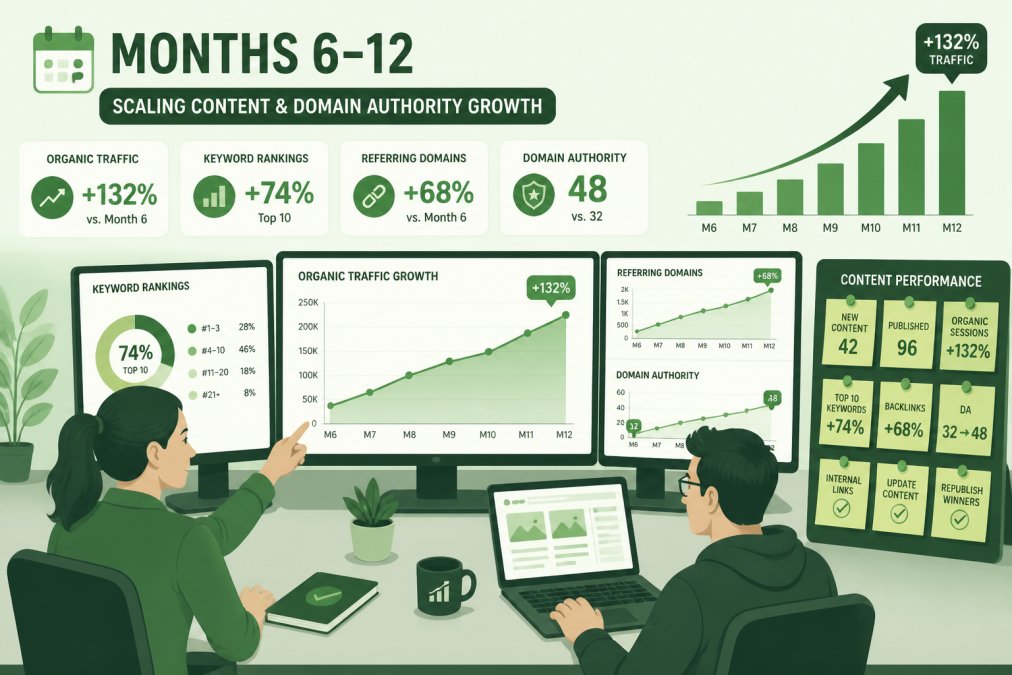
Month twelve isn't the finish line, it's the beginning of sustainable growth. By month eighteen, organic traffic might be 2-3x higher with less effort per piece because your foundation is solid.
SEO ROI for Mid-Sized Business: What to Measure
Measuring SEO ROI requires tracking metrics across the entire funnel, not just organic traffic.
Top-of-funnel metrics: Organic traffic, impressions in search results, and click-through rate show whether your SEO strategy is working at the visibility level.
Mid-funnel metrics: Pages per session, average session duration, and bounce rate from organic traffic show whether your content engages people. Declining engagement despite increasing traffic signals a mismatch between content and search intent.
Bottom-funnel metrics: Conversion rate from organic traffic, cost per acquisition, and customer lifetime value show real ROI. Mid-sized businesses often see 2-3% conversion rates from organic traffic after month six, while paid traffic converts at 0.8-1.5%.
The calculation: Divide revenue generated from organic traffic by total SEO costs (tools, salaries, content creation). A company spending $50,000 annually and generating $300,000 in revenue from organic customers has a 6:1 ROI, which is typical for mature programs.
What to track monthly:
- Organic traffic (total sessions)
- Organic traffic by keyword difficulty tier
- New keywords ranking (page 1, page 2-3)
- Backlinks acquired
- Domain authority
- Conversion rate from organic traffic
- Revenue attributed to organic traffic
- Cost per acquisition from organic
Most mid-sized businesses see positive ROI by month six. By month twelve, SEO typically becomes one of the lowest cost-per-acquisition channels.
Factors That Speed Up or Slow Down Your SEO Timeline
Industry competitiveness is the biggest variable. A niche SaaS company might rank for competitive terms in six months. A mid-market e-commerce business competing against major retailers might need twelve months.
Content velocity matters enormously. Publishing one piece per month shows results slowly. Publishing 2-3 pieces per week accelerates everything. Automation tools like GrandRanker help by reducing time between keyword identification and publication.
Backlink acquisition speed affects domain authority growth. Actively building relationships with industry publications and earning mentions increases domain authority faster than hoping for natural links. Most mid-sized businesses should allocate 20-30% of SEO effort to backlink outreach.
Technical SEO quality determines whether your content can rank. Poor site architecture, crawl errors, or slow page speed can delay results by months. A comprehensive technical audit in month one is worth more than publishing ten mediocre pieces.
Search intent alignment is underrated. Content that perfectly matches search intent ranks faster than generic content. Targeting "best email marketing platform" requires comparing specific platforms with pricing and features, not general tips.
Team experience accelerates everything. Teams with SEO expertise move faster than teams learning as they go.
Algorithm updates create unpredictability. Google releases core updates roughly every three months. Teams that diversify keyword targets and content types are more resilient.
The Plateau Phase and Long-Term Sustainability
Most SEO timelines hit a plateau phase around month 8-10. You've captured easy keywords. Your content calendar is full. Organic traffic growth slows from 50% month-over-month to 15-20%. This is normal, not failure.
Pushing through requires strategy changes:
First, shift from keyword difficulty expansion to commercial value expansion. Focus on keywords that drive revenue, not every keyword you can rank for.
Second, improve existing content instead of constantly publishing new pieces. Content ranking on page two or three for high-value keywords is worth updating.
Third, integrate SEO with other channels. Organic traffic is more valuable as part of a cohesive strategy.
Long-term sustainability requires accepting that SEO is never "done." Your competitors are publishing content. Google's algorithm is changing. Your industry is evolving. Teams that stay committed to SEO as a permanent channel see the best long-term results.
Common SEO Timeline Myths vs. Reality
Myth: SEO results appear in 30 days. Reality: Meaningful results appear in 3-6 months. Anyone promising faster results is either lying or targeting extremely low-competition keywords that don't matter for your business.
Myth: More content always means faster results. Reality: Publishing 50 mediocre pieces is worse than publishing 10 excellent pieces. Quality and search intent alignment matter more than volume.
Myth: SEO is a one-time project. Reality: SEO requires ongoing effort. Your competitors are publishing content. Google is updating algorithms. Your industry is evolving.
Myth: Backlinks are the only thing that matters. Reality: Backlinks matter, but so do content quality, technical SEO, user experience, and topical relevance.
Myth: You need to hire a full SEO team. Reality: Mid-sized businesses can achieve excellent results with one person managing strategy and one person creating content, especially with automation tools.
Myth: SEO doesn't work for competitive industries. Reality: SEO works in every industry, but the timeline is longer in competitive spaces. The long-term ROI is often higher because organic traffic is cheaper than paid traffic.
Accelerating Your SEO Timeline with Resource Allocation
The fastest way to accelerate your SEO timeline is to allocate resources strategically.
Content production is the highest-use activity. Every piece of content is a potential traffic source. Automation tools like GrandRanker let one person produce the output of three by automating keyword research, content optimization, and publishing.
Backlink building is the second-highest-use activity. One high-quality backlink from an authoritative site can move your rankings more than ten mediocre pieces. Invest in relationship building with industry publications and thought leaders.
Technical SEO is foundational but not ongoing. Spend heavily in month one. Fix crawl issues, improve site speed, establish proper schema markup. Then maintain it.
Content optimization is underrated. Updating existing content that ranks on page two or three often produces faster results than publishing new content.
Team composition for mid-sized businesses:
- One SEO strategist managing keyword research, competitive analysis, and ROI measurement
- One content creator or content manager
- One technical SEO specialist (can be part-time or outsourced)
- AI-powered platform (like GrandRanker) handling optimization and publishing
This structure scales from $2-3K monthly to $8-10K monthly. ROI typically becomes positive by month six.
SEO timeline expectations for mid-sized businesses are realistic: 3-6 months to see meaningful results, 6-12 months to establish a reliable traffic channel, and 12+ months to build sustainable competitive advantage. The businesses that win understand this timeline, allocate resources accordingly, and push through the plateau phase.
GrandRanker helps mid-sized businesses accelerate this timeline by automating keyword research, content optimization, and publishing. With AI handling repetitive work, your team focuses on strategy and quality. Start with a free trial and see how automation can compress your SEO timeline while maintaining the editorial quality that actually ranks and converts.
Frequently Asked Questions
What is a realistic SEO timeline for a mid-sized business?
Most mid-sized businesses see initial organic traffic improvements within 3-4 months, measurable ranking growth by 6 months, and significant ROI by 12 months. Your specific timeline depends on your starting domain authority, content gap, keyword difficulty, and resource allocation. Competitive niches or businesses starting from zero domain authority may need 12-18 months for substantial results. The key is consistent, strategic effort across technical SEO, content expansion, and link building throughout this period.
How long does SEO take to show results for established companies?
Established companies with existing domain authority typically see faster results, often 6-8 weeks for ranking improvements on easy keywords and 3-4 months for competitive terms. However, scaling organic traffic to meaningful business impact still requires 6-12 months of sustained effort. Existing authority accelerates the timeline, but SEO ROI for mid-sized business still depends on content quality, search intent alignment, and competitive positioning rather than speed alone.
What are the key milestones in an annual SEO growth plan?
Month 1-2: Complete technical audit, fix crawl issues, and establish baseline metrics. Month 2-3: Launch foundational content targeting high-intent keywords. Month 4-6: Achieve first page rankings on 20-30 keywords and see measurable organic traffic increase. Month 6-9: Expand content library, build backlink profile, and improve domain authority. Month 9-12: Scale to 50+ ranking keywords, establish top-of-funnel content, and demonstrate clear SEO ROI through conversion tracking and attribution.
Why does SEO take longer for mid-sized businesses compared to startups?
Mid-sized businesses often face more competition in established markets, have larger existing content footprints to optimize, and navigate more complex site architecture. Startups can move faster in niche markets with lower keyword difficulty. However, mid-sized businesses have advantages: existing traffic, brand recognition, and resources to invest in quality content and link building. The timeline difference reflects market competition and domain authority gaps, not effort, strategic resource allocation can close that gap significantly.
This article was written using GrandRanker