 listicle
SEO Alternatives for Mid-Sized Business Growth
Table of Contents
- SEO Alternatives for Mid-Sized Business Growth: Strategic Options Beyond Organic Search
- When to Consider SEO Alternatives
- Paid Advertising for Mid-Sized Business: Immediate Visibility and ROI
- Email Marketing Automation Strategies for Sustained Growth
- Account-Based Marketing for B2B Growth: Precision Targeting High-Value Accounts
- Hybrid Approach: Combining SEO Alternatives for Maximum Impact
- Local Search and PR: Building Authority Beyond Organic Rankings
- Measuring ROI Across SEO Alternatives
- Which SEO Alternative Fits Your Mid-Sized Business?
- Conclusion
Last Updated: August 14, 2026
SEO Alternatives for Mid-Sized Business Growth: Strategic Options Beyond Organic Search
When organic search traffic takes too long to generate meaningful results, mid-sized businesses face a critical decision: double down on SEO or explore alternatives that deliver faster visibility and measurable ROI. The truth is, SEO alternatives aren't about abandoning search engine optimization entirely, they're about recognizing that different growth channels serve different timelines, budgets, and business models.
At GrandRanker, we've worked with hundreds of founders and marketing teams who discovered that the most successful growth strategies blend SEO with complementary tactics that fill revenue gaps while organic rankings develop. Rather than choosing between SEO and alternatives, the key is understanding when and how to combine them for maximum impact.
This guide explores the most effective SEO alternatives for mid-sized business growth, including paid advertising, email marketing automation, account-based marketing, and local search strategies. We'll break down the pros, cons, and real-world ROI of each approach so you can build a growth strategy that matches your timeline, team capacity, and revenue goals.
When to Consider SEO Alternatives
Not every business should wait months for organic rankings to compound. SEO alternatives become necessary when you face immediate revenue pressure, limited content resources, highly competitive keywords, or a sales cycle that demands faster lead generation.
Mid-sized businesses often operate in a difficult middle ground, too small to outspend enterprise competitors on brand awareness, but too large to survive on organic referrals alone. This is where alternatives shine. If your sales team needs qualified leads this quarter, not next year, SEO alternatives provide the bridge.
The decision also depends on your competitive landscape. In saturated industries where top results are dominated by established brands with massive domain authority, the cost of ranking can exceed the cost of paid channels. A bootstrapped SaaS company competing against Salesforce might find Google Ads more cost-effective than trying to rank for broad keywords.
Another trigger: your content team is stretched thin. Creating the volume of high-quality content needed to rank for competitive keywords requires significant investment or time. If you lack both, paid channels and email automation let you generate revenue without the content creation burden.
Paid Advertising for Mid-Sized Business: Immediate Visibility and ROI
Paid advertising delivers what SEO cannot: immediate visibility to high-intent buyers. The moment your campaign goes live, you're in front of searchers actively looking for solutions. For mid-sized businesses with defined target audiences and clear conversion goals, paid advertising often outperforms organic efforts in the first 90 days.
The advantage is measurability. You know exactly how much you spent, how many clicks you received, and which campaigns drove conversions. This transparency makes it easier to justify marketing budgets and optimize spend in real time.
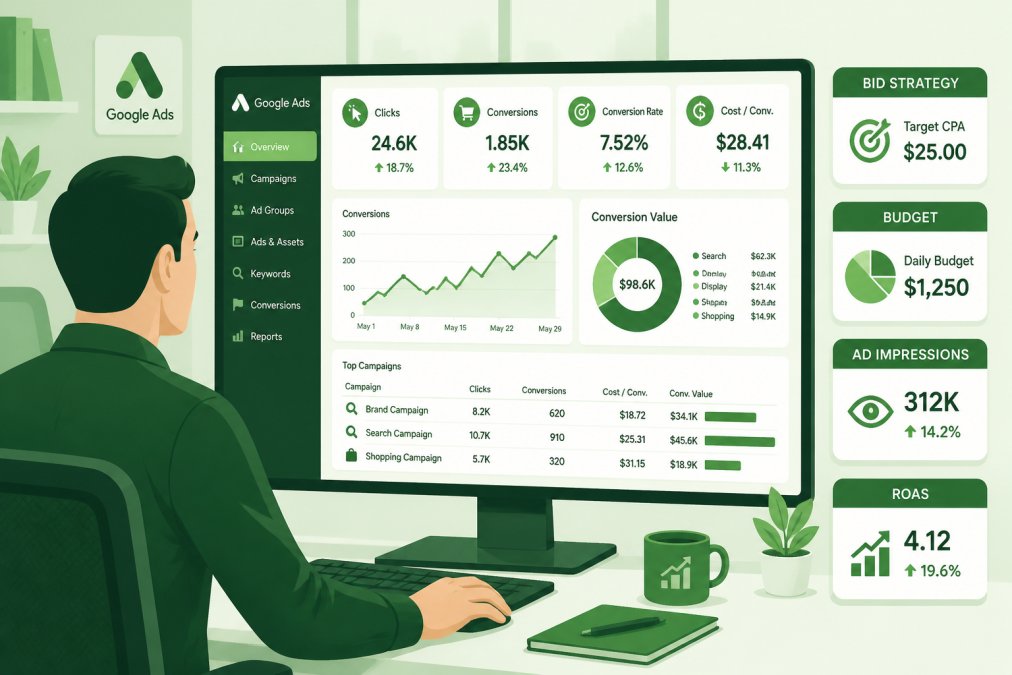
Google Ads: High-Intent Search Targeting
Google Ads captures searchers at the moment they're actively looking for your solution. Someone typing "project management software for remote teams" is further along the buyer journey than someone reading a blog post. This high intent translates to higher conversion rates and better ROI.
For mid-sized businesses, Google Ads works best when you have clear conversion metrics: demo requests, trial signups, or direct purchases. The platform's conversion tracking lets you measure which keywords and ad copy drive actual business results. You can scale spend on winning campaigns and pause underperformers within days.
The challenge is bid competition. In popular industries, cost-per-click can become prohibitive. This makes keyword selection critical. Long-tail keywords with lower search volume often deliver better ROI because they face less competition and attract more qualified prospects.
Meta Ads: Audience-Based Reach and Retargeting
Meta Ads (Facebook and Instagram) operate on a different principle than search advertising. Instead of targeting people actively searching for your solution, you're reaching people based on interests, behaviors, and demographics. This makes Meta Ads better for awareness and engagement than direct conversion.
For B2C brands and consumer products, Meta Ads can be exceptionally cost-effective. The platform's audience targeting is granular, you can reach people by age, location, interests, and past purchase behavior. Retargeting campaigns that show ads to people who visited your website but didn't convert often deliver the highest ROI.
B2B companies typically see lower conversion rates on Meta unless targeting decision-makers with highly specific audience parameters. The strength of Meta Ads is creative flexibility. Video ads, carousel ads, and story ads allow you to tell a brand story in ways search ads cannot.
TikTok for Business: Emerging Channels for Younger Audiences
TikTok represents a fundamentally different advertising model, prioritizing organic engagement and authentic content over polished ads. This makes TikTok ideal for brands targeting Gen Z and younger millennials, particularly in consumer products, fashion, beauty, and lifestyle categories.
For B2B companies, TikTok is less proven, though some B2B SaaS brands have found success building thought leadership and reaching younger decision-makers. The cost-per-engagement on TikTok is often lower than Meta or Google, making it worth testing if your target audience skews young.
The key to TikTok success is authenticity. Polished, corporate ads perform poorly. Brands that succeed use behind-the-scenes content, employee spotlights, and educational short-form videos that feel native to the platform.
Email Marketing Automation Strategies for Sustained Growth
Email marketing automation is the workhorse of sustainable growth for mid-sized businesses. Unlike paid advertising, which stops delivering results when you stop spending, email automation compounds. Every new subscriber becomes a potential repeat customer, and automation sequences deliver personalized messages without ongoing manual work.
Email automation works because it aligns with buyer behavior. Most prospects aren't ready to buy on their first interaction. Email automation nurtures leads through multiple touchpoints, building trust and providing value. For B2B companies with longer sales cycles, email automation often delivers higher lifetime value than paid channels.
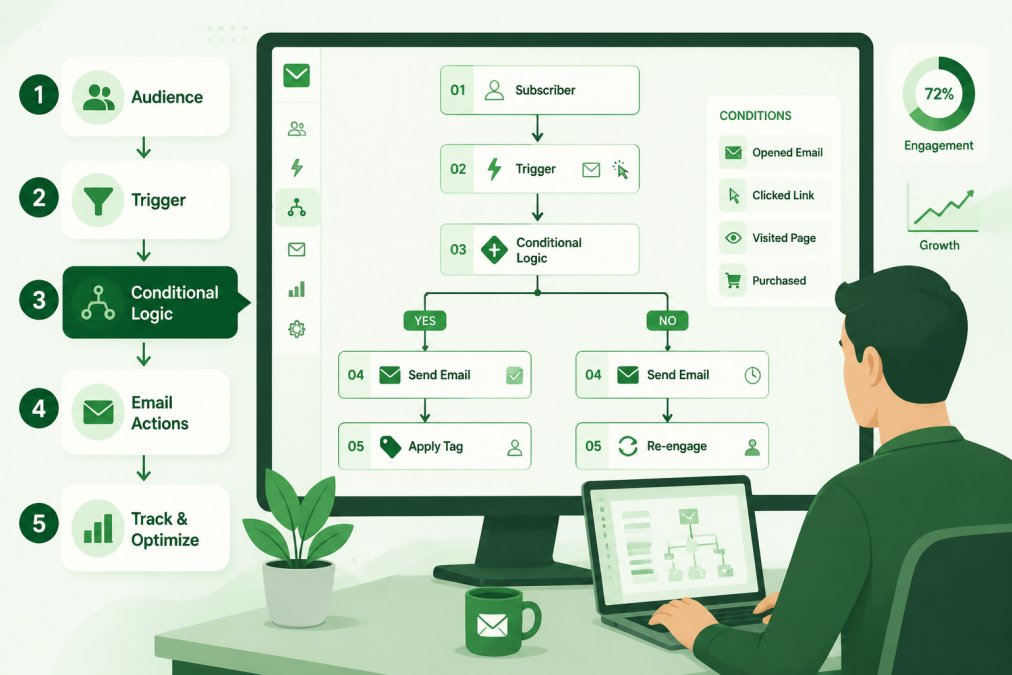
The most effective strategies segment audiences and personalize messaging. Rather than sending the same email to every subscriber, you segment by behavior (clicked a link, downloaded a resource, abandoned a cart) and send targeted follow-ups. This dramatically improves open rates, click rates, and conversions.
Building Your Email Automation Stack: In-House vs. Agency vs. Software-Only
Mid-sized businesses face a critical resource decision: build email automation in-house, outsource to an agency, or adopt software and manage it internally.
In-house automation requires hiring a marketing operations specialist. This person owns your automation strategy, builds workflows, manages segmentation, and optimizes performance. The advantage is deep institutional knowledge and rapid iteration. For businesses with complex sales cycles or high email volume, in-house automation often pays for itself through optimization that software alone cannot achieve.
Agency management costs depending on scope. An agency handles strategy, workflow design, copywriting, and optimization. This is ideal if your team lacks email expertise or you need fast implementation. The downside is reduced control and slower iteration.
Software-only approach means adopting a platform and managing automation internally without dedicated headcount. This works if your email program is straightforward (welcome sequences, promotional campaigns, abandoned cart reminders) and your team has bandwidth. The cost for software, but you avoid hiring.
For most mid-sized businesses, a hybrid approach works best: adopt software (HubSpot, ActiveCampaign, or Klaviyo), hire one marketing operations person to manage it, and use an agency for quarterly strategy reviews.
Core Email Automation Workflows for Mid-Sized B2B and B2C
Welcome sequence (3-5 emails over 7 days). New subscribers receive a welcome email immediately, followed by educational content and a soft offer. This sequence typically achieves 40-60% open rates and establishes your brand voice. For B2B, welcome sequences often include a free resource that qualifies leads. For B2C, welcome sequences often include a first-purchase discount.
Behavioral trigger emails (sent based on user action). When a prospect downloads a resource, visits a pricing page, or abandons a cart, an automated email follows within 1-4 hours. These emails achieve 2-3x higher click rates than batch-and-blast campaigns because they're contextually relevant. For SaaS companies, a "pricing page visitor" email might offer a demo. For e-commerce, an abandoned cart email typically recovers 10-15% of lost sales.
Re-engagement campaigns (sent to inactive subscribers). After 90 days of inactivity, send a re-engagement email asking subscribers to confirm they want to stay on your list. Typically, 20-30% of inactive subscribers re-engage, and the rest can be removed, which improves your sender reputation.
Post-purchase nurture (for SaaS and e-commerce). After a customer makes a purchase, send a sequence of onboarding and educational emails. For SaaS, this might include setup guides and feature tutorials. For e-commerce, this might include care instructions and related product recommendations. Post-purchase sequences reduce churn and increase customer lifetime value by 15-30%.
Lead scoring and sales handoff. Use automation to score leads based on email engagement, website behavior, and demographic fit. When a lead reaches a threshold score, automatically notify your sales team. This ensures sales focuses on qualified prospects.
Segmentation and Personalization: The Multiplier Effect
The difference between generic email and high-performing automation is segmentation. Instead of sending the same email to your entire list, segment by industry, buyer stage, past purchase behavior, and engagement level. Segmented campaigns achieve 20-30% higher conversion rates than one-size-fits-all messaging.
Most email platforms support conditional logic that automates these decisions. For example: "If subscriber opened email A AND clicked link B AND visited pricing page, send email C." This level of personalization separates high-performing automation from mediocre campaigns.
Platform Comparison: Feature Depth and Team Fit
HubSpot CRM Suite offers an all-in-one platform for marketing, sales, and customer service. The free CRM includes basic contact management and email tracking. Paid tiers add sophisticated marketing automation, including email campaigns, landing pages, and behavioral workflows. For mid-sized businesses, HubSpot's strength is integration, your marketing team can create automated email sequences that trigger based on sales activity. When a prospect opens an email, HubSpot notifies the sales team. HubSpot's content management system also makes it easy to publish blog posts and landing pages without relying on a developer. The drawback is cost, pricing scales quickly with users and contacts.
ActiveCampaign specializes in sophisticated marketing automation. The platform excels at building complex workflows that respond to user behavior. If a prospect clicks a link in email A but not email B, you can trigger a different follow-up sequence. For B2B companies with complex sales cycles, ActiveCampaign's conditional logic and automation capabilities are unmatched. You can create workflows that score leads based on behavior and automatically assign leads to sales reps when they reach a threshold. Pricing starts at $15/month for 1,000 contacts.
Klaviyo dominates e-commerce email automation. The platform is built specifically for online retailers and includes native integrations with Shopify and WooCommerce. Klaviyo's strength is predictive analytics, the platform uses machine learning to identify which customers are most likely to purchase and when to send emails to maximize conversion. For e-commerce businesses, Klaviyo typically delivers 2-3x higher ROI than generic email platforms. Pricing starts around $20/month for small lists.
Mailchimp offers a free email marketing platform with basic automation features, making it ideal for small teams testing email marketing. The free tier includes up to 500 contacts and simple automation workflows. For mid-sized businesses that don't need enterprise-level features, Mailchimp's paid plans provide solid automation at reasonable pricing. Pricing starts at $13/month (Essentials tier) for unlimited contacts.
Measuring Email Automation Performance
Track these metrics to optimize your email program:
Open rate (percentage of recipients who open your email). Industry average is 20-25% for B2B, 15-20% for B2C. Improve open rates by testing subject lines, send times, and sender names.
Click-through rate (percentage of recipients who click a link). Industry average is 2-5%. Improve CTR by simplifying email copy and using clear calls-to-action.
Conversion rate (percentage of recipients who complete a desired action). This varies widely by industry, but 1-5% is typical for cold email and 5-15% for engaged subscribers.
Revenue per email (total revenue generated divided by number of emails sent). This is the most important metric because it connects email to actual business results. Most mid-sized businesses find that email generates $0.50-$2.00 per email sent over time.
Unsubscribe rate (percentage of recipients who opt out). If this exceeds 0.5%, your email frequency or relevance is likely too low.
Use these metrics to identify which workflows and segments perform best, then double down on winners and pause underperformers.
Account-Based Marketing for B2B Growth: Precision Targeting High-Value Accounts
Account-based marketing flips the traditional funnel on its head. Instead of casting a wide net and filtering down to qualified leads, ABM identifies your highest-value target accounts and focuses all marketing and sales resources on winning them.
For B2B companies selling to enterprises or mid-market accounts, ABM often delivers better ROI than traditional lead generation. Closing one $500K enterprise deal is worth more than closing 100 small accounts. ABM concentrates resources on opportunities that matter most.
You identify 10-50 target accounts based on firmographic data and fit scores. Your marketing team creates personalized campaigns for each account. Ads, emails, and content are customized to address the specific challenges of that company. Your sales team focuses exclusively on these accounts, building relationships with multiple decision-makers.
ABM works best when you have clear ideal customer profiles and a sales team capable of managing complex, multi-stakeholder deals. The investment required is higher than broad-based lead generation, but deal sizes and close rates often justify it.
Hybrid Approach: Combining SEO Alternatives for Maximum Impact
The most successful mid-sized businesses don't choose a single growth channel. They build a hybrid strategy that balances immediate revenue from paid channels with long-term compounding from email automation and organic growth.
A typical hybrid approach: paid advertising generates immediate leads and revenue while you build email lists. Email automation nurtures those leads and existing customers, increasing lifetime value. Meanwhile, you're publishing content optimized for organic search, which compounds over time. Within 12-18 months, organic traffic becomes a significant revenue driver, reducing reliance on paid advertising.
This hybrid model reduces risk. If paid advertising becomes too expensive or algorithm changes reduce email effectiveness, you still have organic growth working in the background. Most mid-sized businesses find that starting with paid advertising (for immediate revenue) and email automation (for sustainable growth) is more practical than trying to rank organically while bootstrapped.
GrandRanker helps bridge this gap by automating keyword research and content creation. With AI-powered SEO, you can build your organic presence without hiring a full content team. This frees resources for paid advertising and email automation while your content compounds in the background.
Local Search and PR: Building Authority Beyond Organic Rankings
For businesses with physical locations or local service areas, local search delivers high-intent traffic with lower competition than national keywords. A plumber in Denver competing for "plumber near me" faces far less competition than competing for "plumbing services."
Local search optimization involves claiming and optimizing your Google Business Profile, building local citations, and collecting customer reviews. Public relations complements local search by building authority and earning media coverage. A mention in a local news outlet signals to both Google and potential customers that your business is credible.
Tools like BrightLocal help manage local SEO tasks including citation auditing, review monitoring, and rank tracking across local search results.
Measuring ROI Across SEO Alternatives
The biggest mistake mid-sized businesses make is implementing multiple channels without clear measurement frameworks. You can't optimize what you don't measure. However, measurement varies dramatically by channel.
The key is establishing a KPI hierarchy: identify which metrics matter most for your business, track them consistently, and use them to make monthly budget decisions.
The KPI Hierarchy: Revenue First, Engagement Second
Every channel should ultimately connect to revenue. However, not every channel drives revenue directly or immediately. Your KPI hierarchy should look like this:
Tier 1 (Revenue metrics). Track cost-per-acquisition (CPA), customer lifetime value (LTV), and return on ad spend (ROAS). These are the only metrics that matter for long-term ROI decisions.
Tier 2 (Leading indicators). These predict revenue but don't measure it directly. Examples include cost-per-lead (CPL), lead quality score, and conversion rate. Use these to optimize campaigns in real time, but don't make long-term budget decisions based on them alone.
Tier 3 (Engagement metrics). These are diagnostic tools, not decision drivers. Open rates, click rates, impressions, and page views tell you if content is resonating, but they don't tell you if it's driving revenue.
Most mid-sized businesses make the mistake of optimizing for Tier 3 metrics when they should be optimizing for Tier 1 metrics.
Paid Advertising: Measurement Framework
Paid advertising is the easiest channel to measure because the data is immediate and transparent.
Google Ads measurement:
- Set up conversion tracking to track form submissions, purchases, or other desired actions.
- Calculate cost-per-click (CPC), cost-per-conversion, and return on ad spend (ROAS).
- Set a break-even CPA: the maximum you can spend to acquire a customer and still be profitable. If your average customer lifetime value is $1,000 and your gross margin is 60%, your break-even CPA is roughly $600.
- Scale campaigns with CPA below your break-even threshold. Pause campaigns above it.
- Most mid-sized B2B companies find Google Ads CPAs range from $50-$300 depending on industry and keyword competitiveness.
Meta Ads measurement:
- Set up Facebook Pixel on your website to track conversions.
- Calculate cost-per-result and ROAS.
- For retargeting campaigns, measure conversion rate. Retargeting conversion rates are typically 2-5x higher than cold audience campaigns.
- Most mid-sized businesses find Meta Ads cost-per-acquisition is 30-50% lower than Google Ads for cold audiences, but conversion rates are lower.
Account-based marketing measurement:
- Instead of measuring individual leads, measure account engagement and pipeline value.
- Track the number of target accounts that engaged with your campaigns.
- Measure pipeline value: the total deal value of opportunities created from ABM campaigns.
- Calculate ABM ROI by dividing total pipeline value by total ABM spend. Most mid-sized businesses find ABM generates $3-$10 in pipeline value per dollar spent.
Email Marketing Automation: Measurement Framework
Email measurement is trickier because results compound over time.
Direct attribution: Track revenue directly attributed to email campaigns. Divide total revenue by total emails sent to calculate revenue-per-email. For mid-sized businesses, this typically ranges from $0.50-$2.00 per email sent.
Cohort analysis: Segment subscribers by when they joined and track their lifetime value. Subscribers who joined 12 months ago should have higher lifetime value than subscribers who joined 1 month ago.
Campaign-level ROI: For specific campaigns (welcome sequence, promotional email, re-engagement campaign), calculate revenue generated divided by cost. Most mid-sized businesses find welcome sequences generate 5-10x ROI, promotional emails generate 2-5x ROI, and re-engagement campaigns generate 1-3x ROI.
Unsubscribe rate and list decay: Track the percentage of subscribers who unsubscribe each month. A healthy unsubscribe rate is 0.1-0.5% per campaign. Also track list decay (percentage of subscribers who become inactive monthly). If more than 5% of your list becomes inactive monthly, your content isn't resonating.
Organic Search: Measurement Framework
Organic search is the hardest channel to measure because results compound over 6-12 months. However, you can still track ROI.
Keyword rankings: Track your rankings for target keywords using Google Search Console or third-party rank tracking software. Aim to rank in the top 10 for high-intent keywords. Ranking in the top 3 typically drives 3-5x more traffic than ranking in positions 4-10.
Organic traffic: Track total organic traffic from Google Search Console. Set a goal to increase organic traffic by 20-30% quarterly.
Organic conversion rate: Measure the percentage of organic visitors who convert. Organic conversion rates are typically 2-3x higher than paid advertising conversion rates because organic visitors are further along the buyer journey.
Revenue from organic search: Use Google Analytics to track revenue attributed to organic search. Divide total organic revenue by total organic traffic to calculate revenue-per-visitor. For mid-sized B2B companies, this typically ranges from $5-$50 per visitor.
Content ROI: For individual pieces of content, track how much traffic and revenue each generates. Use this data to identify which topics and content formats work best, then double down on winners.
Attribution Modeling: The Multi-Touch Problem
The challenge with measuring ROI across multiple channels is attribution. When a customer converts, which channel gets credit?
Last-click attribution gives all credit to the last channel. This overvalues email and undervalues awareness channels.
First-click attribution gives all credit to the first channel. This overvalues awareness and undervalues conversion channels.
Position-based attribution distributes credit across channels, giving the first and last channels more credit (40% each) and middle channels the remaining 20%. For mid-sized businesses, position-based attribution is often the most practical.
Most analytics platforms support multiple attribution models. Set up position-based attribution and use it to evaluate channel performance. This will show you that awareness channels drive initial interest, email drives conversion, and organic search drives high-value customers.
Monthly Measurement Cadence and Budget Reallocation
Establish a monthly measurement rhythm:
Week 1: Collect data from all channels. Pull reports from Google Ads, Meta Ads, email platform, Google Analytics, and CRM.
Week 2: Calculate key metrics for each channel: CPA, ROAS, revenue-per-email, organic conversion rate, etc. Compare to previous month and to your break-even thresholds.
Week 3: Identify winners and losers. Which channels are delivering ROI above your break-even threshold? Which are below?
Week 4: Reallocate budget. Increase spend on channels performing above threshold. Decrease or pause spend on channels below threshold. Test new channels with 10-20% of budget.
This monthly cadence ensures you're making data-driven decisions and continuously optimizing your marketing mix. Most mid-sized businesses find that this discipline improves overall ROI by 20-30% within 3 months.
Which SEO Alternative Fits Your Mid-Sized Business?
The right SEO alternative depends on your specific situation. Here's a quick decision framework:
Choose paid advertising if: You need leads this quarter, have budget for testing, and want immediate visibility. Start with Google Ads for high-intent keywords and Meta Ads for retargeting.
Choose email marketing automation if: You have an existing audience or can build one through content or lead magnets. Email delivers best results when you have a sequence of products or a long sales cycle.
Choose account-based marketing if: You sell high-ticket B2B solutions with complex sales cycles. ABM works best when you can identify 10-50 target accounts and your sales team can manage multi-stakeholder deals.
Choose local search if: You have physical locations or serve a geographic area. Local search delivers high-intent traffic with lower competition.
Choose a hybrid approach if: You have the resources to manage multiple channels simultaneously. Most mid-sized businesses benefit from combining paid advertising (immediate revenue) with email automation (sustainable growth) and organic search (long-term compounding).
GrandRanker fits into this framework as the organic search component of a hybrid strategy. While you're running paid campaigns and building email lists, GrandRanker automates keyword research, content creation, and optimization. This lets you build long-term organic growth without hiring a full content team.
The most successful mid-sized businesses recognize that SEO alternatives aren't replacements for organic search, they're complements. Paid advertising generates immediate revenue. Email automation builds sustainable growth. Local search captures high-intent local traffic. Account-based marketing wins high-value deals. And organic search, powered by consistent content creation and optimization, compounds over years.
Rather than choosing between SEO and alternatives, build a hybrid strategy that balances short-term revenue needs with long-term growth. According to HubSpot's State of Marketing Report, companies using multiple marketing channels see 60% higher engagement rates than those relying on a single channel.
Start with the channel that addresses your most urgent need. If you need leads immediately, begin with paid advertising. If you have an audience but struggle with retention, focus on email automation. If you're competing locally, optimize for local search. And if you want long-term compounding growth, invest in content and SEO. With GrandRanker's automation, you can do this without overwhelming your team.
Get started with GrandRanker's free trial and automate your keyword research and content creation while you test paid channels and email automation. With AI-powered SEO running in the background, you'll build organic traffic that compounds while you focus on immediate revenue generation through alternatives.
Frequently Asked Questions
Is SEO still necessary for mid-sized businesses, or should we focus entirely on SEO alternatives?
SEO remains valuable for long-term, sustainable organic growth, but mid-sized businesses benefit most from a hybrid approach. Organic search builds domain authority and costs less per click over time, while alternatives like paid advertising deliver immediate results. The best strategy combines SEO with paid advertising, email marketing automation, and account-based marketing to balance short-term lead generation with long-term visibility. Your choice depends on your industry, budget, and growth timeline.
How do email marketing automation strategies compare to SEO for lead generation?
Email marketing automation drives results faster than SEO but works best with an existing audience. Automation platforms like HubSpot and ActiveCampaign nurture leads through personalized workflows, increasing conversion rates by 25-50% compared to manual outreach. SEO builds organic traffic over months, while email automation converts warm leads immediately. For mid-sized businesses, using both together, SEO to attract new prospects and email automation to convert them, delivers the strongest ROI.
What's the typical cost difference between SEO alternatives and organic search optimization?
Paid advertising costs vary by industry and competition but typically range from $1-50 per click depending on platform and targeting. Email marketing automation starts around $15-20 monthly for small lists and scales with contacts. SEO requires upfront investment in content and technical optimization but generates lower cost-per-lead long-term. Mid-sized businesses often allocate 40% to paid channels, 35% to email automation, and 25% to organic SEO for balanced growth and predictable ROI.
Can account-based marketing for B2B growth work alongside traditional SEO strategies?
Yes. Account-based marketing targets specific high-value accounts with personalized campaigns, while SEO builds general visibility. ABM works best for B2B companies with defined target accounts, using paid ads, email, and direct outreach. SEO complements ABM by ensuring your company appears in search results when decision-makers research solutions. Together, they create multiple touchpoints: prospects find you through search, then ABM campaigns nurture them toward conversion with personalized messaging.
This article was written using GrandRanker