 comparison
SaaS Marketing Strategy vs SEO: What to Prioritize
Table of Contents
- SaaS Marketing Strategy vs SEO: Understanding the Core Conflict
- Mapping the Buyer Journey: Keyword Intent and Content Strategy for SaaS
- SaaS SEO Best Practices That Drive Pipeline, Not Just Traffic
- SaaS SEO vs PPC: Choosing the Right Acquisition Channel
- Budget Allocation Frameworks: Splitting Investment Between SEO and Other Channels
- Attribution Modeling and Pipeline-Focused Metrics for SaaS
- B2B SaaS Marketing Strategy Examples: How Leading Teams Blend SEO and Other Channels
- When SaaS Marketing Strategy vs SEO Is the Wrong Question to Ask
- Conclusion
Last Updated: June 2, 2026
The debate over SaaS marketing strategy vs SEO comes down to a fundamental tension: should you build an asset that compounds over time, or deploy capital against channels that produce results this quarter? GrandRanker has helped 421+ founders work through exactly this question, and the answer is almost never binary. Most SaaS teams treat these as competing priorities when they're actually complementary systems that need different resource allocations at different growth stages. Below, we'll show you exactly how to decide where to invest, how to structure your budget, and how to measure whether either channel is actually working.
Here's what most guides get wrong: they frame SEO as a marketing strategy when it's actually a distribution channel. SaaS marketing strategy is the broader system that includes positioning, retention, lifecycle marketing, and pipeline generation. SEO is one lever inside that system.
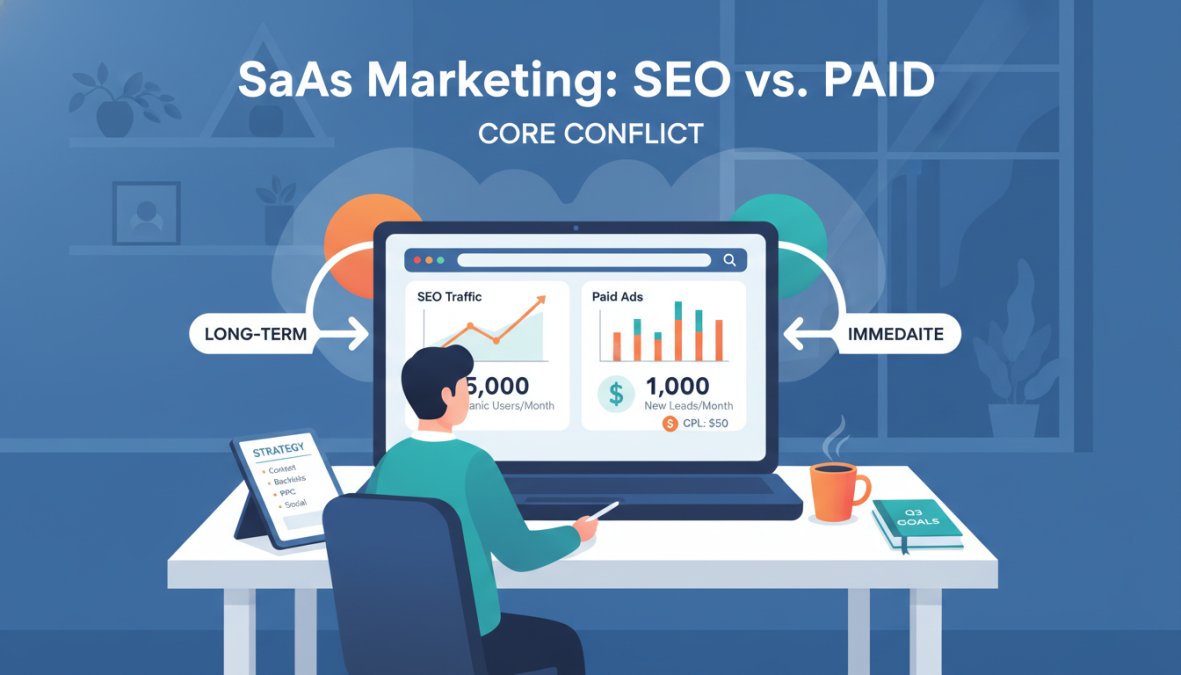
SaaS Marketing Strategy vs SEO: Understanding the Core Conflict
SaaS marketing strategy is the full operational system a company uses to acquire, convert, and retain customers across every channel and stage of the buyer journey. SEO is a specific organic acquisition channel within that system. Confusing the two leads to misallocated budgets and misaligned teams.
The conflict surfaces most visibly at the board level. Founders under pressure to show pipeline growth this quarter often deprioritize SEO because organic results typically take months to materialize. Paid acquisition produces demos and sign-ups faster. The problem is that paid acquisition scales linearly with spend, while SEO builds an organic revenue engine that compounds. Teams that abandon SEO during a growth push often find themselves locked into paid dependency, with customer acquisition cost (CAC) rising every quarter.
What Makes SaaS Marketing Fundamentally Different
SaaS marketing differs from traditional product marketing in one critical way: the customer relationship doesn't end at purchase. Churn is a constant threat. Lifetime value (LTV) depends entirely on retention, expansion revenue, and reducing time-to-value during onboarding. This means every marketing channel must be evaluated not just on conversion rate but on the quality of customers it attracts.
A lead from a high-intent organic search query, someone searching for a specific solution to a specific problem, tends to convert to a paying customer at higher rates and churn less than a lead from a broad paid acquisition campaign. This is why SaaS companies that build strong organic programs often see their overall CAC improve over time even as they scale.
Where SEO Fits Inside a Broader SaaS Marketing Strategy
SEO is one of several acquisition channels in a SaaS marketing stack. The others typically include paid acquisition (PPC, paid social), product-led growth (PLG), sales-led growth with account-based marketing (ABM), and lifecycle marketing through email and in-app messaging. SEO's role is to generate non-branded search traffic from buyers who are actively researching solutions, then convert that traffic into qualified leads, demos, and sign-ups.
The mistake most teams make is treating SEO as a content volume game. Publishing more articles doesn't automatically generate pipeline. What generates pipeline is matching keyword intent to buyer journey stage and building content that answers the specific questions buyers have at each stage.
Mapping the Buyer Journey: Keyword Intent and Content Strategy for SaaS
Buyer journey mapping for SaaS means aligning your content to the three distinct mental states of your prospective customer: problem-aware but solution-unaware, actively evaluating solutions, and ready to commit. Each state corresponds to a different type of search query, and each requires a different content format.
This is where most SaaS SEO programs fail. Teams publish awareness-stage content (blog posts about industry trends) while neglecting the high-intent decision-stage queries (comparisons, alternatives, pricing pages) that actually drive sign-ups. The organic traffic looks healthy in the dashboard, but pipeline contribution is near zero.
Keyword Research for SaaS: Non-Branded and High-Intent Opportunities
Non-branded search is where SaaS companies win or lose the organic channel. Branded searches (people typing your company name directly) indicate existing awareness. Non-branded searches (people typing their problem or a solution category) represent net-new demand you can capture.
Effective keyword research for SaaS focuses on three tiers:
- Problem-aware queries: "how to reduce customer churn," "why is my SaaS retention low" - high volume, low purchase intent, best for authority building
- Solution-aware queries: "best project management software for agencies," "Asana alternatives" - medium volume, high purchase intent, best for comparison content
- Decision-ready queries: "[Competitor] vs [Your Product]," "[Your Product] pricing," "[Category] software reviews" - lower volume, highest intent, best for conversion
Search volume matters less than search intent. A keyword with 200 monthly searches that maps to a buyer ready to start a trial is worth more than a keyword with 20,000 searches attracting people who will never buy.
Content Mapping Across Awareness, Consideration, and Decision Stages
Content mapping is the process of assigning specific content formats to specific stages of the buyer journey. For SaaS, this typically looks like:
- Awareness: Long-form educational guides, thought leadership, problem-framing content
- Consideration: Comparison pages, use case breakdowns, integration guides, ROI calculators
- Decision: Pricing pages, free trial landing pages, case studies, demo request flows
The consideration stage is consistently underfunded. Most SaaS content programs are heavy on awareness content and light on the middle-funnel assets that move prospects from "interested" to "evaluating." According to Gartner's B2B buyer research, B2B buyers spend the majority of their purchase journey doing independent online research before ever engaging a sales rep. That research happens in the consideration stage, and if you don't have content there, a competitor does.
SaaS SEO Best Practices That Drive Pipeline, Not Just Traffic
The goal of SaaS SEO best practices is not rankings or traffic in isolation. The goal is pipeline generation. Every SEO decision should be evaluated against its expected contribution to qualified leads, demos, and sign-ups, not just organic sessions.
This reframe changes how you prioritize. A technical SEO fix that improves crawlability across 500 pages matters more than a blog post targeting a high-volume keyword with low purchase intent.
Technical SEO for SaaS: Schema Markup, Entity Consistency, and Site Architecture
Technical SEO for SaaS applications carries specific complexity that standard content sites don't face. Dynamic URLs, app subdomains, gated content, and JavaScript-heavy interfaces all create crawlability challenges that can suppress organic performance regardless of content quality.
Three technical areas have outsized impact on SaaS organic performance:
Schema markup: Implementing structured data (SoftwareApplication schema, FAQ schema, Review schema) helps Google understand what your product does and surfaces rich results in search. This is particularly valuable for pricing pages and feature comparison content.
Entity consistency: Your product name, category, and core use cases should be described consistently across your site, your Google Business Profile, and third-party directories. Inconsistent entity signals confuse search engines and reduce your authority for the queries that matter most.
Site architecture: Logical URL structures, clean internal linking between related content, and proper canonicalization of similar pages prevent crawl budget waste and ensure link equity flows to your highest-value pages.
AI Search Optimization and AEO: Getting Cited by AI Assistants
AI Overviews in Google Search and direct answers in tools like ChatGPT and Perplexity now intercept a meaningful share of queries that previously drove organic clicks. For SaaS companies, this creates a new optimization target: answer engine optimization (AEO).
AEO is the practice of structuring content so AI systems can extract, quote, and cite it as an authoritative answer. The principles overlap with traditional SEO but emphasize different elements: clear definitional sentences, structured answer blocks, and self-contained paragraphs that make sense without surrounding context.
GrandRanker is built specifically for this challenge. The platform automates not just keyword research and content creation, but also the structural optimization that gets SaaS companies cited by AI assistants, including ChatGPT, Claude, and Perplexity. For founders who want to capture both Google rankings and AI citations without building a full content team, this is the most direct path.
According to Google's Search Central documentation on structured data, properly implemented schema markup increases the likelihood of appearing in AI-generated search features. The window to establish AI citation authority is narrow. Companies that build it now will be significantly harder to displace in 12 months.
SaaS SEO vs PPC: Choosing the Right Acquisition Channel
Most guides frame this as a simple timeline trade-off: PPC for speed, SEO for the long game. That framing is incomplete and, for founders under real budget pressure, actively misleading. The more useful frame is channel dependency risk: every dollar you spend on paid acquisition without building organic infrastructure is a dollar that creates no compounding return and increases your exposure to cost-per-click inflation, platform policy changes, and competitor bidding wars.
The honest comparison requires looking at both channels across three dimensions: speed to pipeline, cost trajectory over time, and strategic defensibility.
Speed to Pipeline
PPC delivers pipeline in days. A well-structured Google Ads campaign targeting high-intent keywords, "[category] software for [use case]", can produce demo requests within 48 hours of launch. For a seed-stage company that needs to validate messaging or close its first ten customers, this speed is genuinely valuable and not easily replicated by organic.
SEO delivers pipeline in months. The commonly cited window for meaningful organic traction is six to twelve months for a new domain, and that assumes consistent, well-targeted content production from day one. For a founder who needs to show pipeline to close a Series A in four months, SEO is not the answer to that specific problem.
The mistake is treating this speed difference as a permanent argument for PPC. It is an argument for sequencing.
Cost Trajectory: Where the Lines Cross
PPC costs scale linearly with pipeline. If you need twice the demos, you spend roughly twice the budget. There is no compounding. Worse, cost-per-click in competitive B2B SaaS categories has risen significantly over the past several years as more companies have shifted budget to performance channels. Categories like CRM, project management, and HR software now carry CPCs that make paid-only acquisition economics extremely difficult to sustain at scale.
SEO costs are front-loaded and then flatten. The investment in technical infrastructure, keyword strategy, and content production is concentrated in the first twelve to eighteen months. After that, a well-built organic program generates pipeline with marginal additional spend. The crossover point, where organic CAC drops below paid CAC on a fully-loaded basis, typically occurs somewhere in the second year for companies that invest consistently.
This is why the comparison is not really SEO vs PPC. It is short-term CAC vs long-term CAC efficiency, and the answer depends entirely on your current stage and runway.
The Paid Dependency Trap
The scenario that damages SaaS companies most is not choosing PPC over SEO early, that is often the right call. The damage comes from never making the transition. Teams that rely on paid acquisition through Series A and into Series B often find themselves in a structural trap:
- CAC rises as ad costs increase and the most efficient audiences saturate
- Organic infrastructure was never built, so there is no compounding channel to offset rising paid costs
- The budget required to maintain pipeline grows faster than revenue, compressing margins
- Any platform disruption, a Google Ads policy change, a Meta algorithm shift, creates immediate pipeline risk with no organic floor to fall back on
This is not a hypothetical. It is a pattern visible in the unit economics of SaaS companies that scaled primarily on paid acquisition and then faced deteriorating payback periods as they grew.
When Paid Acquisition Is Genuinely the Right Priority
There are specific scenarios where PPC should take clear precedence over SEO investment:
- Pre-product-market fit: You need conversion data and messaging feedback faster than organic can provide it. Paid channels give you both in weeks.
- Entering a category with entrenched organic players: If the top three organic positions for your highest-intent keywords are held by Salesforce, HubSpot, and G2, displacing them organically will take years. PPC lets you compete for that traffic immediately while you build domain authority in adjacent, less competitive queries.
- Time-sensitive demand capture: Product launches, conference cycles, and seasonal demand spikes favor paid channels. You cannot accelerate organic rankings on a deadline.
- ABM targeting: Paid social and display allow firmographic and account-level targeting that organic search structurally cannot replicate. For enterprise SaaS with a defined ICP of 50 to 500 target accounts, ABM via paid channels is a different tool than SEO, not a substitute for it.
The Right Sequencing Model
The most effective SaaS teams do not choose between SEO and PPC. They sequence them deliberately:
- Months 0-6: Paid acquisition as the primary pipeline driver. Simultaneously, build SEO infrastructure, technical foundation, keyword map, and a small set of high-intent decision-stage pages targeting queries where you can realistically rank.
- Months 6-18: Begin systematic content production targeting consideration and decision-stage queries. Maintain paid as a pipeline floor while organic begins to contribute.
- Month 18+: Organic becomes a meaningful pipeline contributor. Begin shifting budget allocation toward content and SEO while using paid for specific high-value campaigns rather than baseline pipeline generation.
The sequencing model only works if you start the SEO foundation in phase one, even at minimal investment. Teams that wait until month twelve to begin organic infrastructure are pushing the crossover point out by another twelve months.
Budget Allocation Frameworks: Splitting Investment Between SEO and Other Channels
Budget allocation for SaaS marketing is one of the most consequential decisions a founder makes, and most guides skip it entirely. Here's a framework that reflects how successful SaaS teams actually allocate resources.
The core principle: your stage determines your channel mix. Early-stage companies need signal and speed. Growth-stage companies need to build defensible, compounding channels.
Early-Stage vs Growth-Stage SaaS Budget Priorities
Early-stage (pre-product-market fit, under $1M ARR):
- Paid acquisition: 50-60% of marketing budget
- Content and SEO foundation: 20-30%
- Brand and community: 10-20%
Rationale: You need to learn fast. Paid channels give you conversion data, messaging feedback, and pipeline in weeks rather than months. Invest in SEO infrastructure (technical foundation, keyword strategy, a handful of high-intent pages) but don't expect it to drive pipeline yet.
Growth-stage ($1M-$10M ARR, post-PMF):
- Content and SEO: 35-45%
- Paid acquisition: 30-40%
- Lifecycle and retention marketing: 15-25%
Rationale: You know what your buyers look like and what they search for. Now you build the organic engine. Shift budget toward SEO systematically while maintaining paid as a reliable pipeline floor.

| Stage | SEO/Content | Paid Acquisition | Lifecycle/Retention |
|---|---|---|---|
| Early-stage (<$1M ARR) | 20-30% | 50-60% | 10-20% |
| Growth-stage ($1M-$10M ARR) | 35-45% | 30-40% | 15-25% |
| Scale-stage (>$10M ARR) | 40-50% | 20-30% | 20-30% |
Attribution Modeling and Pipeline-Focused Metrics for SaaS
Attribution modeling is where SaaS marketing strategy vs SEO debates get genuinely complicated. SEO's contribution to pipeline is chronically underreported in most attribution setups, which leads to it being underfunded.
The problem is last-touch attribution. Most CRMs and marketing automation platforms default to crediting the last touchpoint before a conversion. For SaaS buyers who read three blog posts, attended a webinar, and then clicked a paid retargeting ad before requesting a demo, the paid ad gets 100% of the credit. The organic content that initiated the relationship gets nothing.
Connecting CAC, LTV, and Churn to Your SEO Investment
Multi-touch attribution models distribute credit across all touchpoints in the buyer journey. For SaaS companies serious about understanding organic contribution, first-touch and linear attribution models typically reveal that SEO is driving significantly more pipeline than last-touch models suggest.
The metrics that actually matter for evaluating SEO investment:
- Organic-sourced pipeline: The dollar value of deals that had organic as a first or significant touchpoint
- CAC by channel: Organic CAC should be calculated on a fully-loaded basis (content production, technical SEO, tooling) and compared to paid CAC over a 24-month horizon
- LTV by acquisition channel: Customers acquired through high-intent organic search often show lower churn rates, which improves LTV and justifies higher CAC tolerance
- Churn rate by content engagement: Customers who engaged with your educational content before converting tend to understand your product better and churn less in the first 90 days
According to HubSpot's marketing attribution research, companies using multi-touch attribution models report significantly different channel ROI rankings than those using last-touch. SEO almost always improves in relative standing when the full buyer journey is considered.
B2B SaaS Marketing Strategy Examples: How Leading Teams Blend SEO and Other Channels
The most instructive examples in SaaS marketing are not the ones where a company picked the right channel, they are the ones where a company built a system in which each channel made the others more effective. Below are three structural patterns, drawn from publicly observable strategies, with the specific mechanisms that explain why they work.
Pattern 1: The Free Tool as Organic Acquisition Engine (PLG + SEO)
Ahrefs and Semrush are the most cited examples of this model, but the mechanism is worth examining precisely rather than just naming them.
Both companies built free tools, Ahrefs' free backlink checker, Semrush's free website audit, that target the same high-intent queries their paid product solves. The free tool ranks organically for queries like "check backlinks free" and "website SEO audit." A user searching that query is, by definition, someone who cares about SEO and is likely evaluating tools in the category. The free tool converts organic traffic into product users without a sales conversation. Product users who find value upgrade to paid plans.
The integration mechanism is: organic search fills the top of the PLG funnel with pre-qualified users who have already demonstrated intent through their search behavior. The product does the conversion work. Sales is not involved until enterprise deal sizes justify it.
What makes this replicable for other SaaS companies is the underlying logic, not the specific tools. Any SaaS product that solves a problem people search for can build a lightweight, free version of that solution as a standalone landing page or tool, optimize it for the relevant queries, and use it as both an organic acquisition asset and a product-led conversion mechanism. The content strategy and the product strategy become the same strategy.
What most guides miss about this model: The free tool approach only works when the tool targets queries with genuine purchase intent, not just high search volume. A free tool that attracts curious non-buyers generates traffic but not pipeline. The selection of which tool to build should be driven by keyword intent analysis, not by what is easiest to build.
Pattern 2: Organic as Sales Air Cover (SLG + ABM + SEO)
For companies selling to enterprise buyers with long sales cycles and large buying committees, SEO plays a fundamentally different role than in PLG. It does not replace the sales motion, it makes the sales motion more effective.
The mechanism works like this: when a sales rep sends an outbound sequence to a target account, the buying committee researches the vendor independently. They search for the company name, read review site listings on G2 and Capterra, look for case studies, and evaluate whether the company appears credible and authoritative in its category. This research happens before the first sales call and often determines whether that call happens at all.
SaaS companies that have invested in organic authority, category-level content, technical documentation, customer case studies, and strong review site presence, show up as credible and established during this independent research phase. Companies that have not invested in organic appear thin, which creates friction in the sales process even when the product is strong.
The practical implication is that for sales-led SaaS companies, SEO investment should be evaluated not just on direct organic pipeline but on its contribution to sales cycle velocity and close rates. A deal that closes faster because the buying committee found authoritative content during their research phase is a return on SEO investment that last-touch attribution will never capture.
Connecting this to attribution: This is precisely why multi-touch attribution matters for SLG companies. If your CRM credits the outbound sequence with 100% of the deal, you will systematically undervalue the organic content that made the buying committee receptive to that sequence. First-touch and linear attribution models surface this contribution. Companies that measure it consistently find that organic content is influencing a larger share of enterprise pipeline than their last-touch data suggests.
Pattern 3: Lifecycle Marketing Amplified by Organic Content
The third pattern is the least discussed but often the highest-ROI application of content in a SaaS marketing system: using organic content to reduce churn and expand revenue from existing customers.
Customers who do not fully understand how to use a product churn. This is a well-documented pattern in SaaS, and it is particularly acute in the first 90 days after sign-up. Customer success teams spend significant time answering the same onboarding questions repeatedly. That time has a cost.
SaaS companies that build deep, searchable documentation, use-case guides, and integration tutorials serve two functions simultaneously: they rank organically for queries that attract new buyers researching the category, and they reduce support burden and churn by giving existing customers self-service resources that accelerate time-to-value.
The integration mechanism is: the same content asset that acquires a new customer through organic search also retains that customer after they sign up. The content investment has a dual return that most attribution models never capture because they only measure acquisition.
Customer success teams at SaaS companies that have built this content infrastructure consistently report lower ticket volume for onboarding questions and higher product adoption rates among customers who engage with educational content before and after conversion. Lower churn directly improves LTV, which improves the unit economics of every acquisition channel, including paid.
The Common Thread: Channel Integration, Not Channel Selection
Across all three patterns, the strategic insight is the same. The question is not which channel to use. The question is how to design a system where each channel creates conditions that make the other channels more effective.
Organic search fills PLG funnels with pre-qualified users. Organic authority makes ABM outreach land in warmer accounts. Organic content reduces churn and improves the LTV that justifies paid acquisition spend. None of these returns show up cleanly in a single-channel attribution model, which is why companies that measure channels in isolation consistently underinvest in organic relative to its actual contribution to revenue.
When SaaS Marketing Strategy vs SEO Is the Wrong Question to Ask
The framing of SaaS marketing strategy vs SEO breaks down when you realize that SEO without a broader strategy is just publishing content, and a broader strategy without SEO is leaving a compounding acquisition channel on the table.
The better question is: what is the right role for organic search in your current marketing system, given your stage, competitive position, and resource constraints?
For most SaaS companies in Ljubljana and across the broader European market, the answer is that organic search is underinvested relative to its long-term contribution. Paid acquisition costs have risen steadily across B2B categories. The companies that built organic infrastructure three years ago are now acquiring customers at a fraction of the cost of their paid-dependent competitors.
The real conflict isn't between SEO and marketing strategy. It's between short-term pipeline pressure and long-term CAC efficiency. Both are legitimate concerns. The companies that resolve this tension well are the ones that treat SEO as a strategic investment with a defined payback period, not a discretionary content exercise.
According to Forrester's B2B marketing investment analysis, B2B companies that maintain consistent organic investment through growth stages show materially better unit economics at scale than those that rely primarily on paid acquisition. The data supports what experienced SaaS marketers have known for years: organic is slow to start and hard to stop once it's running.
GrandRanker addresses the execution gap that prevents most SaaS teams from building organic programs at scale. By automating keyword research, content creation, optimization, and publishing, the platform lets founders build an organic revenue engine without hiring a full content team. The AI finds you first approach means your content is structured for both Google rankings and AI assistant citations from day one.
Most SaaS founders understand that organic search matters but struggle to execute consistently while managing everything else. GrandRanker automates the entire organic pipeline, from keyword discovery to published, optimized content, so your domain authority compounds while you focus on the product. With 421+ founders already growing with the platform, the free trial is the fastest way to see what a fully automated organic program looks like for your specific market. Start your free trial at GrandRanker today and build the organic channel your paid acquisition budget can't replace.
Frequently Asked Questions
Is SEO considered part of a SaaS marketing strategy?
Yes, SEO is one channel within a broader SaaS marketing strategy, not a separate discipline. A complete strategy typically includes paid acquisition, lifecycle marketing, product-led growth, ABM, and organic search. SEO contributes to pipeline generation by capturing non-branded search demand, reducing customer acquisition cost over time, and building authority that supports every other channel. The mistake most SaaS teams make is treating SEO as optional rather than a compounding asset that lowers CAC as the company scales.
Should a new SaaS startup focus on SEO or paid marketing first?
Most early-stage SaaS companies benefit from starting with paid acquisition to validate messaging and generate immediate demos or sign-ups, while building SEO foundations in parallel. Paid channels produce data fast; SEO compounds slowly but lowers long-term CAC. A practical approach: allocate the majority of early budget to paid and ABM, while investing in keyword research, technical SEO, and foundational content. By the time paid costs rise, organic can begin generating qualified leads. SaaS SEO best practices recommend starting keyword and content work from day one.
How does SEO differ from other SaaS marketing channels like PPC or ABM?
SaaS SEO vs PPC comes down to time horizon and cost structure. PPC generates traffic immediately but stops the moment spend stops, making CAC volatile. SEO builds an organic revenue engine that compounds: content ranks, earns authority, and generates qualified leads without ongoing spend per click. ABM targets specific accounts directly, while SEO captures in-market buyers searching for solutions. The key difference is intent timing: SEO intercepts buyers during research; ABM and paid can reach buyers who aren't yet searching.
What are the main components of a B2B SaaS marketing strategy?
A complete B2B SaaS marketing strategy typically includes organic search (SEO and AEO for AI Overviews), paid acquisition, product-led growth or sales-led growth motions, account-based marketing, lifecycle marketing and onboarding, and retention programs to reduce churn. Each component serves a different stage of the buyer journey. B2B SaaS marketing strategy examples from successful companies show that the best-performing teams integrate SEO with demand generation rather than running them as isolated programs, using content mapping to align keyword intent with pipeline goals.
How long does it take for SEO to show results for a SaaS company?
Realistically, most SaaS companies see meaningful organic traffic gains within four to nine months of consistent SEO investment, though this varies by domain authority, content volume, technical SEO health, and competitive landscape. High search volume keywords in competitive SaaS categories can take twelve months or longer to rank. Lower-competition, high-intent keywords, particularly those targeting specific buyer journey stages like comparison or demo-intent queries, tend to show results faster and deliver better conversion rates even at lower traffic volumes.
Can you grow a SaaS company without SEO?
Yes, especially in early stages using paid acquisition, outbound sales, partnerships, and product-led growth. However, ignoring SEO long-term increases reliance on paid channels, which raises CAC and creates fragile growth. Without organic search, SaaS companies miss buyers who are actively researching solutions, the highest-intent traffic available. As paid costs rise and competition increases, companies without an organic revenue engine find growth harder to sustain. SEO is not mandatory to start, but it becomes increasingly difficult to ignore as a company scales.
This article was written using GrandRanker