 comparison
SaaS Content Marketing vs SEO: Which Strategy Wins for Startups
Table of Contents
- SaaS Content Marketing vs Traditional SEO: The Core Differences
- Comparison Table: Content Marketing vs SEO for Startups
- SaaS SEO Challenges and Why Early-Stage Founders Struggle
- SaaS Customer Journey Content Mapping: Aligning Strategy to Funnel Stage
- Measuring SaaS Content Marketing ROI: Metrics That Actually Matter
- Early Stage SaaS Marketing Budget: Allocating Resources Between Content and SEO
- Why the Hybrid Approach Wins for Most Early-Stage SaaS Startups
- Common Pitfalls in SaaS Content Strategy and How to Avoid Them
- Which Strategy Should Your Startup Choose?
- Accelerating Your Organic-Led Growth System
Last Updated: July 17, 2026
When evaluating how to grow an early-stage SaaS company, founders face a critical decision: should they invest in SaaS content marketing vs traditional SEO, or focus resources elsewhere? The answer isn't binary. The winning strategy depends on your runway, product-market fit stage, and team capacity. Most guides present this as either-or. That's wrong. The real question is how to sequence these approaches into a hybrid system that compounds over time.
Both strategies drive organic traffic and reduce customer acquisition cost, but they operate on fundamentally different timelines and require different skill sets. Understanding their distinct mechanics is the difference between founders who build sustainable growth engines and those who waste months chasing the wrong channel.
SaaS Content Marketing vs Traditional SEO: The Core Differences
Content marketing and traditional SEO are often conflated, but they're distinct strategies. Content marketing focuses on creating valuable, educational material that attracts and engages your target audience. Traditional SEO focuses on optimizing pages to rank for specific search queries.
Content marketing asks: "What problems does my audience have, and how can I help them solve those problems?" The goal is to build trust and establish authority. SEO asks: "What keywords are people searching for, and can I own the top position for those terms?" The goal is visibility and traffic.
For early-stage SaaS, this distinction matters enormously. A single well-researched guide can generate inbound leads for years. Traditional SEO requires patience, you're competing against established domains with years of backlink authority, and ranking takes months or longer.
What Content Marketing Brings to Early-Stage SaaS
Content marketing lets you bypass the authority problem by focusing on genuine value creation. Publishing guides, tutorials, case studies, and frameworks that solve real problems means you're not waiting to rank, you're distributing content directly to your audience through email, LinkedIn, communities, and partnerships.
The ROI timeline is shorter. A well-executed guide can generate qualified leads within weeks. You control distribution and aren't dependent on Google's algorithm. Each piece becomes an asset that generates leads and referrals for years.
Early-stage companies like Notion, Slack, and Zapier built initial traction largely through content marketing before SEO became meaningful. They published product guides and educational frameworks their target users actively sought out and shared.
What Traditional SEO Brings to Early-Stage SaaS
SEO is the long-game channel. It requires patience, but the payoff is sustainable, high-intent traffic that costs almost nothing once you've earned the ranking.
When someone searches "how to automate email sequences for e-commerce" and your guide ranks first, you've captured that moment of high intent. The compounding effect is real: unlike paid advertising, SEO traffic is cumulative. After 18 months of consistent work, you might have 200+ pages ranking for long-tail keywords, generating 5,000+ organic visitors monthly at zero cost.
For B2B SaaS, SEO is powerful because buyers research before talking to salespeople. If you own the top ranking for relevant comparison articles and how-to guides, you're in front of prospects actively considering their options.
The challenge is timeline. Ranking takes 4-12 months depending on keyword difficulty and domain authority. For a startup on tight runway, that's a long wait for returns.
Comparison Table: Content Marketing vs SEO for Startups
| Factor | Content Marketing | Traditional SEO |
|---|---|---|
| Time to First Results | 2-6 weeks | 4-12 months |
| Initial Traffic Dependency | Direct distribution required | Organic search (Google) |
| Resource Requirements | Writing, design, distribution | Technical optimization, link building |
| Cost Structure | Upfront (people/tools) | Upfront (tools/time) |
| Long-term Scalability | High (compounding brand) | Very high (permanent rankings) |
| Best For | Rapid credibility, early traction | Sustainable, high-intent traffic |
| CAC Reduction | Medium (over 6-12 months) | High (after 12+ months) |
| Requires Domain Authority | No | Yes |
| Measurable ROI | Immediate (engagement, leads) | Delayed (3-6 month lag) |
SaaS SEO Challenges and Why Early-Stage Founders Struggle
Most early-stage founders underestimate SEO difficulty. They publish a blog post, wait three months, see zero traffic, and abandon the channel entirely.
The real problem is competing against established players with years of domain authority. A new SaaS company with zero backlinks cannot outrank Klaviyo, Mailchimp, or HubSpot on competitive keywords, no matter how good the content is.
This is why keyword research is critical. You can't win on head terms like "project management software." You can win on long-tail keywords like "how to manage remote team tasks without Asana." These have lower search volume but lower competition.
The second challenge is technical SEO. Many founders publish great content but neglect site speed, mobile optimization, proper heading structure, internal linking, and schema markup. Google won't rank you if your site is slow or broken.
The third challenge is the lag between effort and results. You publish in January, rank in June, and see meaningful traffic in September. Many founders move on to paid advertising by then. Winners are those who commit to a 12-month timeline.
SaaS Customer Journey Content Mapping: Aligning Strategy to Funnel Stage
The most sophisticated early-stage SaaS companies don't choose between content marketing and SEO, they align both strategies to different customer journey stages.
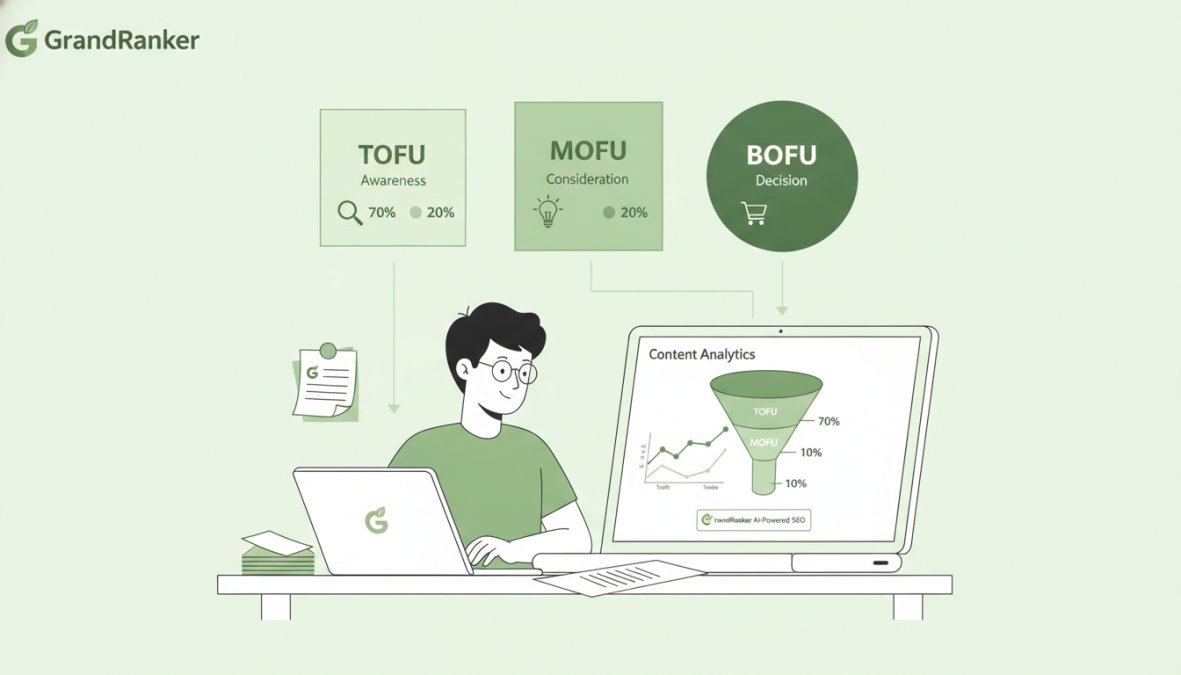
Top-of-Funnel (TOFU): Awareness and Education
At the top of the funnel, prospects don't know they have a problem yet. They're searching for general information or exploring how others solve problems.
TOFU content is educational and broad: "How to structure a remote team," "Why your email marketing isn't converting," "The complete guide to API rate limiting." Your goal is to introduce your brand to people who don't yet know you exist. This is where content marketing shines, you publish and distribute directly to your audience.
From an SEO perspective, TOFU keywords have higher search volume and competition, but are easier to rank for with the right angles.
Middle-of-Funnel (MOFU): Consideration and Evaluation
MOFU content targets prospects who've identified a problem and are evaluating solutions. They're comparing tools, reading case studies, and understanding which approach fits them.
MOFU content is comparative and specific: "SaaS content marketing vs traditional SEO for early stage startups," "Slack vs Teams," "How to choose a CRM." This is where content marketing and SEO work together powerfully. MOFU keywords have lower volume but higher intent, prospects searching "Slack alternative for small teams" are further along the buying journey.
Bottom-of-Funnel (BOFU): Conversion and Trial-to-Paid
BOFU content targets prospects deciding whether to buy your product specifically: "How to set up Slack workflows," "Zapier automation templates for e-commerce," "Getting started with GrandRanker."
BOFU content is less searchable but incredibly valuable for reducing friction and accelerating time-to-value. Early-stage SaaS often underinvests here, then wonders why trial-to-paid conversion is low.
Measuring SaaS Content Marketing ROI: Metrics That Actually Matter
Most founders measure content marketing ROI incorrectly, tracking page views and bounce rates. The right metrics are different.
Content marketing ROI is measured through engagement and lead generation. Track qualified leads from each piece, engagement metrics (time on page, scroll depth, return visits), and TOFU-to-MOFU conversion.
SEO ROI is measured through organic traffic and conversion. Track organic traffic by keyword and landing page, conversion rates, and organic CAC (total SEO cost divided by customers acquired through organic search).
Organic Traffic and Conversion Rate Optimization
Not all traffic is equal. A visitor from a highly targeted long-tail keyword converts at a much higher rate than one from a broad head term. This is why keyword selection matters, a piece ranking for 100 searches of a specific keyword might generate more conversions than one ranking for 1,000 broad searches.
Conversion rate optimization is the hidden multiplier. Improving landing page conversion from 2% to 3% increases organic ROI by 50% without increasing traffic. Many early-stage SaaS companies leave money on the table by focusing on driving more traffic instead of converting what they already have.
Customer Acquisition Cost (CAC) and Lifetime Value (LTV)
The ultimate metric is CAC relative to LTV. If your LTV is $10,000 and organic CAC is $500, you have a 20:1 ratio, excellent. Both content marketing and SEO reduce CAC over time, but differently: content marketing builds brand awareness and trust, increasing referrals; SEO captures high-intent search traffic already ready to buy.
Early Stage SaaS Marketing Budget: Allocating Resources Between Content and SEO
For pre-product-market-fit startups with less than $50K ARR, allocate 80% to content marketing and 20% to SEO. You need credibility fast.
For post-product-market-fit startups with $50K-$500K ARR, shift to 60% content marketing and 40% SEO. You're investing in the long-term channel while building your brand.
For startups with $500K+ ARR, allocate 40% content marketing and 60% SEO. You've built enough domain authority that SEO generates meaningful returns.
Resource-Constrained Execution: The Hybrid Framework
Most early-stage teams have limited resources. The hybrid framework combines content marketing and SEO into a single execution strategy: every piece of content serves multiple purposes.
Write a guide designed to rank for an SEO keyword. Distribute it through content marketing channels. Use it as a lead magnet. Repurpose it into LinkedIn posts and email sequences. One piece generates organic traffic, builds your brand, creates direct leads, and builds backlinks.
Identify the most important keywords your target customers search for. Create content that ranks for those keywords AND solves genuine problems. Distribute directly. Optimize for conversions. Measure across all channels.
When to Invest in SEO vs Content Marketing First
Invest in content marketing first if you're pre-product-market-fit and need credibility quickly, have a unique perspective competitors lack, can distribute directly to your audience, or have limited runway.
Invest in SEO first if you're post-product-market-fit with validated demand, have 12+ months of runway, competitors rank for high-intent keywords you want, and you can commit to consistent content creation.
Most early-stage SaaS should start with content marketing and layer in SEO over time. The timeline mismatch is too risky otherwise.
Why the Hybrid Approach Wins for Most Early-Stage SaaS Startups
The fastest-growing SaaS companies don't pick a side. They build a hybrid system where content marketing and SEO reinforce each other.
Identify keywords your target customers search for. Create content that ranks for those keywords. Distribute through existing channels. Measure which pieces drive the most engagement and conversions. Create more content in that vein.
Over time, you build a library serving multiple purposes. Some pieces rank well and generate organic traffic. Some don't rank but generate direct leads. Some do both. You're optimizing for sustainable growth, not a single metric.
The hybrid approach also solves the "chicken and egg" problem: you don't have domain authority yet, so SEO alone won't work. But you need authority to eventually make SEO work. Content marketing gives you the traffic and backlinks you need while waiting for SEO to kick in.
Content marketing is your short-term engine. SEO is your long-term engine. The hybrid approach runs both in parallel.
Common Pitfalls in SaaS Content Strategy and How to Avoid Them
Mistake #1: Choosing Speed Over Search Intent Alignment
The most common mistake is creating content that's fast to produce but doesn't align with what people actually want. You publish because you need content, not because you've researched what your audience searches for.
Start with keyword research and audience research. Identify keywords your target customers search for. Read top-ranking content and understand what people want. Create content that's better, more specific, or more actionable. This takes more time upfront but ensures every piece has a chance of succeeding.
Mistake #2: Ignoring Technical SEO Foundations
Many founders publish great content but neglect technical foundations: page speed, heading structure, schema markup, mobile optimization. Even good content won't rank on a broken website.
Audit your website for technical SEO issues before investing heavily in content. Use Google PageSpeed Insights, Google Search Console, and Screaming Frog to identify issues. Fix critical ones first.
Mistake #3: AI-Assisted Content Without Human Expertise
Using AI to generate 50 blog posts in a week doesn't work. AI-generated content at scale is detectable, and Google increasingly penalizes it. More importantly, it often lacks depth, specificity, and unique perspective.
Use AI as a tool to accelerate your process, not replace it. Use AI for outlines, research, and drafts. Use human expertise to refine, fact-check, and add unique insights.
Which Strategy Should Your Startup Choose?
Choose Content Marketing First If...
You're pre-product-market-fit and need credibility and leads quickly. Your timeline is tight. You have an audience you can reach directly. Your competitive advantage is your unique perspective.
Focus on creating genuinely valuable content. Distribute aggressively. Measure leads and conversions. Iterate based on what works.
Choose SEO First If...
You're post-product-market-fit with validated demand. You have 12+ months of runway. Competitors rank for high-intent keywords you want. You can commit to consistent content creation.
Focus on identifying keywords your target customers search for. Create ranking content. Build backlinks. Be patient. The payoff is sustainable, high-intent traffic.
Choose the Hybrid Approach If...
You want sustainable growth without leaving money on the table. You have 6-12 months of runway. You want short-term leads while building a long-term SEO engine.
Identify important keywords. Create content that ranks AND solves genuine problems. Distribute through your channels. Measure across all metrics. Iterate.
This is what most successful early-stage SaaS companies do.
Accelerating Your Organic-Led Growth System
Building an organic-led growth system takes time. You're playing a 12-24 month game. If you can't commit to that timeline, focus on paid advertising instead.
Build the right team or tools. You need expertise in keyword research, content creation, and technical SEO. If you don't have it in-house, hire it or use tools that automate it.
Measure relentlessly. Track which content drives organic traffic, which keywords rank, your organic CAC, and conversion rates. Use this data to decide what to do more of.
Iterate. Not all content succeeds. Use data to decide what types to create more of. Double down on what works.
Winners treat organic-led growth as a system, not a one-off project. They publish consistently, measure results, iterate, commit to long-term timelines, and build tools or hire people to help them scale.
The choice between SaaS content marketing vs traditional SEO isn't binary. The fastest-growing companies combine both strategies into a hybrid system that compounds over time. Start with content marketing to build credibility and generate early traction. Layer in SEO to build a long-term, sustainable growth engine. Measure across all channels. Iterate relentlessly. If you want to accelerate this process without hiring an entire marketing team, GrandRanker automates keyword research and content optimization so you can focus on strategy and distribution. The platform identifies high-intent keywords your target customers search for, suggests content angles, and handles technical optimization, helping you build an organic-led growth system faster. Start a free trial and see how automation can compress your timeline to sustainable growth.
Frequently Asked Questions
What is the main difference between SaaS content marketing and traditional SEO for early-stage startups?
Content marketing focuses on creating educational, valuable content to build brand authority and nurture leads through the customer journey. Traditional SEO emphasizes technical optimization and link building to rank for high-volume search terms. For early-stage SaaS, content marketing often delivers faster lead generation, while SEO builds long-term domain authority and organic-led growth. Most successful startups use a hybrid approach, combining both strategies aligned to their runway and product-market fit stage.
How long does it take to see results from SaaS content marketing vs SEO?
Content marketing can show early wins in 4-8 weeks if focused on lead generation and conversion rate optimization, especially for bottom-of-funnel content. Traditional SEO typically requires 3-6 months to see meaningful organic traffic, particularly for competitive keywords. The timeline depends on search volume, keyword difficulty, and domain authority. Early-stage startups with limited runway often prioritize content marketing for faster ROI, then layer in SEO for long-term scalability once they've achieved product-market fit.
How should an early-stage SaaS startup measure content marketing ROI?
Measure SaaS content marketing ROI by tracking organic traffic to specific content, conversion rates at each funnel stage (TOFU, MOFU, BOFU), and customer acquisition cost (CAC) attributed to content. Calculate trial-to-paid conversion rates and compare CAC from content-driven leads against other channels. Use tools to track which content pieces drive the most qualified leads and revenue impact. Focus on evergreen content that compounds over time rather than campaign-style marketing with short shelf lives. Attribution modeling helps clarify which content stages drive the highest lifetime value.
What are the biggest SaaS SEO challenges for early-stage startups?
Early-stage SaaS faces domain authority challenges, new domains struggle to rank against established competitors on high-volume keywords. Limited budget restricts hiring SEO specialists or building large content teams. Startups often lack technical SEO foundations, making it harder to implement crawlability, site speed, and structured data. Search intent misalignment wastes resources on keywords that don't convert. Many startups also fail to balance long-tail keyword research with competitive analysis. Resource constraints force difficult choices: investing in technical SEO, content velocity, or link building becomes a runway question, not a strategic one.
Should early-stage SaaS startups invest in SEO or content marketing first?
The answer depends on your product-market fit stage and runway. If you have product-led growth (PLG) and strong product-market fit, invest in SEO first to capture high-intent search traffic at scale. If you're still validating your product or customer acquisition cost (CAC) is your bottleneck, start with content marketing to drive qualified leads and learn your customer journey. Most early-stage SaaS benefits from a hybrid framework: create BOFU content immediately to support sales and conversions, then layer in mid-funnel content for nurturing, and finally invest in long-tail SEO for scalability. Your startup runway and growth stage determine the sequence, not the channel.
This article was written using GrandRanker