 comparison
Outsourced vs In-House SEO: Which Fits Your Business
Table of Contents
- Outsourced vs In-House SEO: Quick Comparison
- Pros and Cons of In-House SEO
- Advantages of Outsourcing SEO to an Agency
- In-House SEO Salary Benchmarks and Recruitment Costs
- SEO Agency Pricing Models and Cost Structure
- Hiring an SEO Manager vs Agency: Control and Communication
- Scalability, Growth, and Long-Term ROI
- Hybrid SEO Models: The Middle Ground
- How to Choose: Decision Framework for Mid-Sized Businesses
- Conclusion
Last Updated: August 13, 2026
Outsourced vs In-House SEO: Quick Comparison
The choice between outsourced and in-house SEO isn't binary. For mid-sized businesses navigating competitive search landscapes, the real decision hinges on control, cost structure, and how quickly you need results. According to Gartner's 2026 digital marketing trends report, organizations are increasingly adopting hybrid approaches rather than committing entirely to one model.
Outsourced vs in-house SEO represents fundamentally different operational philosophies. In-house teams offer direct control and brand alignment but require significant recruitment, training, and ongoing salary investment. Agencies bring specialized expertise, established processes, and faster implementation, but you're dependent on their priorities and paying premium retainer fees. GrandRanker has analyzed how hundreds of mid-sized founders approach this decision, and the pattern is clear: the winning strategy often combines both.
Here's what separates each approach:
| Factor | In-House SEO | Outsourced SEO | Winner (Context-Dependent) |
|---|---|---|---|
| Setup Time | 2-4 months to hire and onboard | 2-4 weeks | Outsourced |
| Monthly Cost Range | $5,000-$12,000+ salary | $4,000-$15,000+ retainer | Depends on team size |
| Control & Communication | Direct, daily interaction | Scheduled check-ins | In-House |
| Expertise Depth | Limited to your hires | Broad across specializations | Outsourced |
| Scalability | Slow; requires new hires | Fast; add services on demand | Outsourced |
| Brand Alignment | High; embedded in culture | Variable; external perspective | In-House |
| Long-Term ROI | Better after 18+ months | Immediate but dependent on agency | In-House (long-term) |
The truth most guides miss: your choice depends less on which is "better" and more on what your business can afford to wait for, how much control you need, and whether you have the bandwidth to manage external partners.
Pros and Cons of In-House SEO
Building an in-house SEO team gives you direct control over strategy and execution. Your SEO manager becomes embedded in product decisions, content planning, and competitive analysis, they understand your brand's voice, technical constraints, and business priorities in ways external partners often don't.
The advantage compounds over time. An in-house SEO specialist who's spent 18 months learning your industry, audience, and technical infrastructure will make faster, smarter decisions than a new agency starting from scratch. They attend your product meetings, understand why certain content angles matter, and can pivot strategy without lengthy approval cycles.
But here's where in-house SEO breaks down: hiring is brutally slow and expensive. You're competing against agencies and larger companies for the same talent. A competent SEO manager with 3-5 years of experience typically commands significant salary expectations. You'll spend 8-12 weeks recruiting, interviewing, and negotiating before someone starts, and another 6-8 weeks before they're genuinely productive in your specific environment.
The hidden costs are substantial. Beyond salary, you're paying for tools (SEMrush, Ahrefs, Moz Pro each run $50-$200+ monthly), training, and time spent managing performance. You're also assuming recruitment risk: if your hire doesn't work out, you've lost 3-4 months and need to restart the process.
In-house SEO also concentrates risk. When your single SEO person takes vacation, gets sick, or leaves for another job, your organic traffic growth stalls. You have no backup, no redundancy, and no institutional knowledge beyond one person's notebook.
Common mistakes with in-house SEO:
Many mid-sized businesses hire a generalist marketer and assign SEO as a secondary responsibility. This fails because SEO demands sustained focus. It's not something you do "alongside" social media management or email campaigns, it's a specialized discipline with its own tooling, frameworks, and execution rigor.
Another mistake: hiring too junior. A coordinator-level hire is cheap but can't make strategic decisions, negotiate with developers, or manage stakeholder expectations. You end up supervising constantly rather than delegating.
Advantages of Outsourcing SEO to an Agency
Agencies bring specialized expertise you can't afford to build in-house. A mid-tier SEO agency has specialists in technical SEO, content strategy, link building, and competitive analysis. They've implemented the same strategies across dozens of companies in your industry, they know what works, what doesn't, and how to avoid common pitfalls.
Speed is the agency advantage. Where hiring takes 2-4 months, an agency starts producing work within 2-4 weeks. They have established processes, templates, and frameworks. They don't need to learn your industry from scratch, they've already worked with competitors and understand the landscape.
Agencies also provide institutional redundancy. If your primary contact leaves, you have a team behind them. If a campaign needs adjustment, you have other specialists to pull in. This matters more than most businesses realize until they're mid-campaign and their solo in-house person is unavailable.
The accountability structure is different with agencies. You're paying for results against agreed metrics. Most agency contracts include performance reporting, KPI tracking, and transparent communication. If they're not delivering, you have contractual use to escalate or exit.
But outsourced SEO has real limitations. Agencies prioritize clients based on revenue and complexity. If you're a mid-market account generating $4,000-$8,000 monthly revenue, you're not their priority when a $20,000/month enterprise client needs attention. Your project gets assigned to junior staff, and strategy decisions take weeks because they're routed through account managers.
Agency SEO also creates distance. Your SEO strategy is developed by people who don't attend your product meetings, don't understand your technical constraints, and don't live with your brand every day. They make smart recommendations based on data, but they miss the context that would make those recommendations exceptional.
There's also vendor lock-in. Agencies build their own processes, use their proprietary dashboards, and structure work around their methodology. Switching agencies means restarting relationships, re-explaining your business, and potentially losing momentum on campaigns in progress.
In-House SEO Salary Benchmarks and Recruitment Costs
Understanding in-house SEO salary benchmarks is essential for budgeting. According to U.S. Bureau of Labor Statistics occupational data, digital marketing specialists command competitive salaries that vary significantly by experience level and geography.
For a mid-sized business in a major market, expect these ranges:
Entry-Level SEO Specialist (0-2 years experience): $45,000-$60,000 annually. This person handles basic on-page optimization, keyword research, and content updates. They can't make strategic decisions independently and require significant supervision.
Mid-Level SEO Manager (3-5 years experience): $65,000-$85,000 annually. This is the sweet spot for most mid-sized businesses. They can own strategy, manage technical audits, negotiate with developers, and drive results independently. Most agencies lose their mid-level people to in-house roles because the stability and brand focus appeal to experienced professionals.
Senior SEO Manager/Director (5+ years experience): $90,000-$130,000+ annually. These people can build SEO programs from scratch, manage teams, and align SEO with broader business strategy. They're expensive but essential if you're treating SEO as a core business function.
Recruitment costs add 15-25% on top of salary. You're paying recruiter fees, posting costs, and internal time spent interviewing. If you hire through an agency recruiter, expect to pay 20% of the first-year salary as a placement fee.
Then there's onboarding overhead. Plan for 6-8 weeks before your new hire is genuinely productive. During that period, you're paying salary while they're still ramping on your tools, processes, and industry knowledge.
Tool costs for in-house teams:
An in-house SEO person needs access to professional-grade tools. Semrush costs $139.95 monthly for a standard subscription. Ahrefs starts at $29 monthly but the useful tiers run $99-$399 monthly. Moz Pro begins at $49 monthly. Most in-house teams use 2-3 of these platforms simultaneously, bringing monthly tool costs to $250-$600.
Add Google Search Console (free), Google Analytics (free), and specialized tools for rank tracking, content optimization, or link analysis, and you're looking at $300-$800 monthly in platform costs alone.
SEO Agency Pricing Models and Cost Structure
SEO agencies use several pricing models, each with different implications for mid-sized businesses.
Monthly Retainer Model (most common): You pay a fixed monthly fee for a defined scope of work. Agencies like Victorious charge retainers starting around $4,999 monthly for mid-market clients. This model provides predictability, you know exactly what you're paying each month. The downside: if the agency underestimates the work required for your industry, they have incentive to minimize effort rather than maximize results.
Retainer pricing typically scales with scope. A $4,000-$6,000 retainer might include keyword research, content optimization, and basic link building. A $8,000-$12,000 retainer adds technical audits, competitive analysis, and more aggressive link acquisition. Larger retainers ($15,000+) include dedicated account management, strategy sessions, and custom reporting.
Performance-Based Pricing: Agencies charge based on results, typically a percentage of revenue generated or a fee per ranking improvement. This sounds ideal but creates misaligned incentives. Agencies chase quick wins (easy-to-rank keywords) rather than high-value keywords that take longer. Most mid-sized businesses avoid this model because it's hard to isolate SEO's revenue contribution from other marketing channels.
Project-Based Pricing: You pay a flat fee for a specific deliverable, a technical audit, content strategy, or site redesign. This works well for one-time projects but not for ongoing SEO, which requires sustained effort.
Hybrid Models: Some agencies combine retainer + performance bonus. You pay a base retainer ($5,000-$8,000) plus a bonus if you hit agreed KPIs (e.g., 20% organic traffic growth). This aligns incentives better than pure retainer but requires clear, measurable metrics.
For mid-sized businesses, monthly retainers between $5,000-$10,000 are typical. This covers keyword research, monthly content optimization, technical audits, and basic link building. Agencies in the $4,000-$6,000 range often use junior staff and provide less strategic depth. Agencies above $10,000 typically include more hands-on strategy and account management.
The hidden costs of agency SEO: you're paying for account management overhead, not just execution. A $6,000 retainer might break down as $3,500 execution + $2,500 account management + $1,000 profit margin. You're subsidizing their sales process and client management infrastructure.
Hiring an SEO Manager vs Agency: Control and Communication
The difference between hiring an SEO manager and outsourcing to an agency fundamentally comes down to decision velocity and brand alignment.
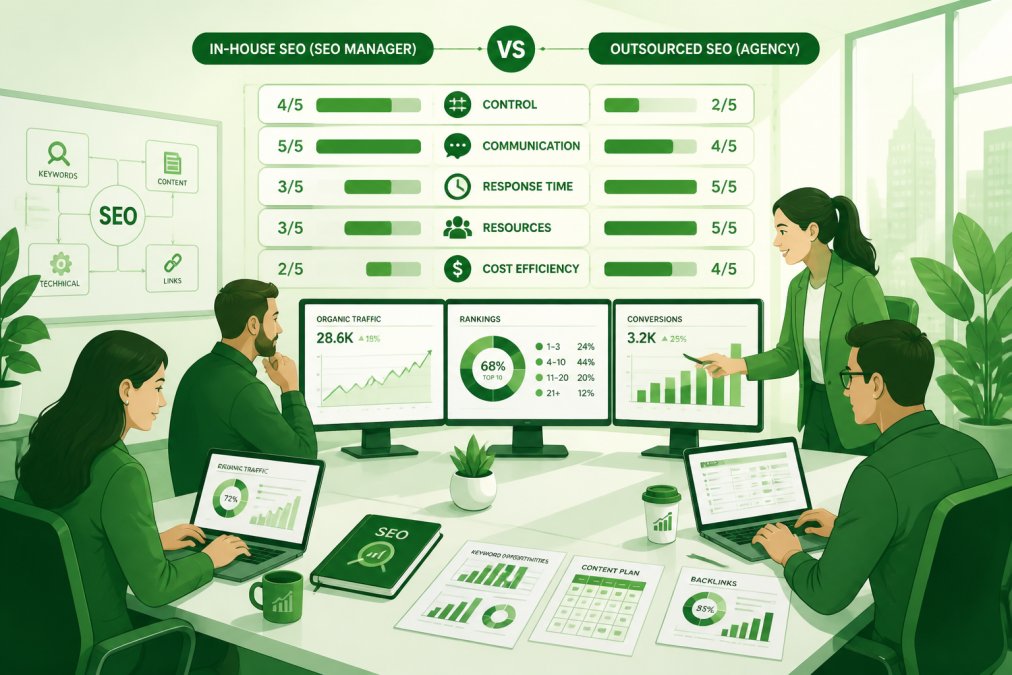
When you hire an in-house SEO manager, they're embedded in your organization. They attend product meetings, understand why certain features matter to customers, and can make strategic decisions without approval cycles. If your product team ships a new feature, your SEO manager immediately sees the opportunity and can optimize around it. If a competitor launches something relevant, they can assess the threat and adjust strategy in real time.
Communication is synchronous. You can walk over to their desk, ask a question, and get an answer in five minutes. You can push back on recommendations, debate strategy, and iterate quickly. This matters enormously in fast-moving industries where SEO opportunities have short windows.
In-house managers also develop institutional knowledge. After six months, they know your technical infrastructure, understand your audience's search behavior, and recognize patterns specific to your business. This context enables better strategic decisions.
The trade-off: you're paying for their time whether you need them or not. During slow periods, you're still paying their salary. If SEO needs spike, say you're launching a new product line, you can't quickly add capacity. You're bottlenecked by one person's bandwidth.
Agencies operate differently. Communication is asynchronous and scheduled. You have monthly check-ins, quarterly strategy sessions, and email updates. If you need to discuss strategy, you wait for your next scheduled call. This creates friction in fast-moving situations.
But agencies provide flexibility. If you suddenly need aggressive link building, they add resources. If you need technical SEO expertise for a site migration, they pull in a specialist. You're not bottlenecked by one person's skills.
Agencies also bring external perspective. Because they work across industries, they see patterns your in-house team might miss. They can benchmark your performance against competitors and identify opportunities based on broader market trends.
The communication disadvantage is real, though. Agency staff turnover means you're constantly re-explaining your business to new people. Decisions take longer because they route through account managers. If your account manager leaves, you lose continuity.
For control-focused businesses (where brand voice and strategic alignment matter deeply), in-house wins. For speed and expertise-focused businesses (where you need specialists quickly), agencies win.
Agencies work best for: companies under 50 people, those needing specialized expertise immediately, and organizations where SEO is important but not a core strategic function.
Scalability, Growth, and Long-Term ROI
The scalability question is where in-house and outsourced SEO diverge most dramatically over time.
In-house SEO scales poorly in the short term but exceptionally well long-term. When you hire your first SEO manager, they can handle one site with 50-100 target keywords. As you grow, you eventually need a second person to manage more keywords, new content verticals, or international expansion. Each new hire adds months of recruitment and onboarding time.
But here's where in-house wins: after 18-24 months, your team develops institutional knowledge and established processes. Your second hire onboards faster because the first hire has built documentation and frameworks. Your third hire even faster. You're building organizational capability that compounds.
Long-term ROI from in-house SEO is superior. A fully productive in-house team generating $100,000+ monthly in organic revenue costs $120,000-$150,000 annually (salary + tools + overhead). That's a 67-83% ROI, and it improves every year as the team gets more efficient.
Agencies scale quickly but with diminishing returns. You can add services immediately, more aggressive link building, international SEO, technical audits, without waiting for recruitment. But agency ROI plateaus. A $10,000 monthly retainer that generates $50,000 monthly revenue is a 5x return, but that return doesn't improve year-over-year. You're paying the same retainer for the same service.
Worse: agency pricing often increases annually. What costs $10,000 today might cost $12,000 next year. Your ROI shrinks even if results stay constant.
For mid-sized businesses, the inflection point typically occurs around 18-24 months. Before that, outsourced SEO delivers faster results and better ROI. After that, in-house becomes more cost-effective and strategically advantageous.
The scalability question also depends on your business model. If you're a SaaS company with multiple product lines, in-house scales better, one team can manage SEO across products. If you're a services business with one core offering, agency SEO might be sufficient forever.
Hybrid SEO Models: The Middle Ground
The real opportunity most businesses miss: you don't have to choose between in-house and outsourced. The winning strategy for mid-sized businesses is often a hybrid model.
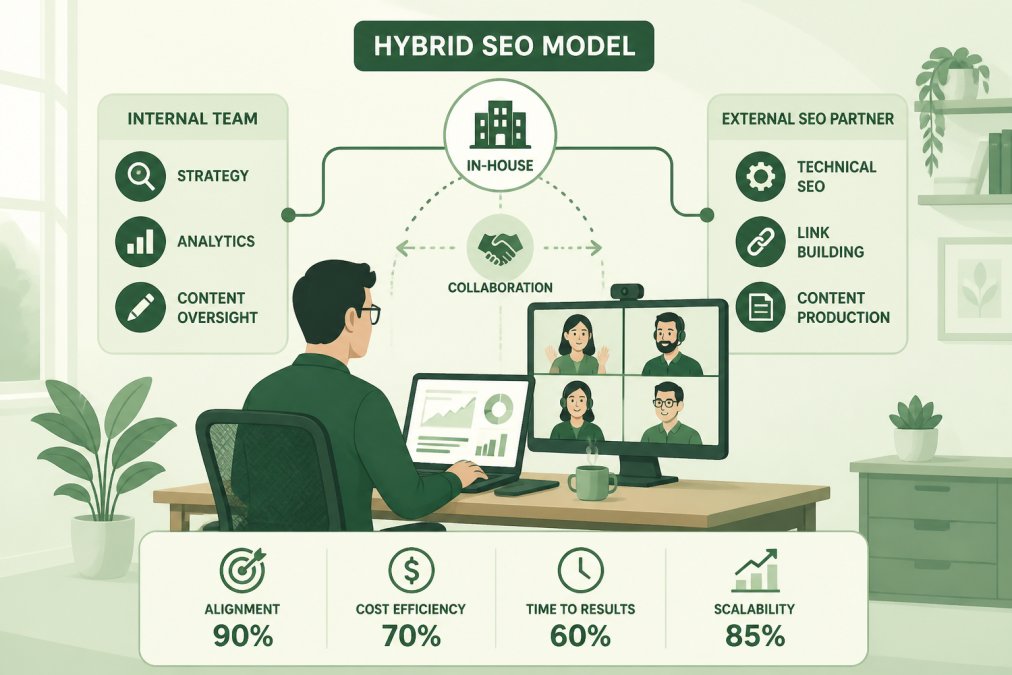
Here's how hybrid works: you hire an in-house SEO manager (or coordinator) to own strategy, oversee execution, and manage agency relationships. Simultaneously, you outsource specialized work to agencies or freelancers, link building, content creation, technical audits, or competitive analysis.
The in-house person becomes your SEO director, not your executor. They spend 30% of time on strategic planning, 30% on agency management and quality control, and 40% on high-impact work only they can do (product strategy alignment, executive communication, competitive intelligence).
This model costs roughly $70,000-$90,000 annually (salary for a coordinator-level manager) plus $4,000-$6,000 monthly for agency services. Total: $120,000-$150,000 annually. But you get:
- Direct control through your in-house manager
- Specialized expertise from the agency
- Scalability (you can add agency services without hiring)
- Redundancy (if your manager is unavailable, the agency continues work)
- Faster decision-making than pure agency
- Better brand alignment than pure in-house
The hybrid model also reduces recruitment risk. You're hiring a coordinator or manager-level person, not a senior specialist. The job is easier to fill, and the person has less pressure to know everything about SEO. Your agency partner fills expertise gaps.
For mid-sized businesses in competitive markets, hybrid is increasingly the standard. You get the benefits of both without the downsides of either.
How to Choose: Decision Framework for Mid-Sized Businesses
The decision between outsourced vs in-house SEO depends on five factors. Score yourself on each, and the pattern will clarify which model fits.
1. Timeline to Results (Weight: 20%)
Do you need organic traffic growth in the next 90 days, or can you wait 6+ months?
- Need fast results (under 90 days): Outsourced wins. Agencies start immediately; hiring takes 2-4 months.
- Can wait 6+ months: In-house becomes viable. You have time for recruitment and onboarding.
2. Budget Predictability (Weight: 20%)
Can you commit to fixed monthly costs, or do you need flexibility?
- Fixed budget preferred: In-house wins. Salary is predictable; retainers often increase annually.
- Need flexibility: Outsourced wins. You can scale agency services up or down monthly.
3. Strategic Complexity (Weight: 20%)
Does SEO strategy directly impact product decisions and business strategy?
- High strategic importance: In-house wins. You need someone embedded in your organization.
- SEO is important but not core strategy: Outsourced is sufficient. An agency can handle execution.
4. Team Size & Capacity (Weight: 20%)
Do you have bandwidth to hire, manage, and develop an SEO person?
- 50+ employees with HR infrastructure: In-house is feasible. You have systems for recruitment and management.
- Under 50 employees: Outsourced is easier. You don't have HR overhead for a specialized hire.
5. Long-Term Vision (Weight: 20%)
Are you building a permanent organic traffic engine, or testing SEO as a channel?
- Building long-term capability: In-house wins. The investment pays off after 18-24 months.
- Testing or temporary need: Outsourced wins. Lower commitment, faster exit if it doesn't work.
Scoring:
For each factor, assign points:
- Strongly favors in-house: 3 points
- Neutral/mixed: 2 points
- Strongly favors outsourced: 1 point
Total 13-15 points: In-house SEO is your best fit. Hire a manager and build internal capability.
Total 10-12 points: Hybrid is optimal. Hire a coordinator and partner with an agency.
Total 5-9 points: Outsourced is your best fit. Work with an agency and avoid in-house overhead.
This framework accounts for the reality that no single factor determines the right choice. Your timeline, budget, and strategic needs all matter.
| Decision Factor | In-House Advantage | Outsourced Advantage | Your Score |
|---|---|---|---|
| Timeline to Results | 6+ month horizon | 90-day horizon | , |
| Budget Predictability | Fixed salary preferred | Flexible scaling needed | , |
| Strategic Complexity | SEO is core strategy | SEO is important but not core | , |
| Team Capacity | 50+ employees | Under 50 employees | , |
| Long-Term Vision | Building permanent capability | Testing or temporary need | , |
The choice between outsourced vs in-house SEO isn't about which is objectively better, it's about which aligns with your business stage, budget constraints, and strategic priorities. Most mid-sized businesses find that a hybrid approach, combining in-house strategic direction with outsourced specialized execution, delivers the best balance of control, expertise, and cost-effectiveness.
If you're building organic traffic as a core growth channel, GrandRanker's AI-powered platform can complement either approach. Whether you're managing an in-house team or working with an agency, GrandRanker automates keyword research, content creation, and optimization, freeing your team to focus on strategy and execution rather than repetitive tasks. Start with a free trial to see how automation can accelerate your SEO results regardless of your organizational model.
Frequently Asked Questions
What are the primary cost differences between in-house and outsourced SEO?
In-house SEO requires salary, benefits, and overhead costs for full-time staff, typically ranging from $50,000 to $120,000+ annually for a dedicated manager or specialist. Outsourced agencies operate on retainer models, where you pay for services without employment overhead. The trade-off: in-house scales with your team size; agencies scale with their retainer tiers. Both models have hidden costs, in-house includes training and tools; agencies may charge extra for rush work or specialized services. Your budget structure determines which makes financial sense.
How do you determine if your business is ready for an in-house SEO team?
Your business is ready for in-house SEO when organic traffic generates measurable revenue, you have consistent content demand, and your marketing budget supports a full-time salary plus tools. Mid-sized businesses with 50+ employees and $5M+ revenue typically justify dedicated SEO staff. Consider in-house if you need deep brand alignment, control over strategy execution, or plan to scale aggressively. If your SEO needs are intermittent, your team lacks technical expertise, or you're still proving organic traffic ROI, outsourcing or a hybrid model works better. Assess your KPI tracking capability and reporting transparency requirements, in-house teams provide direct accountability.
What are the main risks of outsourcing SEO services?
Outsourcing SEO introduces risks around brand misalignment, delayed communication, and reduced control over strategy decisions. Agencies juggle multiple clients, which can dilute focus on your competitive landscape. Reporting transparency varies, some agencies provide surface-level metrics without explaining how they drive conversions. Turnover at the agency level means your account team may change, disrupting continuity. The biggest risk: poor SEO execution can damage domain authority or trigger search penalties. Mitigate by selecting agencies with proven track records, clear contracts defining KPI targets, and regular reporting on organic traffic and conversion rate improvements.
Does an in-house SEO specialist provide better brand alignment than an agency?
Yes, in-house SEO specialists typically deliver stronger brand alignment because they're embedded in your company culture, understand your product deeply, and align strategy with broader business goals. They participate in product launches, sales conversations, and content planning directly, creating cohesive messaging across channels. Agencies, managing multiple clients, may struggle to grasp niche industry terminology or compliance requirements unique to your business. However, in-house teams can develop tunnel vision and miss competitive landscape shifts that external agencies catch. The solution: pair in-house expertise with periodic agency audits or use a hybrid model where your internal team owns strategy while agencies provide specialized technical SEO or link building support.
Can a hybrid SEO model work for mid-sized businesses, and how do you structure it?
A hybrid model works exceptionally well for mid-sized businesses. Structure it by keeping content strategy, keyword planning, and brand alignment in-house while outsourcing technical SEO audits, link building, and specialized tools management to agencies. This approach reduces overhead, you don't need a full team, while maintaining control over messaging and long-term strategic execution. Many mid-market companies hire one internal SEO manager (supporting your content and marketing teams) and retain an agency for quarterly audits, competitive analysis, and domain authority growth initiatives. This balances cost efficiency, resource allocation, and reporting transparency while mitigating the risks of pure outsourcing or pure in-house models.
This article was written using GrandRanker