 comparison
Local SEO vs Organic SEO for Small Business
Table of Contents
- Local SEO vs Organic SEO: Core Differences
- Local SEO Ranking Factors for Small Business
- Organic SEO Ranking Factors: Domain Authority and Beyond
- Local vs Organic SEO: Side-by-Side Comparison
- Do You Need Both? Budget Allocation and Integration Workflow
- SEO Tools for Small Business Owners: Local and Organic
- How to Measure SEO ROI for Small Business
- AI Search Impact: What's Changing for Local and Organic SEO
- Which Strategy Should You Start With?
- Conclusion
Last Updated: August 7, 2026

Local SEO vs Organic SEO: Core Differences
When small business owners ask about local SEO vs organic SEO, they're usually asking the wrong question. It's not "which one should I pick", it's "how do these work together to drive traffic and customers?" Understanding the distinction between local SEO vs organic SEO is essential because they operate on different ranking factors, serve different search intents, and require different optimization strategies.
Local SEO targets customers searching for services or products near them. When someone searches "plumber near me" or "coffee shops in Ljubljana," Google prioritizes results based on geographic proximity, Google Business Profile optimization, and local citations. Organic SEO, by contrast, targets broader search queries without geographic intent. A search for "best plumbing techniques" or "how to brew espresso" pulls results from across the web, ranked primarily by domain authority, content quality, and backlinks.
The critical difference: local SEO is location-dependent; organic SEO is location-agnostic. A small business in Ljubljana competing for local search visibility faces different competitors and ranking challenges than one competing nationally for organic traffic. This distinction shapes everything from keyword strategy to content creation to measurement.
Geographic Targeting and Search Intent
Geographic targeting is the spine of local search. When someone searches with location intent, using terms like "near me," "in [city]," or "[service] + [location]", Google understands they want results physically close to them. This is where local SEO dominates. The search algorithm weighs proximity heavily, pulling businesses from Google Business Profile listings, local citations, and location-specific reviews.
Organic search, meanwhile, ignores geography entirely. A query like "email marketing automation" could return results from anywhere in the world. The ranking factors that matter, domain authority, backlink profile, on-page SEO optimization, are global metrics. A startup in Ljubljana competes against established companies in New York, London, and San Francisco on the same playing field.
This distinction matters because it changes your competitive landscape. Local search is often less saturated. A small business can rank first in Ljubljana's local pack without the domain authority required to rank nationally. But if you want national or international reach, local SEO alone won't get you there.
How Google Business Profile Shapes Local Results
Your Google Business Profile is the anchor of local search visibility. It's the business card Google shows searchers when they look for your service or product nearby. Completeness matters, a fully optimized profile with photos, posts, hours, and service areas ranks higher than an incomplete one. But here's what most guides miss: Google Business Profile optimization is not optional for local SEO. It's foundational.
When someone searches for a service in Ljubljana, Google often displays a "local pack", three business listings with maps. These come directly from Google Business Profile data. If your profile is incomplete, outdated, or inconsistent with your citations across the web, you won't appear in that pack. Organic SEO has no equivalent. There's no "organic pack" on Google's search results page.
This is why local SEO and organic SEO require different tools and workflows. A tool built for organic growth, keyword research, backlink analysis, content optimization, doesn't help you manage your Google Business Profile. You need dedicated local SEO tools to audit your profile, monitor reviews, and track local rankings.
Local SEO Ranking Factors for Small Business
Local search ranking factors cluster into three categories: relevance, distance, and prominence. Relevance measures how well your business matches the search query. Distance measures how close you are to the searcher. Prominence measures your online reputation and authority within your local area.
Understanding these factors is the foundation of local SEO strategy. Unlike organic SEO, which relies heavily on domain authority and backlinks, local SEO depends on consistency, reviews, and local citations. A brand-new business with zero backlinks can rank first in its local area if it has a complete Google Business Profile, consistent NAP data, and strong customer reviews.
NAP Consistency and Citation Building
NAP stands for Name, Address, Phone, the three core pieces of business information that Google uses to verify your business identity. Consistency across the web is critical. If your business name is listed as "Smith Plumbing" on Google, "Smith Plumbing LLC" on Yelp, and "Smith's Plumbing Services" on a directory, Google gets confused. It may treat these as separate businesses, fragmenting your local search visibility.
Citation building, getting your business listed on directories, review sites, and local business databases, signals to Google that your business is real, established, and trustworthy. A citation is simply a mention of your NAP data online. The more consistent citations you have across reputable directories, the stronger your local authority becomes.
This is where local SEO differs fundamentally from organic SEO. Organic ranking relies on backlinks from relevant, high-authority websites. Local ranking relies on citations from local directories and review platforms. A backlink from a major publication helps organic rankings; a citation on a local business directory helps local rankings. Both are "votes" for your authority, but they work in different ecosystems.
Reviews, Schema Markup, and Local Pack Visibility
Customer reviews are a ranking factor in local search. Google's algorithm considers review count, review recency, and review rating when determining local pack placement. A business with 50 recent five-star reviews ranks higher than one with 10 reviews from six months ago. This creates a compounding advantage: more reviews lead to higher rankings, which lead to more visibility, which lead to more reviews.
Schema markup, structured data that tells Google what type of business you are, helps local search visibility. When you add schema markup to your website, you're giving Google explicit information about your business hours, address, phone number, and service areas. This helps Google match your website to local search queries more accurately.
Here's where it gets interesting: organic SEO uses schema markup too, but for different purposes. Organic schema markup helps your website appear in featured snippets, knowledge panels, and other rich results. Local schema markup helps your website appear in local pack results and map results. Same tool, different application.
Organic SEO Ranking Factors: Domain Authority and Beyond
Organic SEO ranking is dominated by three factors: relevance, authority, and user experience. Relevance means your content matches the search query. Authority means your website is trusted and established. User experience means your site loads fast, works on mobile, and keeps visitors engaged.
Domain authority, a metric that measures how much "trust" Google assigns to your entire domain, is the single biggest differentiator in organic search. A website with high domain authority ranks higher than a newer site with better content, all else equal. This is why established brands dominate organic search. They've accumulated domain authority through years of backlinks, brand mentions, and user trust.
For small businesses, building domain authority is a long-term investment. You can't shortcut it. You have to earn backlinks, create content that gets shared and cited, and build your brand reputation over time. This is why many small businesses focus on local SEO first, it offers faster wins, and layer in organic SEO as they grow.
Backlink Profile, On-Page SEO, and Content Relevance
Your backlink profile is the collection of links pointing to your website from other sites. Google treats backlinks as votes of confidence. A link from a high-authority website is worth more than a link from a low-authority site. A link from a relevant website is worth more than a link from an irrelevant one.
Building a strong backlink profile requires strategy. You can't just ask for links, that violates Google's guidelines. Instead, you create content worth linking to, build relationships with journalists and bloggers, and earn mentions from reputable sources. This takes time and skill.
On-page SEO, optimizing your website's content, structure, and metadata, is table stakes for organic ranking. You need to optimize your title tags, meta descriptions, headers, and content for your target keywords. You need fast page load times, mobile optimization, and clear site structure. But on-page optimization alone won't get you to the top of Google. You also need authority (backlinks) and relevance (content quality).
Content relevance is about answering the searcher's question better than your competitors. If you're targeting "email marketing best practices," your content needs to be more comprehensive, more recent, and more useful than existing content ranking for that keyword. This often means longer content, more examples, better formatting, and original research or insights.
Local vs Organic SEO: Side-by-Side Comparison
| Factor | Local SEO | Organic SEO |
|---|---|---|
| Primary Ranking Signal | Google Business Profile, NAP consistency, local citations | Domain authority, backlinks, content quality |
| Geographic Relevance | Critical, proximity to searcher is weighted heavily | Irrelevant, global competition |
| Time to First Results | 2-4 weeks for local pack visibility | 3-6 months for top 10 rankings |
| Citation Building | Essential, directories and review sites | Not applicable |
| Review Impact | High, review count and rating affect rankings | Low, reviews don't affect organic rankings |
| Content Requirements | Minimal, business info, service descriptions | Extensive, long-form content, original research |
| Backlink Importance | Low, local citations matter more | Critical, primary ranking factor |
| Best For | Service businesses with physical locations | Content creators, SaaS, e-commerce, national brands |
The comparison table shows the operational differences, but here's the strategic insight: local SEO is faster to implement and shows results sooner, while organic SEO is slower but builds compounding authority over time. A plumbing business in Ljubljana can rank first in local search within weeks. Ranking first nationally for "plumbing" takes years.
Do You Need Both? Budget Allocation and Integration Workflow
Most small businesses should start with local SEO if they serve a geographic area. It's faster, cheaper, and has immediate ROI. But as you grow, organic SEO becomes increasingly valuable. The question isn't "local or organic", it's "how much of my budget goes to each, and how do I integrate them?"

When Local SEO Alone Isn't Enough
Local SEO is sufficient if your business serves a specific geographic area and has limited growth ambitions. A dental practice in Ljubljana that wants to attract patients within 5 miles doesn't need organic SEO. Local optimization will capture all relevant searches.
But local SEO alone falls short in several scenarios. If you're a SaaS company selling software to customers nationwide, local SEO is irrelevant. If you're a content creator or publisher, local SEO won't help you reach your audience. If you're an e-commerce business selling nationally, you need organic search visibility for product keywords. If you want to build a brand and establish authority in your industry, organic SEO is essential.
Many small businesses also underestimate their growth potential. A local service business that starts in Ljubljana might expand to other cities. At that point, local SEO strategies don't scale, you'd need separate optimization for each city. Organic SEO, by contrast, scales nationally. Building domain authority and ranking for broad keywords serves you regardless of location.
How to Integrate Local and Organic Strategies
Integration means using the same content, tools, and processes to support both local and organic goals. Here's the workflow:
Start with keyword research that covers both local and organic opportunities. Use tools that show local search volume alongside national search volume. Identify keywords with local intent ("plumber in Ljubljana") and keywords with broad intent ("plumbing best practices"). Create content that addresses both.
Your website structure should support both strategies. Your homepage and service pages should be optimized for local keywords and include your Google Business Profile schema markup. Your blog should target broader, organic keywords that establish authority. Your location pages (if you have multiple locations) should be optimized for local keywords in each city.
Google Business Profile and your website should be integrated. Your Google Business Profile should link to your website. Your website should link to and embed your Google Business Profile information. They should have consistent NAP data and consistent messaging.
Use the same analytics and measurement system for both. Track local pack rankings and organic rankings in the same dashboard. Attribute traffic and conversions to both channels. This helps you understand which strategy is driving business results.
The integration point that matters most: content. A single piece of content can serve both local and organic purposes. A blog post about "plumbing emergencies and what to do" can be optimized for the organic keyword "plumbing emergency guide" while also including local keywords like "emergency plumber in Ljubljana" and your service area information. This approach maximizes content ROI.
SEO Tools for Small Business Owners: Local and Organic
Small business owners often ask whether they need separate tools for local and organic SEO. The answer depends on your strategy and budget. Dedicated local SEO tools are purpose-built for local optimization but don't help with organic growth. Comprehensive SEO platforms cover both but may be overkill if you only need local visibility.
Tools Built for Local SEO
BrightLocal is a dedicated local SEO platform starting at $39 per month. It specializes in local ranking reports, citation audits, Google Business Profile optimization, and review monitoring. If your primary goal is local visibility, BrightLocal is purpose-built for that. It tracks your rankings in local pack results, identifies citation inconsistencies, and helps you manage reviews across platforms.
Moz Local starts at $16 per month (billed annually) and focuses on listing distribution and citation management. It distributes your business information to over 90 directories, ensuring NAP consistency across the web. It also monitors reviews and tracks local rankings. Moz Local is excellent for small businesses that want to establish a foundational local presence without complex features.
Semrush Local SEO Toolkit integrates local features into Semrush's broader platform. At $30 per month per location, it includes Google Business Profile automation, AI-powered post generation, and review management. If you're already using Semrush for organic SEO, adding local features is seamless. If you only need local SEO, it's expensive compared to dedicated tools.
Tools for Organic Growth and Domain Authority
Ahrefs is a comprehensive SEO platform starting at $29 per month. It's built for organic SEO, not local. Ahrefs excels at backlink analysis, keyword research, site audits, and rank tracking. If you're building organic authority, Ahrefs is one of the best tools available. It includes a free tier (Ahrefs Webmaster Tools) for site owners.
GrandRanker is an AI-powered SEO platform designed to automate both keyword research and content creation. It's built for founders and marketing teams that want to grow organic traffic without hiring a content team. GrandRanker handles keyword research, content creation, optimization, and publishing, automating the time-consuming parts of organic SEO. It also helps you get cited by AI assistants, which is increasingly important for visibility in AI-powered search. GrandRanker offers a free trial, making it accessible for small businesses testing the platform.
The key difference: GrandRanker focuses on organic growth and content automation, while tools like Ahrefs focus on research and analysis. GrandRanker is best if you need to create content at scale. Ahrefs is best if you're doing deep competitive analysis.
How to Measure SEO ROI for Small Business
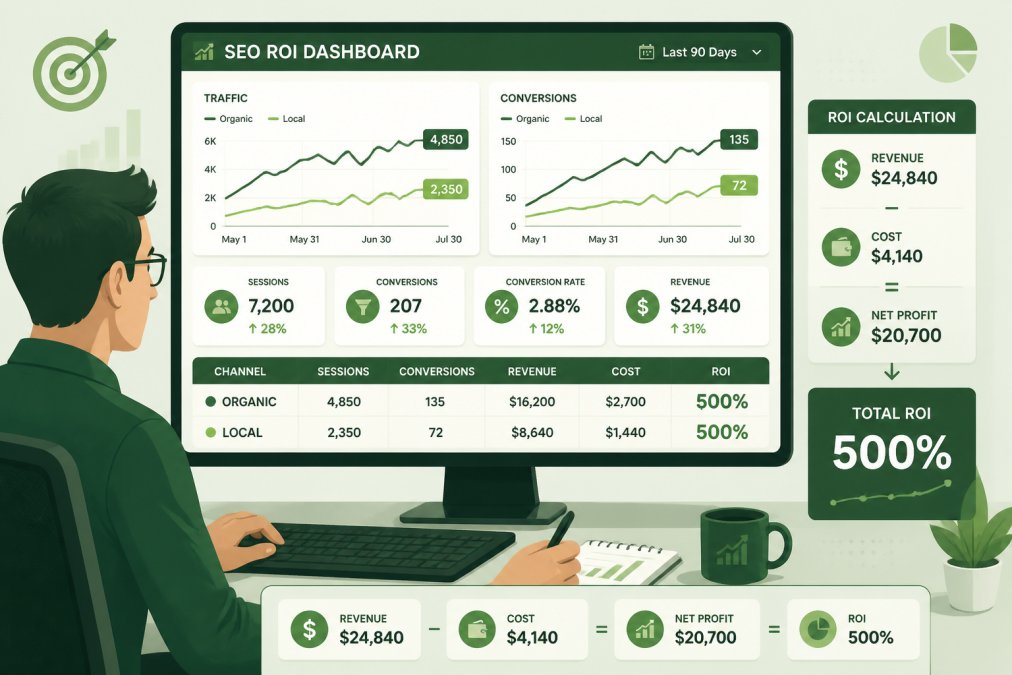
SEO ROI is notoriously difficult to measure because the journey from click to customer is long and indirect. Someone might click your website from organic search, leave, return three weeks later from a social media ad, and convert. Which channel gets credit? This complexity is why many small businesses struggle to prove SEO value.
Tracking Local Search Visibility and Conversion Rate
For local SEO, measurement is more straightforward. Track your local pack rankings for your target keywords. Use a local SEO tool to monitor how many times your business appears in local pack results. Track the conversion rate from local search, how many people who click your business in the local pack actually call, visit, or buy.
Local search attribution is clearer than organic because the intent is immediate. Someone searching "plumber in Ljubljana" is ready to hire a plumber. The time from click to conversion is typically short. You can directly tie local search clicks to business results.
Set up Google Business Profile insights to track how many people found your business through local search, how many called, how many visited your location, and how many requested directions. These metrics directly measure local SEO impact.
Organic Traffic Metrics and Long-Term Domain Authority Growth
Organic SEO ROI is measured differently. Track organic traffic to your website using Google Analytics. Segment traffic by keyword to see which keywords drive the most visits. Track conversion rate from organic traffic, how many organic visitors become customers.
But here's the key: organic SEO is a long-term investment. You won't see significant ROI in the first three months. You'll see it in months 6-12 as your content accumulates backlinks, your domain authority grows, and more keywords rank. This is why patience is essential for organic SEO.
Track domain authority growth over time. Use a tool like Ahrefs or Moz to monitor your domain's authority score. As it grows, you should see more keywords ranking and more organic traffic flowing. This is a lagging indicator, it shows you that your organic strategy is working, even if revenue hasn't increased yet.
The real measure of organic SEO ROI is lifetime value. A customer acquired through organic search today might generate revenue for years. That long-term value justifies the upfront investment in content creation and link building.
AI Search Impact: What's Changing for Local and Organic SEO
AI-powered search is reshaping both local and organic SEO. Tools like ChatGPT and Claude are changing how people search and what kind of visibility matters. For local SEO, AI impact is minimal so far. People still search "plumber near me" on Google Maps. But for organic SEO, AI search is a major shift.
When someone asks ChatGPT a question, the AI doesn't show Google search results. It generates an answer from its training data and cites sources. This means your website needs to be cited by AI assistants to drive traffic from AI search. Getting cited requires different optimization than ranking in Google. Your content needs to be authoritative, well-structured, and citation-worthy.
GrandRanker addresses this by optimizing content not just for Google ranking but also for AI citation. The platform ensures your content is structured in ways that AI systems recognize as authoritative and citable. This is increasingly important as AI search grows.
For local search, AI impact is more subtle. Google's AI features are being integrated into local search results. Google's AI Overview (a feature that summarizes search results with AI) is starting to appear for some local queries. This could change how local search visibility translates to traffic. Monitoring these changes and adapting your local SEO strategy accordingly will be important.
Which Strategy Should You Start With?
If you serve a geographic area and want immediate results, start with local SEO. You'll see rankings and traffic within weeks. Local SEO is also cheaper and requires less content creation than organic SEO.
If you want to build a national brand, establish industry authority, or create a content business, start with organic SEO. It takes longer but builds compounding authority that serves you for years.
Most small businesses should do both, but sequentially. Start with local SEO to establish a foundation and drive immediate revenue. Then layer in organic SEO as you grow. Use the same tools and processes where possible to maximize efficiency.
The timeline matters. If you need revenue in the next 60 days, local SEO is your answer. If you can wait 6-12 months for results, organic SEO offers better long-term ROI. If you can do both, allocate 60% of budget to local SEO for immediate results and 40% to organic SEO for long-term growth, you'll build a sustainable, diversified traffic engine.
Local SEO and organic SEO serve different purposes, but they're not mutually exclusive. Small businesses that understand the distinction, and integrate both strategies, build resilient traffic sources that compound over time. Start where your customers are searching. For most small businesses, that's local search. But as you grow, organic visibility becomes increasingly valuable.
GrandRanker helps small businesses automate the content creation and optimization that organic SEO requires. By handling keyword research, content creation, and optimization, GrandRanker lets you focus on your business while your domain authority grows. Start a free trial to see how AI-powered content creation can accelerate your organic growth.
Frequently Asked Questions
What is the difference between organic SEO and local SEO?
Organic SEO targets broad, national search intent and ranks your website across Google's main search results. Local SEO optimizes your presence for location-specific searches, with results appearing in Google Maps, the local pack, and location-based SERP features. Organic SEO builds domain authority through backlinks and content; local SEO relies on Google Business Profile optimization, NAP consistency, and citations. Small businesses serving customers in specific geographic areas need local SEO; those selling nationally or building brand authority need organic SEO.
Does my small business need both local and organic SEO?
It depends on your business model and target audience. If you have a physical location or serve a specific geographic area (plumbers, dentists, restaurants), local SEO is essential. If you sell products or services online to a national audience, organic SEO should be your priority. Many small businesses benefit from both: local SEO drives immediate, high-intent foot traffic and local conversions, while organic SEO builds long-term domain authority and attracts customers beyond your immediate area. A hybrid approach maximizes visibility across search intent variations.
What are the key ranking factors for local SEO vs. organic SEO?
Local SEO ranking factors include Google Business Profile completeness and accuracy, NAP consistency across citations, customer reviews and ratings, schema markup, and local backlinks. Organic SEO ranking factors include domain authority, backlink quality and volume, on-page SEO (keyword optimization, content relevance, user experience), technical SEO, and E-E-A-T signals. Both share common factors like user experience and mobile optimization. Local SEO prioritizes geographic proximity and business information; organic SEO prioritizes content authority and topical relevance across a broader audience.
How long does it take to see results from local vs. organic SEO?
Local SEO typically shows results faster, often within 3-6 months of optimizing your Google Business Profile, building citations, and gathering reviews. Organic SEO is a longer-term investment, usually requiring 6-12 months or more to build sufficient domain authority and backlink profile for competitive keywords. Factors affecting timeline include competition level, current domain authority, keyword difficulty, and how consistently you execute your strategy. Local SEO delivers quicker wins for location-based businesses, while organic SEO compounds over time as your domain authority grows.
Can I use the same keywords for local and organic SEO?
Partially. You can use base keywords for both strategies, but they should be optimized differently. For local SEO, add geographic modifiers (e.g., 'plumber near me' or 'SEO services in Denver'). For organic SEO, use broader, long-tail variations that appeal to national audiences. Local SEO targets high-intent, location-specific search volume, while organic SEO targets broader search volume and builds topical authority. Your content strategy should reflect these differences: local content focuses on location pages and Google Business Profile posts; organic content focuses on pillar pages, blog posts, and comprehensive guides that establish domain authority.
This article was written using GrandRanker