 ultimate-guide
Keyword Research Cost for Small Business: 2026 Guide
Table of Contents
- How Much Does Keyword Research Cost for Small Business?
- Free vs Paid Keyword Research Tools: What Small Businesses Actually Get
- SEO Keyword Research Services Pricing: A Tier-by-Tier Breakdown
- What You Are Actually Paying For: The Value Breakdown
- How to Do Keyword Research for Small Business on Any Budget
- ROI-Based Budgeting: How Much Should Your Small Business Spend?
- Best Keyword Research Tools for Small Business: Compared by Price and Value
- How to Choose the Right Keyword Research Option for Your Budget
- Conclusion
Last Updated: May 15, 2026
Finding the right customers online starts with knowing what they search for, but for many entrepreneurs, the keyword research cost for small business remains a frustratingly opaque number. This guide from GrandRanker cuts through the noise. We'll provide a clear framework for understanding not just what you might pay, but what you should pay based on your goals and resources. The reality is that effective search engine optimization doesn't have a single price tag; it's a strategic investment that can range from the cost of your time to significant monthly retainers.
The most important insight is this: the cost is a direct trade-off between your time, your money, and your expertise. You can spend very little money by investing a lot of your own time, or you can save time by hiring an expert or subscribing to powerful software. Below, we'll show you exactly how to analyze this trade-off for your business, break down the pricing models you'll encounter, and provide a step-by-step process for getting started on any budget. Forget vague answers; you'll leave with a clear model for making a smart investment in your organic growth.
How Much Does Keyword Research Cost for Small Business?
Understanding the keyword research cost for small business requires looking at three distinct models: doing it yourself (DIY), hiring a freelancer, or partnering with an SEO agency. Each has a different cost structure and is suited for different stages of business growth. There is no single "right" price, only the right fit for your specific budget, timeline, and internal resources.
DIY Keyword Research: Time vs. Money Trade-Off
The DIY approach has the lowest direct monetary cost but the highest time commitment. Your primary expense is the subscription fee for keyword research tools, which can range from free to several hundred dollars per month. You are trading your own hours for dollars, which can be a smart move for founders in the early stages. The real cost here is the learning curve and the potential for mistakes. Ineffective keyword research can lead to months of creating content that never ranks, a significant opportunity cost.
Freelance Rates for Keyword Research
Hiring a freelance SEO specialist is a common middle ground. Costs here are typically structured either as a one-time project fee or an hourly rate. A one-time project for foundational keyword research and a content plan might range from a few hundred to a couple of thousand dollars. Hourly freelance rates vary widely based on experience, but you can expect a wide band. This option gives you access to expertise without the long-term commitment of an agency retainer. The key is to properly vet the freelancer's experience and past results.
SEO Agency Retainers and Pricing Tiers
Partnering with an SEO agency represents the highest level of investment and service. Agency retainers for comprehensive SEO, which includes keyword research as a core component, often start in the low thousands per month and can scale significantly from there. For this price, you get a dedicated team, advanced tools, in-depth competitor analysis, and ongoing strategy. This is best for established small businesses that see SEO as a primary growth channel and have the budget to support a long-term partnership.
Free vs Paid Keyword Research Tools: What Small Businesses Actually Get
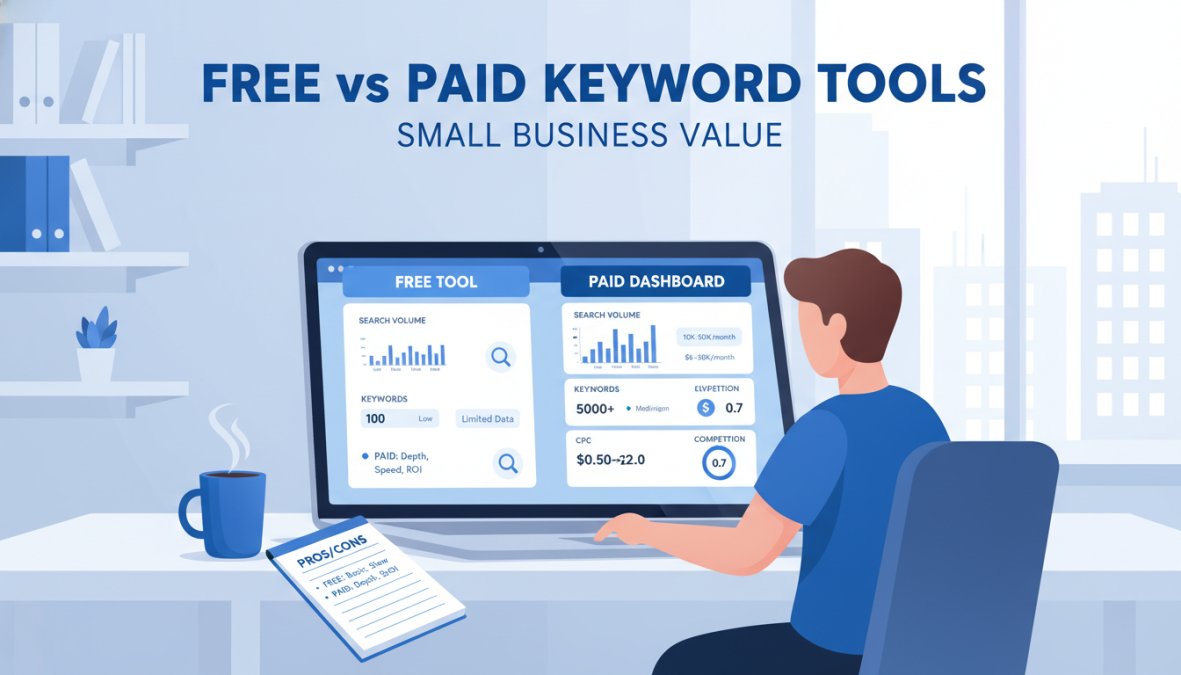
One of the first decisions a small business owner faces is whether to use free tools or invest in a paid subscription. Most guides stop at listing features. This section goes further by quantifying the real cost of each path, because 'free' is rarely free once you account for your time.
The True Cost of Free Tools: Quantifying Your Time
Free tools like Google Keyword Planner, Google Search Console, and AnswerThePublic are genuinely useful, but they require significant manual effort to produce the same output a paid tool delivers in minutes. Consider a realistic workflow comparison:
Free-tool workflow for a 30-keyword research project:
- Pull seed ideas from Google Keyword Planner: 30-45 minutes
- Cross-reference search volume ranges against Google Trends to narrow broad buckets (e.g., "1K-10K/month"): 45-60 minutes
- Manually open each target SERP to assess competition and infer keyword difficulty: 60-90 minutes
- Use AnswerThePublic or "People Also Ask" scraping to find long-tail variants: 30-45 minutes
- Compile, deduplicate, and prioritize in a spreadsheet: 45-60 minutes
Total estimated time: 3.5 to 5 hours per research cycle.
Now apply your own hourly rate. If your time is worth even a modest amount per hour as a founder or marketing manager, a single keyword research session using free tools costs more in labor than a mid-tier paid subscription. This is the hidden cost most guides never surface.
According to official documentation from Google's guide to Keyword Planner, Keyword Planner is designed primarily for Google Ads campaign planning, not organic SEO. Its volume data is deliberately bucketed into wide ranges (100-1K, 1K-10K, 10K-100K) to serve advertisers, not content strategists. This means you are making ranking decisions based on data that could be off by a factor of ten in either direction.
The Risk Cost: Wrong Keywords, Wasted Content
Beyond time, there is a second hidden cost: the cost of acting on bad data. Targeting a keyword that free tools show as "1K-10K/month" but which actually receives 200 monthly searches means you could spend 8-15 hours writing and optimizing a piece of content for a term that will never meaningfully move the needle. At a conservative content production cost, whether in your own time or a freelance writer's fee, that is a real dollar loss, not just an inconvenience.
Free tools also provide no reliable keyword difficulty score. Without this metric, small businesses routinely target keywords dominated by high-authority domains (major publishers, national brands, Wikipedia), where ranking on page one is effectively impossible without a significant backlink profile. A paid tool surfaces this reality in seconds; a free-tool workflow may never surface it at all.
When a Paid Subscription Pays for Itself
A paid tool's monthly subscription is justified the moment the time it saves plus the revenue it helps generate exceeds its cost. Here is a simple break-even test:
- Estimate your time cost per research cycle using free tools (use the 3.5-5 hour estimate above as a baseline).
- Multiply by your effective hourly rate (your salary divided by working hours, or your freelance rate).
- Compare that number to the monthly subscription cost of a paid tool.
For most small business owners, a paid tool breaks even after a single research session. The ongoing value, rank tracking, competitor monitoring, content gap analysis, compounds every month after that.
Paid tools like Semrush, Ahrefs, and GrandRanker provide precise monthly search volume (not ranges), a calibrated keyword difficulty score, SERP feature analysis, and competitor keyword gap reports. They collapse a 4-hour manual workflow into 20-30 minutes of structured analysis. For a small business, the first high-intent, low-competition keyword cluster that a paid tool surfaces, and that a free tool would have missed or misrepresented, can justify months of subscription cost through the organic traffic and leads it generates.
Practical Decision Rule
Use free tools when you are in the earliest ideation phase, brainstorming topic areas, understanding your niche vocabulary, and identifying the questions your customers ask. Switch to a paid tool (even a trial or entry-level plan) the moment you need to prioritize a keyword list and commit content production resources to it. The cost of a wrong decision at that stage almost always exceeds the cost of a monthly subscription.
SEO Keyword Research Services Pricing: A Tier-by-Tier Breakdown
Beyond tools, many businesses opt for professional services. The pricing for SEO keyword research services typically falls into a few distinct tiers, reflecting the depth of the analysis and the scope of the deliverables. It's less about buying a list of words and more about investing in a strategic roadmap for content and organic growth.
The most basic tier often involves a one-time project delivering a foundational keyword set. This is a common entry point for businesses new to SEO. The provider will identify a core list of target keywords, often categorized by search intent, and deliver them in a spreadsheet. This is a valuable asset but lacks ongoing strategic guidance.
A mid-tier service usually includes the foundational research plus competitor analysis and a content brief for several core pages or posts. This moves beyond just a list of terms and provides actionable direction on how to use them. You're not just getting the "what," you're getting the "how." This level of service is often priced as a larger one-time project or a short-term retainer.
Top-tier services, typically offered by agencies as part of a comprehensive SEO retainer, integrate keyword research into an ongoing monthly strategy. The research is never "done." It's a continuous process of identifying new opportunities, tracking ranking progress, and adjusting the strategy based on performance data and market changes. This is the most expensive option but provides the most strategic value, as the keyword strategy evolves with your business.
Hybrid Service Models: The Middle Ground Most Businesses Miss
A frequently overlooked option is the hybrid model, which combines a one-time deep-dive project with quarterly consulting calls. This gives a small business the powerful strategic foundation of a comprehensive keyword research project without the high monthly cost of a full agency retainer. You execute the strategy in-house using the provided roadmap and check in with the expert periodically to review progress and adjust course. This model offers a fantastic balance of expertise and affordability.
What You Are Actually Paying For: The Value Breakdown
To truly understand the keyword research cost for small business, you must look past the price and focus on the value delivered. Whether you're paying for a tool subscription or an agency retainer, the cost covers a bundle of critical business intelligence that forms the foundation of a successful digital marketing strategy.
First and foremost, you are paying for data and accuracy. Premium tools invest heavily in crawling the web and processing massive amounts of data to provide reliable metrics on search volume and keyword difficulty. This data is the bedrock of your decisions.
Second, you are paying for competitive insight. A key part of keyword research is SERP analysis and understanding who is already ranking for your target terms and why. This involves analyzing their content, backlinks, and overall authority. This intelligence allows you to find gaps in the market and create content that is genuinely better than the competition's.
Third, you are paying for strategic direction. The ultimate goal of keyword research is not just a list of words; it's a prioritized action plan. This includes understanding search intent (what the user actually wants when they type a query), identifying valuable long-tail keywords, and mapping those terms to different stages of the customer journey. This transforms a simple list into a content ideation engine that drives business growth. Platforms like GrandRanker automate much of this strategic work, using AI to identify opportunities and guide content creation, delivering agency-level insights without the high overhead.
How to Do Keyword Research for Small Business on Any Budget
You don't need a massive budget to start doing effective keyword research. With a smart process, you can build a strong foundation using a combination of free tools and strategic, minimal investment. The key is to focus your resources where they will have the most impact.
Step 1: Define Your Search Intent and Niche
Before you look at any tool, start with your customer. What problems do they have? What questions do they ask? Brainstorm a list of topics related to your products or services. Think about the different types of search intent: informational (e.g., "how to fix a leaky faucet"), commercial ("best plumbers near me"), and transactional ("hire a plumber online"). A clear understanding of your niche and your customer's intent is the most valuable, and free, first step.
Step 2: Use Free Tools to Build Your Initial List
With your topic list, turn to free resources to expand your keyword ideas and get initial data.
- Google Search Console: If your site has been active for a while, the Performance report shows you the queries people are already using to find you. This is a goldmine of relevant terms.
- Google Keyword Planner: Use your seed topics to generate hundreds of related keyword ideas. While the volume data is broad, it’s perfect for initial keyword ideation.
- AnswerThePublic: This tool visualizes the questions, prepositions, and comparisons people search for around your topic. It’s excellent for finding long-tail keywords and content ideas.
Step 3: Layer In Paid Data Where It Matters Most
Once you have a large list of potential keywords from free tools, it's time to prioritize. This is where a small, strategic investment pays off. Instead of a large monthly subscription, consider a tool with a low-cost entry plan or a free trial to get more precise data. Use the paid tool to analyze your top 20-30 keywords. Look for two key metrics: accurate monthly search volume and a reliable keyword difficulty score. This allows you to focus your content creation efforts on the keywords that offer the best balance of traffic potential and a realistic chance to rank.
ROI-Based Budgeting: How Much Should Your Small Business Spend?
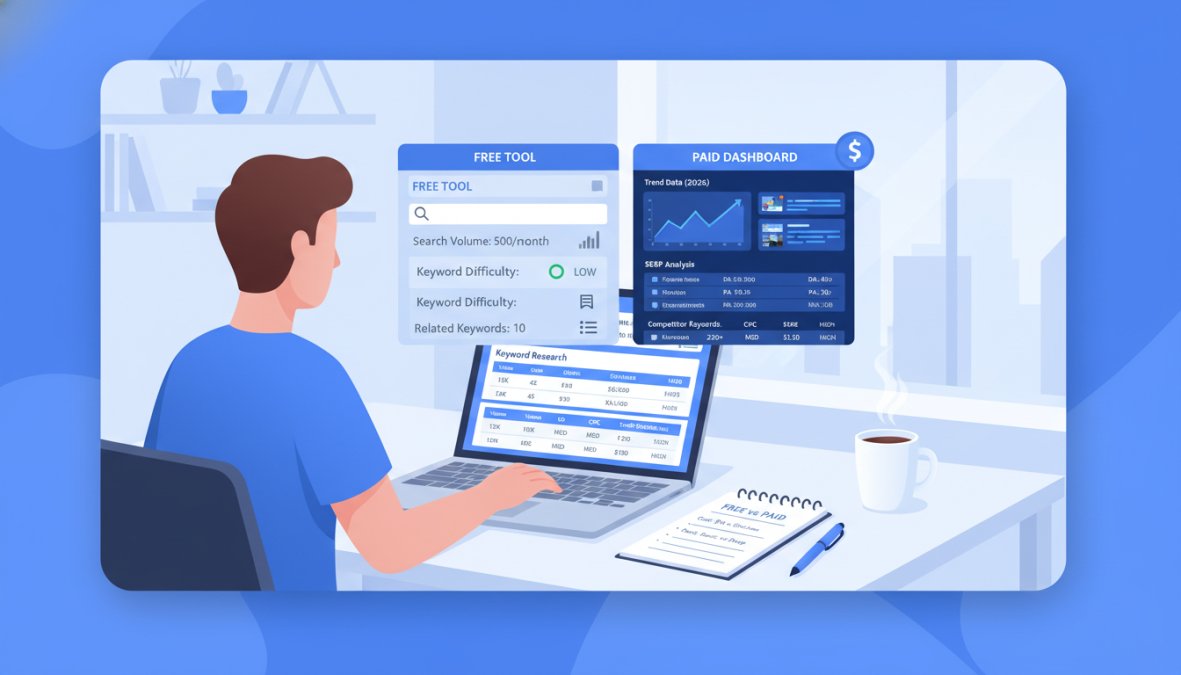
The most effective way to budget for keyword research is to stop thinking of it as a cost and start treating it as an investment with a calculable return. The question is not "how much does it cost?" but "how much revenue can this investment generate, and how long until it pays back?" This section gives you a working framework to answer both questions with your own numbers, something no other guide on this topic currently provides.
The Keyword Research ROI Calculation: A Step-by-Step Framework
To size your budget rationally, you need four numbers. All of them are knowable for your business:
Step 1: Establish your Customer Lifetime Value (LTV) LTV is the average total revenue a single customer generates over their relationship with your business. If you run a local service business where the average customer spends a certain amount per year and stays for two to three years, multiply those figures. If you run an e-commerce store, use your average order value multiplied by average purchase frequency over 12 months as a proxy.
Step 2: Establish your website's lead-to-customer conversion rate What percentage of website visitors who take a meaningful action (fill out a form, call, add to cart) actually become paying customers? If you do not have this data yet, a conservative starting assumption for a service business is 10-20% of leads convert; for e-commerce, look at your store's overall conversion rate.
Step 3: Calculate the value of one organic visitor This is the core number. The formula is:
Value per visitor = LTV × (visitor-to-lead rate) × (lead-to-customer rate)
Example using placeholder logic (substitute your own figures): If your LTV is meaningful, your site converts 3% of visitors to leads, and 15% of leads become customers, then each organic visitor is worth LTV × 0.03 × 0.15. Even with a modest LTV, this number is often surprisingly large, which is why organic search is one of the highest-ROI channels available to small businesses.
Step 4: Set your budget as a percentage of projected organic revenue A common practitioner benchmark is to invest 10-20% of the projected incremental revenue from a channel back into the activities that drive it. If your keyword research and content strategy is projected to bring in a meaningful number of new organic visitors per month, and each visitor has a calculable value, your maximum rational spend on keyword research (tools plus services) is a fraction of that projected return.
This framework reframes every pricing conversation. A one-time keyword research project that costs several hundred dollars is not expensive if it surfaces a keyword cluster that drives even a handful of new customers with a strong LTV. The math makes the decision, not the sticker price.
Industry-Specific Pricing Benchmarks
The right budget is not just a function of your LTV math, it is also a function of how competitive your niche is. Keyword difficulty and the cost of ranking vary significantly by industry. Here is a practical breakdown of common small business categories:
Local service businesses (plumbers, electricians, landscapers, cleaning services) These businesses compete primarily in local search (Google Maps, "near me" queries). Keyword research is typically narrower in scope, focused on a defined geographic area and a limited set of service terms. A one-time foundational keyword research project plus a modest ongoing tool subscription is often sufficient. Competition varies by city size: ranking in a small or mid-size market is meaningfully easier than ranking in a major metropolitan area where national franchise brands and aggregator sites (Angi, Thumbtack, Yelp) dominate the first page.
E-commerce (product-based small businesses) E-commerce keyword research must cover product pages, category pages, and informational content, a significantly larger scope. Competition from Amazon, major retailers, and established niche stores means keyword difficulty is higher on average. Budget requirements are correspondingly larger, and the research is never truly finished because product catalogs and competitor offerings change continuously. A recurring tool subscription is almost always justified here, and a professional audit at launch or relaunch is a strong investment.
Professional services (accountants, lawyers, consultants, therapists) These niches are among the most competitive in local and national search. Searchers have high intent and high LTV, which means established players invest heavily in SEO. Keyword difficulty scores for core terms in legal, financial, and medical categories are routinely among the highest across all industries. Budgets for keyword research and SEO in these niches need to reflect that reality, a minimal investment will produce minimal results against entrenched competition.
B2B and SaaS small businesses Search volumes for B2B keywords are typically lower than B2C, but LTV is often dramatically higher. This changes the ROI math significantly: a keyword that drives only a few hundred visitors per month can be extraordinarily valuable if each converted customer is worth thousands of dollars. The priority here is precision over volume, finding the specific, high-intent terms that signal purchase readiness, even if those terms have modest search volume. A professional keyword research project focused on the full buyer journey (awareness through decision) is often the highest-leverage investment for this category.
| Business Type | Typical Research Scope | Competitive Pressure | Suggested Starting Investment |
|---|---|---|---|
| Local service (small market) | Narrow, local + service terms | Low to moderate | Free tools + entry-level paid plan |
| Local service (major metro) | Moderate, local + competitive terms | Moderate to high | Entry-level paid plan + freelance audit |
| E-commerce | Broad, products, categories, content | High | Mid-tier tool subscription + ongoing research |
| Professional services | Moderate, high-difficulty core terms | Very high | Professional project + ongoing retainer |
| B2B / SaaS | Narrow but deep, full funnel | Moderate (niche-dependent) | Professional project focused on buyer intent |
Note: These are directional benchmarks based on common practitioner patterns, not guaranteed outcomes. Your specific market, geography, and existing domain authority will all affect results.
Scaling Your Investment With Your Results
The most disciplined approach is to start with the minimum viable investment for your business type, measure the output (rankings, traffic, leads), and scale your budget in proportion to demonstrated ROI. A small business that commits to a foundational keyword research project, executes consistently against the resulting content plan, and tracks organic traffic and lead volume in Google Search Console will have real data within three to six months to justify, or recalibrate, its next investment level.
Best Keyword Research Tools for Small Business: Compared by Price and Value
When navigating the market for keyword research tools, small businesses need to balance power with affordability. The best choice depends entirely on your budget, technical comfort, and long-term goals. Here’s a breakdown of the leading options.
Our top recommendation for founders and small teams is GrandRanker. It's designed specifically to remove the complexity and high cost associated with traditional SEO. By using AI to automate keyword research and content creation, it provides the strategic power of an enterprise tool without the steep learning curve. It helps you find low-competition opportunities and automatically generates content to rank for them, directly boosting your domain authority and getting you customers from Google and AI assistants. This makes it an ideal all-in-one solution for businesses that need results without hiring a dedicated SEO team.
For businesses with more experience and a larger budget, platforms like Ahrefs and Semrush are the industry standard. They offer an exhaustive suite of tools covering everything from keyword research and competitor analysis to backlink audits and rank tracking. Their data is among the most accurate available. However, their strong feature sets come with a higher monthly subscription cost and can be overwhelming for beginners.
On the budget-friendly end of the spectrum, tools like Ubersuggest offer a great deal of functionality for a lower price point. It provides solid keyword data, competitor insights, and site audit features. While its data might not be as comprehensive as the top-tier platforms, it provides more than enough power for many small businesses to execute a successful SEO strategy. There are also specialized, boutique tools like LowFruits that focus specifically on finding low-competition, long-tail keywords, which can be a highly effective strategy.
| Tool Category | General Price Range | Best For | Key Trade-Off |
|---|---|---|---|
| AI-Powered Platforms (GrandRanker) | Accessible monthly plans | Founders needing automated, all-in-one SEO | Less manual control than complex suites |
| All-in-One Suites (Ahrefs, Semrush) | Higher-tier monthly subscriptions | Experienced marketers needing deep data | High cost and complexity for beginners |
| Budget-Friendly Tools (Ubersuggest) | Low-cost monthly subscriptions | DIY marketers on a tight budget | Less data depth than premium tools |
| Niche Tools (LowFruits) | Varies, often project-based | Finding easy-to-rank keywords | Lacks comprehensive SEO features |
How to Choose the Right Keyword Research Option for Your Budget
Ultimately, choosing the right option comes down to a simple evaluation of your business's current stage. There is no one-size-fits-all answer, but you can use this framework to make a confident decision.
If you are a solo founder or a very early-stage startup with more time than money, the DIY approach is your best starting point. Combine free tools like Google Search Console with a low-cost subscription to a budget-friendly tool. Your goal is to learn the fundamentals of SEO and target a small set of high-intent, long-tail keywords to secure your first few wins.
If you are an established business with a consistent revenue stream but lack the in-house expertise, hiring a freelancer for a one-time project is often the most efficient use of capital. This provides you with a professional strategy and a clear roadmap that you can execute over time. It's a strategic injection of expertise without ongoing overhead.
If your business is scaling, SEO is a proven channel, and you're ready to invest in it as a primary driver of growth, then a comprehensive tool suite or an agency partnership makes sense. This level of investment is for businesses ready to compete on a larger scale and commit to a long-term, sophisticated SEO strategy.
Finally, if you want the results of an agency without the cost and complexity, an AI-powered platform like GrandRanker is the clear choice. It automates the expert-level work, making it the perfect fit for busy founders who need to focus on their core business while their organic traffic grows on autopilot. The right keyword research cost for small business is the one that aligns with your stage and delivers a clear, positive ROI.
Frequently Asked Questions
How much does professional keyword research cost for a small business?
The keyword research cost for small business varies widely depending on the approach. DIY tools range from free to around $100-$400 per month for platforms like Semrush or Ahrefs. Freelance specialists typically charge $150-$500 per project. SEO agency retainers that include keyword research generally start at $500-$1,500 per month. Choosing the right tier depends on your business size, competition level, and how central organic search is to your growth strategy.
Can I do keyword research for free as a small business?
Yes, free keyword research is possible using tools like Google Keyword Planner, Google Search Console, AnswerThePublic, and Ubersuggest's free tier. These tools provide search volume estimates, long-tail keyword ideas, and basic SERP analysis. However, free tools often have limited data, no keyword difficulty scores, and restricted CSV export options. For competitive niches, free tools are a starting point, but paid data typically leads to faster, more accurate results for your SEO strategy.
Are free vs paid keyword research tools really that different for small businesses?
The gap is significant in practice. Free tools like Google Keyword Planner lack keyword difficulty metrics, competitor analysis, and search intent signals. Paid platforms such as Semrush, Ahrefs, Moz Pro, and LowFruits offer deeper SERP analysis, backlink data, content brief generation, and PPC overlap insights. The hidden cost of free tools is the time spent compensating for missing data. For small businesses in competitive markets, a paid tool often pays for itself through better-targeted content and faster ranking progress.
What factors influence the cost of keyword research services?
Several factors affect pricing: the number of target keywords and niche depth, whether local SEO or national SEO is needed, the level of competitor analysis required, whether deliverables include a content brief or just a keyword list, and the provider type, tool subscription, freelancer, or agency retainer. Industry complexity also matters; highly competitive sectors like finance or legal require more sophisticated SERP analysis and keyword ideation, which raises the cost of thorough keyword research.
Is keyword research worth the cost for a small business with a tight budget?
For most small businesses, keyword research delivers strong ROI because it prevents wasted content spend. Publishing content without understanding search volume, keyword difficulty, or search intent often results in pages that never rank. Even a modest investment in keyword research, whether a $29/month niche tool or a one-time freelance project, helps align your content with what real customers search for, improving organic traffic, reducing PPC costs, and building domain authority over time.
Growing your organic traffic feels complex, but it doesn't have to be. GrandRanker is the AI-powered SEO platform built for founders who need results without the learning curve. Our system automates keyword research and content creation, ensuring you rank higher on Google and get cited by AI assistants. Stop guessing and start growing with a platform that finds your customers for you. Get started with GrandRanker and see your organic traffic grow on autopilot.
This article was written using GrandRanker