 comparison
Keyword Gap vs Backlink Analysis: Which Wins for SEO
Table of Contents
- Keyword Gap Analysis vs Competitor Backlink Analysis: The Core Difference
- Comparison Table: Keyword Gap vs Backlink Analysis
- How to Perform a Keyword Gap Analysis Step-by-Step
- How to Perform Competitor Backlink Analysis
- Best Backlink Analysis Tools and Platforms
- SEO Competitive Analysis Framework: Integration Strategy
- When to Prioritize Keyword Gap Analysis Over Backlink Analysis
- Avoiding Negative SEO: Link Disavow and Backlink Quality Filters
- Conclusion: Building a Balanced SEO Audit Strategy
Keyword Gap vs Backlink Analysis: Which Wins for SEO
Last Updated: July 8, 2026
Keyword Gap Analysis vs Competitor Backlink Analysis: The Core Difference
Keyword gap analysis identifies search terms your competitors rank for that you don't. Backlink gap analysis identifies websites linking to competitors but not to your domain. The first answers "What content should we create?" The second answers "Where can we build authority?"
The real power comes from combining them strategically. A keyword opportunity means nothing without the topical authority to rank. A link opportunity means nothing without content worth linking to. According to Moz's Domain Authority research, sites with stronger backlink profiles consistently outrank competitors on identical keywords, but those backlinks flow to pages solving real search intent, which keyword gap analysis reveals.
What Keyword Gap Analysis Reveals
Keyword gap analysis shows you search volume and ranking difficulty for terms your competitors own but you don't. It reveals content your audience actively searches for, filtered through what competitors have validated as valuable.
When you run this analysis, you're identifying high-volume keywords you've overlooked, long-tail variations you haven't targeted, and emerging topics where competitors moved first. The real insight comes from prioritization: not every gap represents an opportunity worth pursuing. GrandRanker's approach focuses on identifying gaps where search volume justifies the effort and your domain authority can realistically compete.
What Backlink Gap Analysis Reveals
Backlink gap analysis identifies referring domains pointing to competitors but not to your site, websites with established authority in your niche where your target audience already congregates and trusts recommendations.
The strategic value is specificity. You're finding links from domains that have already validated your competitors' relevance. If a tech blog links to your competitor's API guide, that same blog likely values content on that topic and is a qualified prospect for your own guide.
Backlink gap analysis also reveals link velocity patterns. If a competitor acquired 15 referring domains in three months, you can identify which sites linked to them and prioritize outreach timing. The limitation: a backlink gap doesn't tell you whether those links generate actual ranking value, making filtering and qualification critical.
Comparison Table: Keyword Gap vs Backlink Analysis
| Aspect | Keyword Gap Analysis | Backlink Gap Analysis |
|---|---|---|
| Reveals | Search terms competitors rank for that you don't | Websites linking to competitors but not your site |
| Answers | What content should we create? | Where can we build authority? |
| Primary Metric | Search volume, ranking difficulty, organic traffic | Domain authority, link velocity, referring domain count |
| Time to Impact | 2-4 weeks (after content creation and indexing) | 4-12 weeks (outreach, negotiation, link acquisition) |
| Best For | Content strategy, identifying market gaps | Link building, topical authority acceleration |
| Data Accuracy | High (based on actual search behavior) | Moderate (estimates vary by tool) |
| Complexity | Low to moderate | Moderate to high |
| Tools Required | Ahrefs, Semrush, Moz, SE Ranking | Ahrefs Link Intersect, Semrush Backlink Gap, Moz Link Explorer |
How to Perform a Keyword Gap Analysis Step-by-Step
Keyword gap analysis requires defining your competitive set, extracting their ranking data, and identifying opportunities you can realistically pursue. The process takes 2-3 hours for thorough analysis.
Step 1: Define Your Competitors and Target Market
List 3-5 direct competitors ranking in positions 1-10 for your primary target keywords. Focus on sites competing for the same search intent and audience segment. If you sell project management software for agencies under 20 people, your competitors are other affordable tools, not enterprise solutions like Asana that serve different markets.
Define your target market geographically and by use case. This filters your analysis to opportunities that actually convert for your business model.
Step 2: Extract Competitor Keywords and Organic Traffic Data
Use Ahrefs, Semrush, or SE Ranking to export each competitor's top 200-500 ranking keywords. Filter out branded keywords, navigational queries, and low-volume terms. You want keywords with 100+ monthly searches and clear commercial or informational intent.
Extract organic traffic estimates from each competitor's top pages. These estimates help you prioritize which gaps represent real traffic opportunities.
Step 3: Identify Your Keyword Gap and Prioritize Opportunities
Combine all competitor keyword lists into a single spreadsheet. Identify keywords where competitors rank but you don't, or where you rank in positions 11-20 while they rank in positions 1-5.
Prioritize using this framework:
-
High volume + High difficulty + You don't rank: Competitive gaps worth pursuing if your domain authority is strong. Expect 3-6 months to rank.
-
Medium volume + Medium difficulty + You rank 11-20: Quick wins. Updating existing content often moves you to positions 1-5 within 4-8 weeks.
-
Low volume + Low difficulty + You don't rank: Filler opportunities. Easy to pursue but won't move the needle significantly.
According to Backlinko's ranking factors analysis, content quality and backlink profile matter equally for competitive keywords. This means keyword gap analysis tells you what to create, but you'll need backlinks to actually rank.
Create a prioritized list of 10-20 keyword opportunities with search volume, ranking difficulty, and estimated timeline to rank. This becomes your content roadmap for the next 2-3 quarters.
How to Perform Competitor Backlink Analysis
Backlink gap analysis identifies where your competitors build authority and helps you target the same sources.
Step 1: Audit Your Current Backlink Profile
Export your own backlink profile from your chosen tool. Document:
- Total referring domains
- Domain authority distribution
- Anchor text distribution
- Link velocity (new links per month)
This baseline shows your competitive position and helps you track progress after executing outreach. Disavow any toxic or low-quality links and focus outreach on acquiring links from high-authority, topically relevant domains.
Step 2: Map Competitor Referring Domains and Link Sources
Use Ahrefs' "Link Intersect," Semrush's "Backlink Gap," or equivalent tools. Configure the analysis to include your top 3-5 competitors. Filter aggressively to remove directories, link farms, competitors' own properties, unrelated niches, and broken domains.
What remains is your qualified prospect list: real websites in your niche with genuine authority that have linked to competitors.
Step 3: Identify Link Gaps and Qualifying Prospects
Sort your filtered prospect list by domain authority and topical relevance. Qualify each prospect using these criteria:
- Domain Authority: Target domains with authority 20+
- Topical Relevance: Does the site cover topics related to your industry?
- Traffic and Engagement: Does the site receive meaningful traffic?
- Link Placement: Are links within articles (editorial) or sidebars (low-value)?
Create a prioritized outreach list of 20-50 prospects. The best prospects are sites that recently linked to competitors and have high topical relevance to your content.
Best Backlink Analysis Tools and Platforms
Different platforms use different link indices, returning different results. Most professionals use 2-3 tools to cross-reference findings.
Ahrefs: Link Intersect and Backlink Intelligence
Ahrefs maintains the largest backlink index, crawling over 1.6 trillion URLs monthly. Their "Link Intersect" tool identifies websites linking to multiple competitors but not to your domain, making it the most direct path to qualified link prospects.
The interface allows filtering by domain rating, traffic, and other criteria. Data is typically 2-3 weeks fresher than competitors. Ahrefs also provides detailed backlink profiles showing exactly which pages link to competitors and what anchor text they use.
Ahrefs starts at $99/month with no free tier. For agencies and serious SEO professionals, the investment pays for itself through faster link acquisition.

Semrush: Integrated Keyword and Backlink Gap Analysis
Semrush offers both keyword gap and backlink gap analysis in a single platform. Their "Backlink Gap" tool works similarly to Ahrefs' Link Intersect with additional filtering options.
What sets Semrush apart is integration. After identifying link gaps, you can immediately cross-reference those prospects against your keyword gap analysis. You might discover that a domain linking to competitors also ranks for keywords you're targeting, a high-priority outreach prospect.
Semrush pricing starts at $139.95/month. The platform includes a free tier for limited analysis, though the backlink gap tool requires a paid subscription.
Moz Pro: Domain Authority and Link Explorer
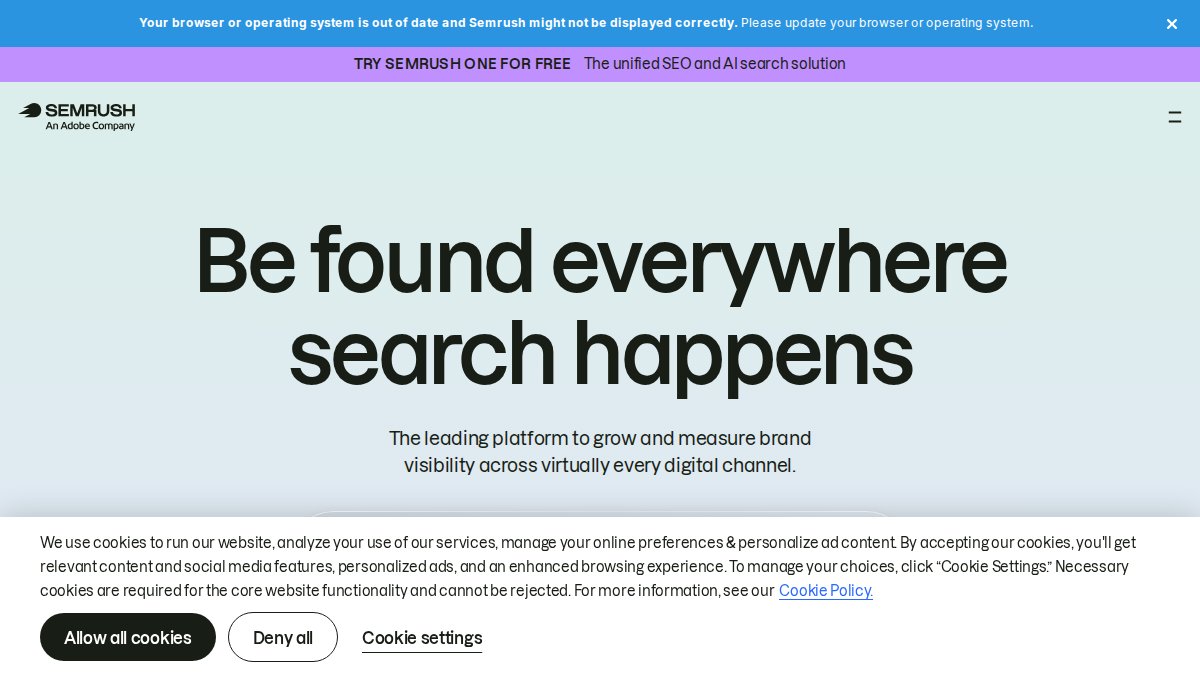
Moz Pro provides solid backlink analysis with a smaller index than Ahrefs or Semrush. For many practitioners, the difference is negligible. Moz's strength lies in Domain Authority (DA), their proprietary metric for predicting ranking potential.
Moz Pro includes the MozBar browser extension, which displays link metrics for any site you visit. This is invaluable for quick research before investing time in outreach.
Moz Pro starts at $99/month and includes a free tier for basic link analysis.
SE Ranking: Affordable Competitive Research
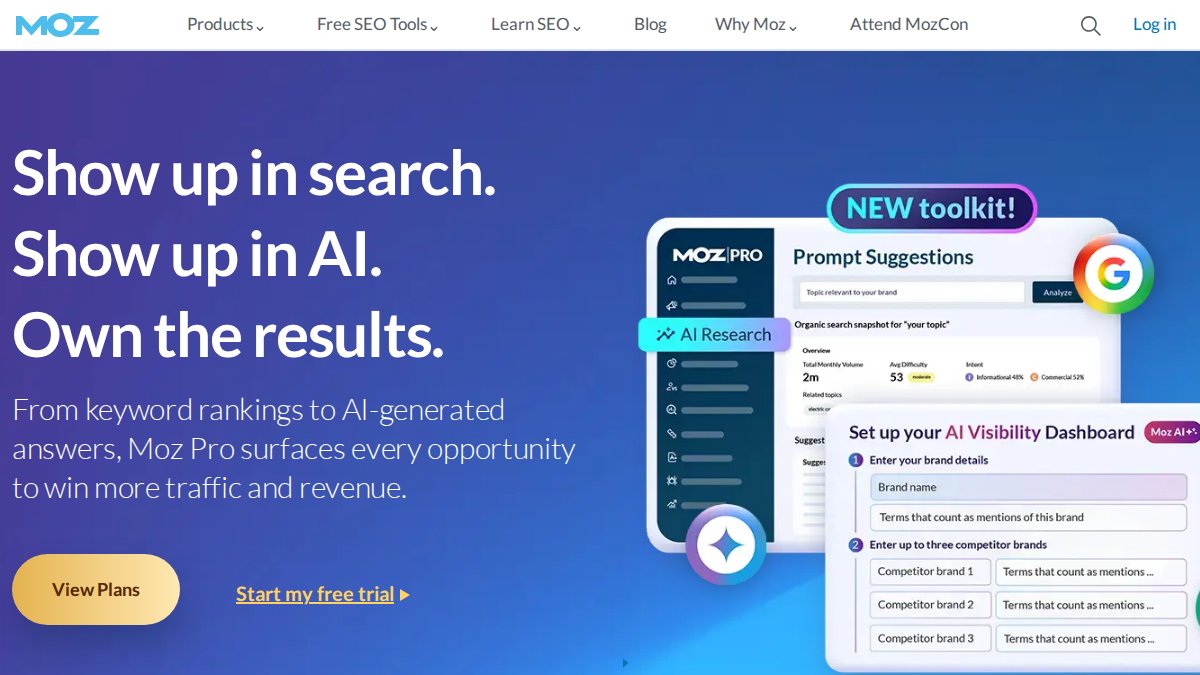
SE Ranking positions itself as the budget-friendly alternative. Their "Backlink Gap" tool compares your profile against up to 5 competitors simultaneously with a clean interface and reasonable data freshness.
For small businesses and freelancers, SE Ranking offers remarkable value. The trade-off: their backlink index is smaller than competitors, which might mean missing some link opportunities. For most small-to-medium businesses in less saturated niches, this limitation is minor.
SE Ranking pricing starts at $55/month, making it the most affordable option for serious SEO work.
SEO Competitive Analysis Framework: Integration Strategy
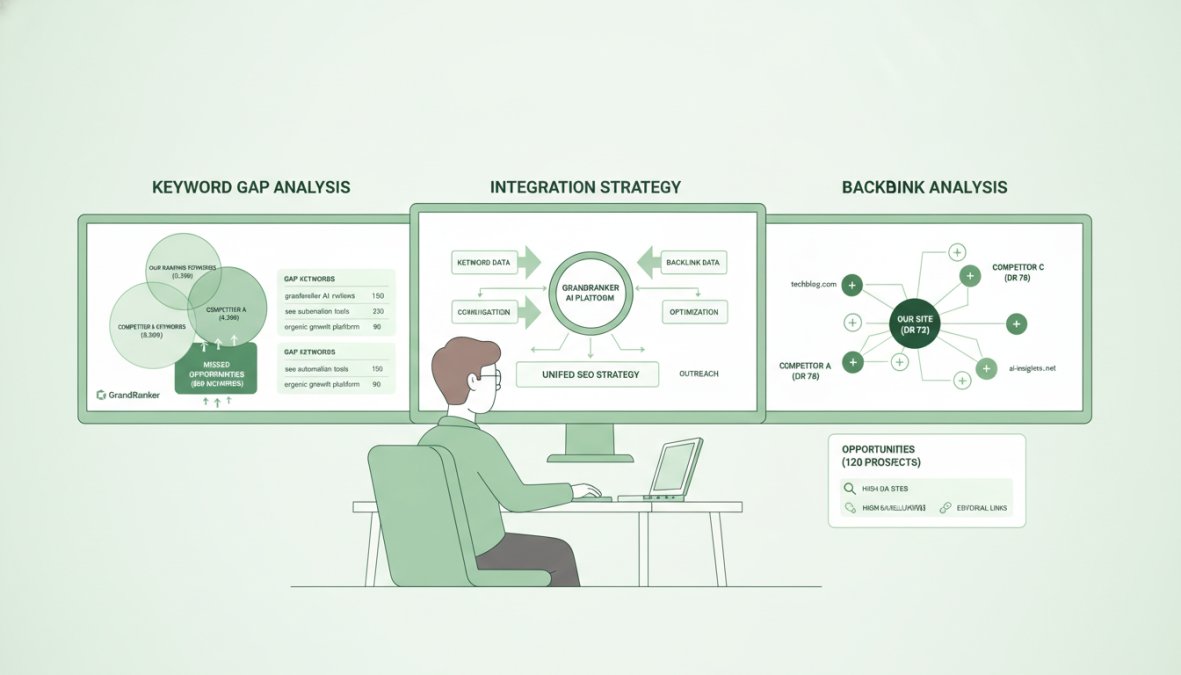
The real competitive advantage comes from integrating keyword gap analysis and backlink gap analysis into a unified strategy.
Phase 1: Combine Keyword and Backlink Data for Holistic Intelligence
Overlay your keyword gap findings onto your backlink gap findings. You're looking for the intersection: keywords with search volume where you also have (or can acquire) backlinks.
-
List your top 20 keyword opportunities sorted by search volume and ranking difficulty.
-
Identify which competitors rank for these keywords.
-
Cross-reference with your backlink gap analysis. For each keyword opportunity, identify which domains in your backlink prospect list link to the competitor ranking for that keyword.
-
Prioritize opportunities where link prospects exist. If no qualified backlink prospects link to content on that topic, you'll need broader outreach.
-
Create integrated opportunity clusters. Group keywords by topic and link source. If 5 domains in your backlink prospect list link to competitor content on these topics, you've found a cluster worth pursuing.
This integration reveals which opportunities have the shortest path to ranking.
Phase 2: Prioritize Opportunities Using Strategic Filters
Tier 1, Quick Wins (pursue first):
- Keywords with 500-2,000 monthly searches
- Ranking difficulty below your current domain authority
- Multiple backlink prospects in your list
- Competitors ranking in positions 6-10
Tier 2, Medium-term Targets (pursue next):
- Keywords with 2,000-5,000 monthly searches
- Ranking difficulty near your domain authority
- 2-3 backlink prospects available
- Competitors ranking in positions 3-5
Tier 3, Long-term Plays (pursue when domain authority grows):
- Keywords with 5,000+ monthly searches
- Ranking difficulty above your current domain authority
- Few backlink prospects available
- Competitors dominating positions 1-3
This tiering prevents chasing unrealistic opportunities while ensuring you're always working on something achievable. Quick wins build momentum and domain authority, making medium-term targets progressively easier.
Research from Moz's ranking factors study indicates that on-page factors and backlink profile matter equally for competitive keywords. A Tier 1 opportunity is worth 10x more than a Tier 3 opportunity.
Phase 3: Link Acquisition and Outreach Campaign Planning
Once you've identified keyword opportunities with backlink prospects, begin outreach. For each target keyword cluster, identify the top 3-5 backlink prospects, domains linking to competitor content on similar topics.
Your outreach angle should reference this connection: "We noticed you linked to [Competitor's Content] on [Topic]. We've created a more comprehensive guide. We think your audience would find it valuable."
This approach works because you're referencing existing editorial decisions, offering a better resource, and demonstrating relevance through homework.
Create an outreach template that references your keyword opportunity and the competitor's existing link. Personalize the first sentence for each prospect. Send outreach in batches of 10-15 per week to manage responses and maintain quality conversations.
Track which prospects convert to links. Over time, you'll identify which domains are most likely to link to you and which require different approaches.
When to Prioritize Keyword Gap Analysis Over Backlink Analysis
Keyword gap analysis should be your starting point in most scenarios. Keywords represent actual search demand. A keyword with 5,000 monthly searches represents real people looking for solutions.
Prioritize keyword gap analysis first if:
- You're a new domain with limited backlink authority (under 20 referring domains)
- You're entering a new market segment or geographic region
- Your competitors' backlink profiles are significantly larger than yours
- You need quick traffic wins to prove ROI to stakeholders
- Your content is thin relative to competitors
Mature domains with 500+ referring domains and strong topical authority should balance both. The timeline also matters: keyword gap analysis shows impact faster (2-4 weeks), while backlink acquisition takes 4-12 weeks. If you need traffic this quarter, prioritize keyword gaps. For a 12-month strategy, balance both.
Avoiding Negative SEO: Link Disavow and Backlink Quality Filters
As you pursue backlink gap analysis, you'll encounter low-quality link opportunities. Not all referring domains are worth pursuing.
Toxic link sources to avoid:
- Private blog networks (PBNs) and link farms
- Automated directory submissions
- Comment spam and forum spam links
- Press release distribution sites (unless highly relevant)
- Unrelated niche sites
- Sites with high spam scores (above 30%)
- Domains with sudden, unnatural link velocity spikes
If you already have links from these sources, use Google Search Console's "Disavow Links" tool. However, disavow should be a last resort, it's better to avoid bad links than clean them up later.
When running backlink gap analysis, filter aggressively before outreach. A smaller list of high-quality prospects beats a large list of mixed-quality prospects. According to Google's link schemes documentation, acquiring links through manipulative practices violates webmaster guidelines and can result in manual penalties. Focus on earning links through content quality and genuine relevance.
Conclusion: Building a Balanced SEO Audit Strategy
The tension between keyword gap analysis and competitor backlink analysis resolves when you stop treating them as competing priorities. They're complementary: keywords tell you what content to create; backlinks tell you where to build authority.
Start with keyword gap analysis to identify high-value content opportunities. Then use backlink gap analysis to find the most efficient path to ranking for those keywords. Create content worth linking to, then pursue links from domains already linking to similar content.
This integrated approach accelerates your path to competitive rankings without requiring massive domain authority upfront. You're working smarter, not just harder.
GrandRanker automates both keyword gap analysis and content creation, helping you identify opportunities and produce high-quality content at scale. Our AI-powered platform finds keyword gaps across your competitive set, generates comprehensive content optimized for those opportunities, and helps you build topical authority faster. Start a free trial and see how automated gap analysis and content creation can accelerate your organic growth.
Frequently Asked Questions
What is the difference between keyword gap analysis and backlink analysis?
Keyword gap analysis identifies keywords competitors rank for that you don't, focusing on content opportunities and organic traffic potential. Backlink analysis examines the referring domains and link sources competitors have that you lack, revealing link building opportunities. Keyword gap targets content strategy; backlink gap targets link acquisition strategy. Both are essential for a complete SEO competitive analysis framework, but they address different ranking factors.
When should I prioritize keyword gap analysis over backlink analysis?
Prioritize keyword gap analysis when you have a strong backlink profile but limited organic traffic, or when entering a new market segment. It's ideal for content-heavy websites, blogs, and SaaS platforms where keyword coverage drives visibility. Backlink analysis becomes the priority when your domain authority is low, you need topical authority signals, or you're competing in high-authority niches where link equity matters more than content volume alone.
Can I use backlink analysis to discover new keywords and rank for them?
Indirectly, yes. By analyzing competitor backlink profiles, you can identify anchor text patterns and understand what keywords they're targeting through link velocity and link equity distribution. However, backlink analysis alone won't reveal all keyword opportunities, you need keyword gap analysis tools to see search volume, keyword difficulty, and traffic estimates. Combining both analyses gives you the complete picture: which keywords to target (keyword gap) and which referring domains can help you rank for them (backlink gap).
How do I perform a keyword gap analysis to identify content opportunities?
Start by selecting 3-5 direct competitors. Extract their ranked keywords using tools like Semrush or Ahrefs. Compare their keyword lists against your own to find gaps, keywords they rank for in the top 10 that you don't rank for at all. Filter by search volume and keyword difficulty to prioritize high-impact opportunities. Focus on keywords with 100+ monthly searches and difficulty scores aligned with your domain authority. This systematic approach ensures you target content with real organic traffic potential rather than vanity keywords.
Do I need both keyword gap and backlink analysis for a complete SEO strategy?
Yes. Keyword gap analysis reveals what content to create; backlink analysis reveals how to amplify it. A strong SEO competitive analysis framework integrates both: identify keyword gaps to guide content creation, then use backlink gap analysis to find link building opportunities that support those keywords. This integration ensures you're not just creating content in a vacuum, you're building topical authority and link equity simultaneously, which compounds your ranking potential and drives sustainable organic traffic growth.
This article was written using GrandRanker