 blog
blog
Is SEO Worth the Investment for Startups? 2026 Guide
Table of Contents
- Is SEO Worth the Investment for Startups? The Direct Answer
- SEO vs. Paid Ads for Startups: Which Drives Real Growth?
- How Long Does SEO Take for Startups to Show ROI?
- Cost of SEO for Startups: Budget Allocation Strategies
- SEO vs. Product-Led Growth: When to Prioritize Each
- SEO for Startups Best Practices: What Actually Works
- Free SEO Tools for Startups: Build Without Spending
- The Real Risks: When SEO Isn't Worth It for Your Startup
- AI-Driven SEO for Startups: Automating Your Way to Traction
- Is SEO Worth the Investment? Your Decision Framework
Last Updated: July 18, 2026
Is SEO Worth the Investment for Startups? The Direct Answer
Whether is SEO worth the investment for startups depends on three factors: your runway, your competitive landscape, and your growth model. At GrandRanker, we've analyzed hundreds of early-stage companies and found that SEO delivers exceptional long-term ROI for founders willing to play the marathon game. But if you need customers in 90 days and have limited cash, paid ads might be the faster path.
The short answer: SEO is worth it if you have 6-12 months of runway and operate in a market where organic search matters. It's not worth it if you're burning cash weekly or competing in a space dominated by massive brands with unlimited budgets.
Here's what separates winners from those who waste time on SEO: they match their timeline expectations to reality. Most startups fail at SEO not because it doesn't work, but because they expect results in 8 weeks instead of 8 months. The compounding effect of organic traffic is real, but it requires patience.
SEO vs. Paid Ads for Startups: Which Drives Real Growth?
The choice between organic search and paid advertising isn't binary. Most successful startups use both, but the allocation changes as they grow. Early stage, paid ads win on speed. Growth stage, organic traffic wins on unit economics.
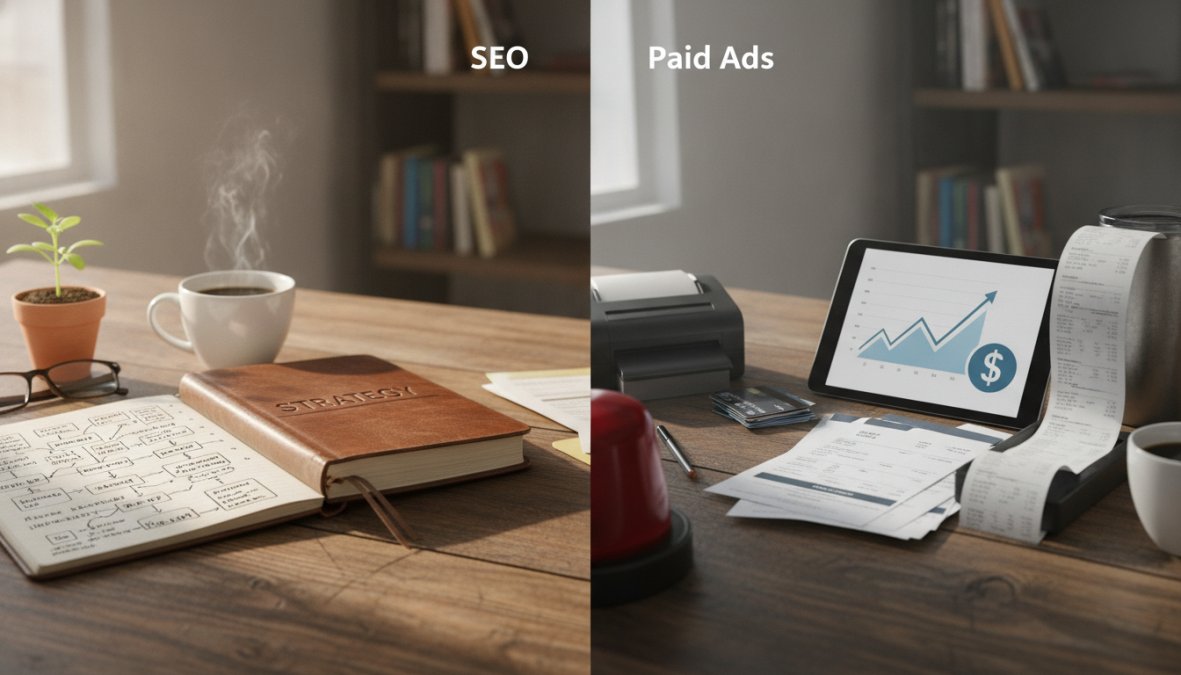
Paid advertising gives immediate visibility. You launch a campaign on Monday and get qualified traffic by Wednesday. This matters when you're validating product-market fit or running low on runway. PPC lets you test messaging, targeting, and offers without waiting for search engines to index your content.
But here's what most guides miss: paid traffic costs compound. Your customer acquisition cost (CAC) stays flat or increases over time as competition for keywords grows. Organic traffic, by contrast, compounds downward. Your cost per acquisition drops as your domain authority grows and your content library expands.
When PPC Makes Sense Early
Pay-per-click advertising is the right move when you need to answer a specific question quickly: Does anyone actually want this product? Can we sell it at a profitable CAC? Do we have product-market fit?
PPC also makes sense if your startup operates in a niche with zero organic search volume. If nobody searches for your specific problem, SEO won't help. Paid ads let you reach those people through interest-based targeting, lookalike audiences, or intent signals.
Budget matters here too. A startup with 18 months of runway and a $500K seed can afford to spend $5-10K monthly on ads while building organic presence. A bootstrapped founder with $50K total budget should skip paid ads entirely and focus on organic growth.
When Organic Traffic Becomes Your Advantage
Organic search becomes your competitive moat around month 6-9, once you've built content authority and backlink profile strength. At this point, your cost per lead drops dramatically while competitors pay increasing amounts for the same keywords.
This is the inflection point most startups miss. They see initial SEO results around month 4-5, get impatient when growth plateaus in month 6, and kill the program. They never reach month 9 when everything compounds. The teams that push through this valley see 10-50x returns by year two.
Organic traffic also builds brand credibility in ways paid ads never will. When prospects find you through Google search results, they perceive you as an authority. When they see your ad, they perceive you as someone willing to pay for attention. The psychology is different.
How Long Does SEO Take for Startups to Show ROI?
Most startups see measurable results between 4-6 months if they're executing properly. But "measurable" doesn't mean "profitable." You'll see ranking improvements and traffic gains before you see meaningful revenue impact.
The timeline breaks into two distinct phases: foundation and compounding.
The 3-6 Month Foundation Phase
Months 1-3 are about establishing technical SEO, building your content foundation, and earning initial backlinks. You won't see much traffic. Your analytics might show a few hundred visitors per month from organic search. This feels slow, and it is.
But the foundation work is critical. You're telling Google that your site is trustworthy, fast, and relevant to specific queries. You're building the content library that will eventually rank for hundreds of variations of your target keywords. You're establishing your domain authority baseline.
By month 4, you should see your first content pieces ranking on page 2-3 for target keywords. Month 5-6, some pieces move to page 1. Traffic accelerates but still feels modest, maybe 500-2,000 monthly organic visitors for a typical B2B SaaS startup.
Months 6-12: Traction and Compounding
This is where SEO becomes undeniable. Your early content pieces have accumulated backlinks and social signals. Search engines understand your topical authority. New content ranks faster because your domain authority has improved.
Between months 6-12, expect organic traffic to 2-3x. A startup generating 1,000 monthly organic visitors in month 6 should see 2,000-3,000 by month 12. More importantly, conversion rates on organic traffic often improve as you refine messaging based on what's actually resonating with searchers.
By month 12, you should have enough organic traffic to generate 5-15 qualified leads monthly (depending on your industry and conversion funnel). Whether that's profitable depends on your CAC target and LTV.
Cost of SEO for Startups: Budget Allocation Strategies
SEO costs vary wildly depending on your approach. A bootstrapped founder can start for free. A startup with budget can spend $2,000-5,000 monthly and see faster results. The question isn't how much SEO costs, it's what return you get on that investment.
In-House vs. Agency vs. Hybrid Models
Building an in-house SEO function requires hiring someone with 2-3 years of experience, which typically costs $60-80K annually in most markets. That person can manage SEO strategy, content production, and technical optimization for a single startup.
Hiring an agency costs $2,000-10,000 monthly depending on scope. Agencies bring specialized expertise and faster execution, but they often prioritize volume over depth. They're managing 10-20 clients simultaneously, so your account gets 10% of their attention.
The hybrid model works best for most startups: hire a fractional SEO consultant (10-20 hours monthly) to set strategy and oversee execution, then handle content production and basic optimization in-house. This costs $1,000-2,000 monthly and gives you expert guidance without the overhead of a full-time hire.
Zero-Budget SEO Framework for Bootstrapped Founders
You can build meaningful organic presence with zero paid budget. It takes more time and requires founder involvement, but it's possible.
Start with keyword research using free tools like Google Search Console, Google Trends, and Ubersuggest's free tier. Identify 10-15 keywords with search volume (100-500 monthly searches) and low competition (mostly small sites ranking, not major brands).
Write one comprehensive guide per week on these keywords. Make it genuinely better than what's currently ranking. Include original research, real examples, and actionable frameworks. Publish it on Medium or your own blog.
Spend 30 minutes per week on outreach: email 5-10 relevant bloggers, journalists, or community members asking if they'd find the guide valuable. Don't pitch, just share and ask for feedback. Some will link to you. Some will share on social media. Both help.
By month 6, you'll have 24 pieces of content. By month 12, you'll have 48. At least 20-30% of those will rank for something. Some will drive 5-10 monthly visitors. A few will drive 50+. Aggregate that across 48 pieces and you're generating 500-1,000 monthly organic visitors with zero ad spend.
| Approach | Monthly Cost | Time Investment | Best For |
|---|---|---|---|
| In-house hire | $5,000-6,700 | 40 hrs/week | Startups with $2M+ ARR |
| Agency | $3,000-8,000 | 5 hrs/week | Startups wanting fast scaling |
| Fractional consultant | $1,000-2,500 | 10 hrs/week | Startups with 12+ months runway |
| Founder-led (zero budget) | $0 | 15 hrs/week | Bootstrapped founders |
SEO vs. Product-Led Growth: When to Prioritize Each
Product-led growth (PLG) and organic SEO aren't competing strategies, they're complementary. But they require different time horizons and different founder energy allocation.
PLG works when your product is so good that users naturally invite others to try it. Slack, Figma, and Notion scaled this way. It requires a product that solves a problem so well that word-of-mouth becomes inevitable.
SEO works when your product solves a problem people are actively searching for solutions to. It requires patience and content production, but it reaches people at the moment they're looking for help.
The decision comes down to your product type and market maturity. If you're building something genuinely novel (nobody's searching for it yet), PLG is your path. If you're solving an existing problem better than competitors, SEO compounds your advantage.
Most successful startups do both: build a product good enough for PLG to work, then layer on SEO to capture people searching for solutions. The combination is more powerful than either alone.
SEO for Startups Best Practices: What Actually Works
The tactics that matter are simpler than most guides suggest. Focus on three things: keyword research that matches your actual business, content that converts (not just ranks), and technical SEO that doesn't hold you back.
Keyword Research on a Startup Budget
Most startups waste time targeting keywords that don't convert. They pick keywords with high search volume, write content, rank for those keywords, and then discover nobody who searches for them is actually a potential customer.
Start by identifying your ideal customer profile. What problems do they have? What language do they use to describe those problems? What are they searching for when they're ready to buy?
Use Google Search Console to see what keywords you're already ranking for, even if you're on page 5. These are your easiest wins. Create better content on these topics and you'll move to page 1 quickly.
Look at what your competitors are ranking for using free tools like Ubersuggest or SEMrush's free tier. You don't need to out-rank them on their strongest keywords. Find the keywords they're ignoring and own those.
Target keywords with 100-500 monthly search volume and low competition (mostly small sites ranking). These convert better than high-volume keywords because the search intent is more specific.
Content Strategy That Converts
Most startup content doesn't convert because it's written for search engines, not for actual humans deciding whether to buy.
Write content that answers the specific question your prospect is asking at each stage of their journey. Top-of-funnel content answers "What is this problem?" Middle-funnel content answers "How do I solve this?" Bottom-funnel content answers "Which solution should I choose?"
Each piece of content should have a clear conversion action. Top-of-funnel might be "Subscribe to the newsletter." Middle-funnel might be "Download the free guide." Bottom-funnel might be "Start a free trial."
Include internal links that guide readers toward your conversion actions. If someone lands on a top-of-funnel piece, link to relevant middle-funnel content. If they land on middle-funnel content, link to your product pages.
Free SEO Tools for Startups: Build Without Spending
You don't need expensive software to execute SEO. The free tier of most tools gives you 80% of the functionality you need.
Google Search Console is non-negotiable. It shows you exactly what keywords you're ranking for, how many impressions you're getting, and your average ranking position. It's free and it's the most important SEO tool you have.
Google Analytics tells you where your traffic is coming from and what visitors are doing on your site. Use it to identify which content drives the most engaged visitors and which converts best.
Ubersuggest's free tier gives you keyword search volume, competition level, and competitor analysis. You can run 3 searches per day, which is enough for most startups doing foundational keyword research.
Ahrefs' free tier lets you analyze your backlink profile and see which of your pages have the most backlinks. This helps you identify your strongest content and understand what Google values about your site.
AnswerThePublic shows you the questions people are asking about your topic. These become content ideas that almost guarantee search visibility because you're answering actual questions people have.
The Real Risks: When SEO Isn't Worth It for Your Startup
SEO fails for startups in predictable ways. Understanding the failure modes helps you avoid them.
Insufficient Runway for Long-Term Play
The number one reason startups fail at SEO is that they run out of cash before organic traffic compounds. You need 9-12 months of runway to see meaningful results. If you have 6 months or less, SEO is a distraction.
This doesn't mean you shouldn't do SEO. It means you shouldn't expect it to be your primary growth driver in the first 6 months. Use paid ads to acquire customers while building your organic presence. When your runway extends, shift budget allocation toward organic.
Highly Competitive Landscapes Require Scale
If you're competing in a space where the top 10 results are all dominated by massive brands with unlimited budgets, SEO becomes expensive. You need more content, more backlinks, and more technical sophistication to compete.
Example: Trying to rank for "best project management software" when Asana, Monday.com, and Notion already own the top spots. These companies have teams of 20+ people working on SEO. You won't out-rank them.
But you can own more specific keywords like "best project management software for nonprofits" or "project management for remote teams." Specificity is your advantage as a startup.
AI-Driven SEO for Startups: Automating Your Way to Traction
AI tools are changing what's possible for lean teams. Instead of hiring a full-time SEO specialist, you can use AI to automate keyword research, content creation, optimization, and publishing.
GrandRanker uses AI to find keywords that match your business, generate content outlines, write first drafts, optimize for search intent, and publish to your blog, all on autopilot. This lets founders focus on product and sales while organic traffic builds in the background.
The advantage for startups is speed and cost. You can execute an SEO strategy that would normally require 2-3 people for a fraction of the cost. The tradeoff is that you still need human oversight to ensure quality and brand alignment.
AI-driven SEO works best when you have a clear product, defined customer profile, and specific keywords you want to target. Feed those into an AI platform and let it handle the repetitive work. You focus on strategy and quality control.
Is SEO Worth the Investment? Your Decision Framework
Here's how to decide whether SEO is worth your time and money right now.
Evaluate Your Runway and Burn Rate
Calculate how many months of runway you have at your current burn rate. If it's less than 6 months, SEO is not your priority. Focus on paid acquisition and product improvements. You need revenue too urgently to wait for organic traffic.
If you have 9-12 months of runway, SEO becomes a solid secondary channel. Allocate 20-30% of your marketing budget to organic while using paid ads to acquire customers immediately.
If you have 18+ months of runway, SEO is a core strategy. Allocate 40-50% of your marketing budget to organic. You can afford to play the long game.
Assess Your Competitive Landscape
Search for your top 10 target keywords. Look at who's ranking in positions 1-5. Are they massive brands with unlimited budgets? Or are they small companies and blogs you could realistically out-rank?
If the top results are dominated by huge companies, look for more specific keywords where competition is lower. You can't beat Shopify for "ecommerce platform," but you might own "ecommerce platform for small fashion brands."
If the top results are small sites and blogs, SEO is absolutely worth it. You have a realistic path to page 1.
Match Your CAC Goals to Your Growth Model
Calculate your target customer acquisition cost. If you're selling a $100/month SaaS product, your CAC needs to be under $300 to have a profitable unit economy. If you're selling a $10,000 enterprise software package, your CAC can be $3,000+.
Paid ads typically generate CAC of $200-1,000+ depending on your market. Organic traffic generates CAC of $50-300 once it's compounding. If your target CAC is tight, organic is essential. If you can afford higher CAC, paid ads get you customers faster.
Organic search is worth the investment if you're playing a multi-year game and your CAC targets are tight. It's not worth it if you need customers immediately and your LTV can support higher acquisition costs.
SEO compounds over time in ways that paid acquisition never will. The founders who win aren't the ones who get the fastest results in month one. They're the ones who commit to the process for 12+ months and watch organic traffic become their most efficient growth channel. If you have the runway to play this game, SEO is one of the highest-ROI investments you can make. Start with GrandRanker's AI-powered platform to automate keyword research, content creation, and optimization, letting your team focus on product and sales while organic traffic builds on autopilot. Get started with a free trial and see how organic search can power your startup's growth.
Frequently Asked Questions
How long does it take for SEO to show results for a startup?
Most startups see initial organic traffic within 3-6 months of consistent effort, but meaningful ROI typically arrives between 6-12 months. The timeline depends on your competitive landscape, keyword difficulty, and content consistency. Building domain authority and search visibility is a long-term strategy, not a sprint. Patience during the foundation phase is critical to avoid abandoning SEO prematurely.
Is SEO more cost-effective than paid ads for startups with limited budgets?
Yes, over time. While PPC delivers immediate lead generation, SEO reduces your customer acquisition cost (CAC) significantly after the initial investment phase. Organic traffic scales without ongoing ad spend, making it ideal for bootstrapped startups with longer runways. However, if you need leads in the next 30 days, PPC is faster. The best approach combines both: use paid ads for immediate traction while building organic traffic as your scalable engine.
What are the best free SEO tools for startups with zero marketing budget?
Google Search Console, Google Analytics, and Ubersuggest (free tier) provide keyword research and performance tracking. Ahrefs' free backlink checker, AnswerThePublic for search intent, and Canva for content creation round out a zero-budget toolkit. Many SEO platforms offer free trials or freemium models. Focus on keyword research, technical SEO audits, and content optimization before investing in paid tools. Automation platforms like GrandRanker offer free trials to test AI-driven SEO at zero upfront cost.
Should I invest in SEO if my startup is in a highly competitive niche?
Competitive landscapes require more runway and resources, but SEO is still viable if you have differentiation. Focus on long-tail keywords with lower search volume but higher conversion intent, and build authority through thought leadership and niche content. Product-led growth (PLG) may be faster for competitive markets. Evaluate your burn rate: if you have 12+ months of runway, SEO's long-term ROI justifies the investment. If runway is 6 months or less, consider blending SEO with paid ads for faster lead generation.
This article was written using GrandRanker