 review
Is AI Content Generation Worth It for Local SEO?
Table of Contents
- Is AI Content Generation Worth It for Local SEO? The Direct Answer
- How Google Treats AI-Generated Content in Local Search
- Pros and Cons of AI Content Generation for Local Businesses
- AI Content Risks SEO: What Can Go Wrong
- AI Local SEO Tools: What's Available and How They Work
- AI Content Best Practices SEO: The Workflow That Works
- Google Business Profile AI Content: Optimization Without the Risk
- Measuring ROI: Does AI Content Generation Actually Drive Traffic?
- When AI Content Generation Makes Sense (and When It Doesn't)
- Conclusion
- Frequently Asked Questions
Last Updated: August 2, 2026
Is AI Content Generation Worth It for Local SEO? The Direct Answer
The question of whether is ai content generation worth it for local seo has a nuanced answer: it depends entirely on your execution strategy and tolerance for risk. At GrandRanker, we've analyzed how AI-generated content performs in local search rankings, and the data reveals a critical truth that most guides miss, pure AI content rarely outranks human-written alternatives, but strategically augmented content consistently does.
Here's what matters: Google's search algorithms don't penalize AI content outright. What they penalize is low-quality, thin, or contextually irrelevant content. The difference between content that ranks and content that tanks often comes down to human oversight, local specificity, and whether the material actually addresses what your target audience in Ljubljana and beyond is searching for.
For local businesses specifically, is ai content generation worth it for local seo becomes a workflow question more than a capability question. AI excels at speed and scalability. It struggles with hyper-local nuance, the neighborhood-specific details, local terminology, and geographic context that actually move local search rankings. The businesses seeing real results aren't replacing their content teams with AI. They're using AI to amplify their teams, handling the repetitive work while humans focus on strategic depth and local relevance.
Below, we'll walk you through exactly when AI content generation makes sense for local SEO, where it falls short, and how to structure a workflow that actually drives traffic and conversions without triggering algorithmic skepticism.
How Google Treats AI-Generated Content in Local Search
Google's official stance on AI-generated content has evolved significantly. According to Google's Search Central guidance on AI-generated content, the search engine focuses on content quality and usefulness rather than the method of creation. This means AI content isn't automatically penalized, but it's also not automatically favored.
What triggers ranking problems isn't the AI origin. It's the execution. Content that lacks local relevance, contains factual errors, or fails to answer specific user intent will underperform whether it was written by AI or a human. The algorithmic signal that matters is whether the content demonstrates expertise, authority, and trustworthiness, what SEO professionals call E-E-A-T.
For local search specifically, Google Business Profile rankings depend heavily on citations, review signals, and local relevance. AI-generated content can support these factors, but it rarely creates them. A well-optimized Google Business Profile with AI-assisted descriptions might rank higher than a neglected one with human-written copy. But a neglected profile will never outrank an actively managed competitor profile, regardless of content generation method.
The real risk with pure AI content in local SEO isn't algorithmic penalty, it's invisibility. Thin, generic descriptions of your business don't signal local relevance to Google's ranking system. They also don't convert visitors into customers. An AI tool that generates "We are a full-service plumbing company serving the Ljubljana area" will produce content that's technically accurate but strategically worthless. It lacks the specificity, the local terminology, and the conversion-focused messaging that actually moves the needle.
Pros and Cons of AI Content Generation for Local Businesses
The case for AI content generation in local SEO is straightforward: speed and volume. A local business owner or marketing manager can generate dozens of location-specific landing pages, service descriptions, and FAQ content in hours instead of weeks. For a plumbing company serving multiple neighborhoods in Ljubljana, AI can create variations of service pages optimized for specific areas without hiring additional writers.
The efficiency gains are real. Tools that automate keyword research, content creation, and optimization can reduce the time from strategy to publication from months to weeks. For bootstrapped startups or small teams, this matters. You can test more content variations, identify what resonates with your local audience, and iterate faster than competitors relying on manual processes.
The case against AI content generation centers on three problems: contextual accuracy, brand voice consistency, and conversion performance. AI systems generate content based on patterns in training data. They excel at producing technically correct, well-structured text. They struggle with the nuanced local knowledge that actually converts visitors.
Consider a local SEO example: an AI system might generate a page about "emergency plumbing services in Ljubljana" that mentions general emergency plumbing concepts. A human writer who actually works in the industry would know that winter freezing is the primary emergency call driver in Ljubljana's climate, that certain neighborhoods have older pipe infrastructure prone to specific failures, and that customers in affluent districts expect different service positioning than those in residential areas. These details don't just improve ranking signals, they improve conversion rates because they speak directly to what your actual customers are experiencing.
Brand voice is another friction point. AI-generated content tends toward a neutral, informational tone. If your local business has built trust through a specific personality, whether that's friendly and approachable or highly technical and authoritative, AI content often dilutes that voice. Customers choose local service providers partly based on trust signals. Inconsistent voice across your content undermines that trust.
| Factor | AI-Generated | Human-Written | Hybrid (AI + Human Review) |
|---|---|---|---|
| Speed | Fast (hours) | Slow (days/weeks) | Moderate (hours + review) |
| Local relevance | Generic | High | High |
| Brand voice consistency | Inconsistent | Consistent | Consistent |
| Scalability | High | Low | Moderate |
| Conversion optimization | Weak | Strong | Strong |
| Cost per piece | Low | High | Moderate |
| Ranking potential | Moderate | High | High |
AI Content Risks SEO: What Can Go Wrong
The primary AI content risks SEO centers on detection and credibility loss. While Google doesn't explicitly penalize AI content, it does penalize low-quality content. If your AI-generated pages are detected as thin, generic, or lacking original insight, they'll underperform. More concerning: if a significant portion of your site consists of low-quality AI content, it can drag down your entire domain's authority signals.
Search engine trust is cumulative. One thin page doesn't destroy your rankings. But a site filled with AI-generated pages that lack local specificity, contain factual errors, or duplicate competitor language will see algorithmic suppression. Google's systems treat sites with high volumes of low-quality content as less trustworthy overall, which affects ranking potential across your entire domain.
There's also the AI detection risk. Several AI detection tools now exist, and while they're imperfect, they're improving. If your content is flagged as AI-generated by detection systems, it may receive lower priority in search algorithms or be treated with skepticism by human reviewers. For local businesses, this is particularly risky because local search includes human review components, Google employees and community moderators assess local business information.
Factual errors present another significant risk. AI systems hallucinate, they generate plausible-sounding but incorrect information. In local SEO, this might mean AI-generated content about your service area that contains wrong neighborhood names, incorrect service descriptions, or inaccurate hours. These errors don't just hurt rankings. They damage customer trust and can lead to negative reviews when customers show up expecting services you don't actually offer.
The workflow risk is equally important. Many teams deploy AI content generation without establishing quality control processes. They publish at scale without human review. This approach trades short-term efficiency for long-term credibility loss. The businesses seeing real ROI from AI content generation aren't the ones publishing everything the AI produces. They're the ones using AI as a starting point, then applying human expertise, local knowledge, and brand voice to every piece before publication.
AI Local SEO Tools: What's Available and How They Work
The landscape of AI local SEO tools has expanded significantly. Most fall into three categories: general content generation platforms, SEO-specific tools with AI features, and specialized local SEO solutions.
General content generation tools like ChatGPT and Claude can produce local content, but they lack SEO optimization built in. You write a prompt, they generate content, and you manually optimize for keywords and local relevance. This approach works for small volumes but becomes inefficient at scale.
SEO-specific platforms with AI capabilities, including GrandRanker, integrate keyword research, content generation, and optimization into a single workflow. These tools analyze search intent, identify ranking opportunities, and generate content pre-optimized for local search signals. The advantage is efficiency: the AI understands SEO context, not just general writing. The limitation is that they still require human review for local accuracy and brand voice alignment.
Specialized local SEO tools focus specifically on Google Business Profile optimization, local citation management, and location-specific content. Some include AI-assisted features for generating business descriptions, service area pages, and FAQ content tailored to local search. These tools understand local search ranking factors specifically, they know that Google Business Profile consistency matters, that local citations impact rankings, and that geographic specificity is a ranking signal.
The most effective approach combines these tools. Use AI content generation for volume and speed. Use SEO-specific optimization to ensure keyword relevance and search intent alignment. Use local SEO tools to manage Google Business Profile content and local citations. And apply human expertise throughout to ensure accuracy, brand consistency, and conversion optimization.
GrandRanker specifically automates keyword research, content creation, and optimization for organic traffic growth. The platform identifies high-intent local keywords, generates content optimized for those keywords, and helps you publish at scale while maintaining quality standards through structured workflows. For local businesses, this means you can create location-specific landing pages, service area content, and FAQ pages without hiring a full content team.
AI Content Best Practices SEO: The Workflow That Works
The workflow that actually delivers results with AI content best practices SEO follows a clear structure: strategy, generation, optimization, review, and publication. Most teams skip steps or compress them. That's where quality suffers.
Start with strategic planning. Identify the keywords and search intents your local audience is actually searching for. This isn't generic, it's specific to your service area, your business type, and your competitive landscape. In Ljubljana, a plumbing business needs to target neighborhood-specific keywords ("emergency plumbing in Bežigrad," "water heater repair in Vič"), service-specific keywords ("frozen pipe repair," "sewer line replacement"), and intent-specific keywords ("emergency plumber near me," "24-hour plumbing service"). AI doesn't create this strategy. It executes it.
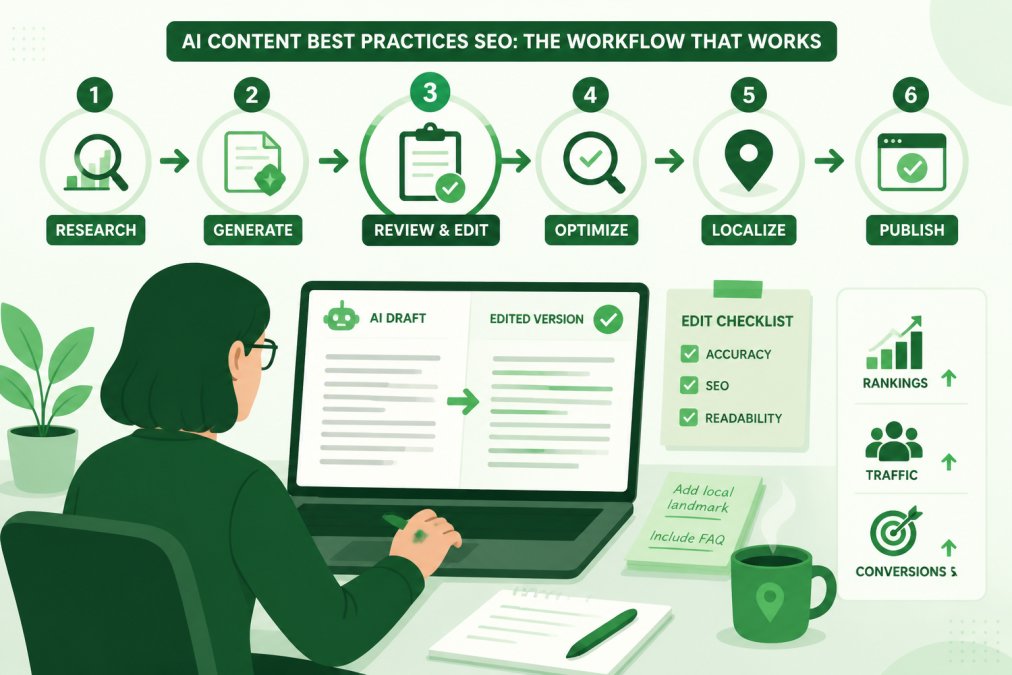
Once you've identified your target keywords, use AI to generate initial content. Provide the AI system with specific inputs: the target keyword, the search intent, your service area, your unique value propositions, and any specific details you want included. The more specific your inputs, the better the output. A prompt like "Generate a 400-word page about emergency plumbing services in Ljubljana that includes our 24-hour response time guarantee and our flat-rate pricing model" will produce better content than "Write about emergency plumbing."
After generation, optimize the content. This step is crucial and often skipped. Use SEO tools to verify keyword placement, check readability scores, ensure proper heading structure, and confirm that internal linking opportunities are captured. Optimization tools should flag issues like keyword density problems, missing meta descriptions, or heading structure problems. Fix these before moving to review.
The review stage is where human expertise enters. Read the AI-generated content with fresh eyes. Does it accurately represent your business? Does it match your brand voice? Does it address what your customers actually need? For local content, verify that geographic details are accurate. Check that service descriptions match what you actually offer. Confirm that hours, contact information, and service area boundaries are correct.
Make revisions based on your review. This might mean rewriting sections for brand voice consistency, adding specific details about your service area, or removing generic language. The goal isn't perfection, it's authenticity. Content that reflects your actual business expertise and local knowledge will outrank generic AI content every time.
Finally, publish with proper local SEO structure. Ensure your Google Business Profile is optimized and consistent with your website content. Build local citations on relevant directories. Create internal linking from your homepage and service pages to new location-specific content. These signals matter more than the content generation method.
Google Business Profile AI Content: Optimization Without the Risk
Your Google Business Profile AI content is one of the highest-use places to use AI assistance, because Google Business Profile is algorithmically simpler than your full website. The platform has structured fields, limited character counts, and specific formatting requirements. AI can handle these constraints effectively.
The business description field (5,000 characters) is where most local businesses either leave generic text or try to keyword-stuff. AI can generate descriptions that are both keyword-optimized and genuinely useful. Provide the AI with your business category, your service area, your key differentiators, and your target keywords. It will generate a description that includes those keywords naturally while explaining what you actually do.
Service descriptions (each up to 10,000 characters) benefit significantly from AI assistance. Instead of writing generic descriptions for each service you offer, you can generate location-specific variations. A plumbing company might have a base "water heater repair" description, then use AI to create variations for different neighborhoods or service areas. This increases your relevance for local search queries without requiring manual writing for every variation.
The FAQ section of your Google Business Profile is another high-impact area for AI content. Generate FAQs that address common questions your local customers ask. AI can produce these quickly and with good keyword optimization. However, verify that the answers are accurate and specific to your business. A FAQ answer that's generic will hurt more than it helps.
The key to Google Business Profile AI content is consistency and accuracy. Your profile information must align with your website, your local citations, and your actual business operations. If your Google Business Profile says you offer 24-hour emergency service but your website says you're only available 9-5, that inconsistency signals untrustworthiness to both Google and customers.
Use AI to generate initial content, but always review it against your actual business details. Update your profile regularly, not just once. Google's algorithms reward active profile management. Adding new photos, updating service lists, and refreshing your description periodically signals that your business is active and current.
Measuring ROI: Does AI Content Generation Actually Drive Traffic?
The only question that matters is whether is ai content generation worth it for local seo translates to actual business results. Here's how to measure it.
Set up tracking before you publish AI-generated content. Create a segment in Google Analytics for traffic from AI-generated pages. Track not just traffic volume, but conversion rate. A page that generates 100 visitors but converts 0 of them is worthless. A page that generates 20 visitors and converts 3 is valuable.
Monitor your local search rankings for the keywords you're targeting. Use Google Search Console to track impressions, clicks, and average position for your target keywords. You should see improvement within 4-8 weeks if your AI content is properly optimized and addressing real search intent.
Track your Google Business Profile performance. Google Business Insights shows how many people view your profile, call your business, visit your website, or request directions. If you're publishing AI-optimized content to your profile, these metrics should improve.
Most importantly, track business outcomes. Calls, form submissions, appointment bookings, or actual sales. This is the ultimate ROI metric. If AI-generated content is driving traffic but not conversions, you need to adjust your strategy. The content might be ranking but not addressing what customers actually want to know.
However, these results require the full workflow: strategic planning, AI generation, optimization, human review, and consistent publication. Businesses that just publish raw AI output typically see minimal ranking improvements and poor conversion rates.
When AI Content Generation Makes Sense (and When It Doesn't)
Is ai content generation worth it for local seo depends on your specific situation. Here's a framework to help you decide.
AI content generation makes sense if:
- You have a large service area with multiple locations or neighborhoods to target
- You need to create numerous service pages, location pages, or FAQ content
- You have limited budget for hiring writers but need to scale content production
- Your content needs are primarily informational rather than brand-building
- You have someone on your team who can review and optimize AI output
- You're competing in a market where content volume matters
AI content generation doesn't make sense if:
- Your business relies on highly specialized expertise that requires deep industry knowledge
- Your brand voice and personality are critical to customer trust
- You're in a highly regulated industry where accuracy is legally critical
- You don't have capacity to review and optimize AI output before publishing
- Your competitive advantage is based on unique insights or proprietary knowledge
- You operate in a niche market where generic content will obviously underperform
For most local businesses, the answer is "partially." Use AI for volume and efficiency. Use humans for strategy, accuracy, and brand voice. This hybrid approach delivers the best results: faster content production than pure human writing, better quality and conversion performance than pure AI, and lower cost than hiring a full content team.
The businesses in Ljubljana and beyond that are seeing real traction with local SEO are the ones treating AI as a tool, not a replacement. They're using it to amplify their teams' output, handle repetitive work, and scale to new service areas. They're not using it to eliminate the strategic thinking, local expertise, and customer understanding that actually drives rankings and conversions.
Conclusion
The answer to whether is ai content generation worth it for local seo is yes, if you implement it strategically. AI-generated content can accelerate your local SEO efforts, help you scale content production, and improve your search visibility when done correctly. The businesses that fail with AI content are the ones expecting the technology to replace strategy and human expertise. The ones that succeed treat AI as an efficiency tool within a larger SEO framework.
Your local search rankings depend on content quality, local relevance, Google Business Profile optimization, and consistent citation management. AI can help with content quality and volume. But it can't replace the strategic thinking, local knowledge, and customer understanding that actually moves the needle.
Start with a clear strategy. Identify the keywords and search intents your local audience is searching for. Use AI to generate initial content quickly. Optimize it for search engines and convert conversion performance. Review it for accuracy and brand voice. Publish consistently. And measure the actual business results, traffic, conversions, and revenue.
If you're looking to simplify this workflow, GrandRanker automates keyword research, content creation, and optimization specifically for local SEO. The platform helps you identify high-intent local keywords, generate content optimized for those keywords, and publish at scale while maintaining quality standards. Learn more about GrandRanker's AI-powered SEO platform to see how it can accelerate your local search growth.
Frequently Asked Questions
Does Google penalize AI-generated content for local SEO?
Google doesn't penalize AI content outright, but it does penalize low-quality, thin, or keyword-stuffed content regardless of how it was created. AI-generated content that lacks local relevance, contextual accuracy, or human oversight will rank poorly. The key is ensuring your AI content meets Google's search engine guidelines for quality, E-E-A-T, and local search intent. Content that reads naturally and addresses your local audience's actual needs will perform well.
What are the biggest risks of using AI content generation for local SEO?
The main AI content risks in SEO include loss of brand voice and local nuance, AI-detection penalties if content reads artificially, keyword stuffing and over-optimization, outdated information if the AI model lacks current data, and failure to address hyper-local specifics that matter to your community. Without human oversight and a clear content strategy, AI content can damage trust and organic reach. The solution is treating AI as a starting point, not a finished product.
Which AI local SEO tools actually work for content generation?
AI local SEO tools range from general content platforms to specialized SEO software. Look for tools that offer automated keyword research, content creation with local context, Google Business Profile optimization, and conversion rate tracking. The best AI local SEO tools integrate with your workflow, allow human editing, and provide transparency on what content performs. Choose a tool that fits your budget and lets you maintain brand voice while automating repetitive tasks.
How do I know if AI content is actually driving traffic and leads?
Track specific metrics: organic traffic from AI-generated pages, click-through rates from search results, conversion rates, and ranking positions for target keywords. Use Google Analytics to segment traffic by content type (AI-assisted vs. fully manual). Monitor Google Business Profile views and actions if you're optimizing local listings. Compare performance before and after implementing AI content. Transparent reporting tools should show you which pieces drive ROI, not just vanity metrics like page views.
Is AI content generation worth it if we already have a content team?
Yes, if your team is stretched thin. AI content generation accelerates production, reduces time spent on research and first drafts, and frees your writers to focus on high-impact work like strategy and brand voice refinement. The best approach is AI-assisted workflows where AI handles initial drafts and optimization, and humans ensure quality, local accuracy, and brand alignment. This hybrid model scales content output without sacrificing the expertise that differentiates you from competitors.
This article was written using GrandRanker