 listicle
7 Simple Ways to Increase Domain Authority for New Websites
Table of Contents
- Why Domain Authority Matters for New Websites
- 1. Build High-Quality Backlinks Through Strategic Outreach
- 2. Master On-Page SEO Optimization
- 3. Implement a Strategic Internal Linking Structure
- 4. Create Content That Establishes Topical Authority
- 5. Fix Technical SEO Fundamentals
- 6. Use the Best Domain Authority Checker Tools to Track Progress
- How Long Does It Take to Increase Domain Authority?
- Beyond Domain Authority: Focus on Real Traffic and Revenue
- Conclusion
Last Updated: August 8, 2026
Why Domain Authority Matters for New Websites
Domain authority matters because it's one of the strongest signals Google uses to rank websites. A site with higher domain authority ranks more easily for competitive keywords, attracts more organic traffic, and establishes credibility faster than competitors starting from zero.
But here's what most new site owners get wrong: they obsess over their domain authority score itself rather than what actually drives traffic and revenue. Domain authority is a metric, not a goal. The real win is getting customers from Google and ChatGPT, and that requires a different approach than just chasing a number.
At GrandRanker, we've analyzed hundreds of new websites and found that the ones growing fastest aren't necessarily those with the highest domain authority scores. They're the ones building topical authority in specific niches, creating content that ranks, and earning backlinks from relevant sources. Domain authority follows that work, not the other way around.
The difference matters because it changes your strategy. Instead of trying to boost a vanity metric, you'll focus on the activities that actually move your business forward. This guide covers seven practical methods to increase domain authority for new websites, all of which have the added benefit of driving real traffic and revenue.
1. Build High-Quality Backlinks Through Strategic Outreach
Backlinks remain the strongest factor in domain authority. Google treats links as votes of confidence from other websites. The more votes you earn, especially from authoritative sources, the higher your domain authority climbs.
The challenge for new sites is that you haven't built relationships yet. You don't have brand recognition. No one knows you exist. So traditional link-building, waiting for people to naturally link to you, won't work in your first year.
Strategic outreach flips this. You identify websites in your industry that already link to similar content, then pitch them a reason to link to you instead. This isn't spam. It's finding genuine relevance gaps and filling them.

Guest Posting on Relevant Industry Sites
Guest posting puts your content in front of established audiences while earning a backlink to your site. The key is choosing publications where your target customers already read.
Start by identifying 20-30 websites in your niche that publish guest posts. Look for sites with real traffic, active audiences, and editorial standards that match your quality. Then research their guest posting guidelines, most publish them openly.
Your pitch should solve a problem their audience faces. Don't pitch a generic topic. Pitch something specific: "5 mistakes SaaS founders make when scaling their first hire" beats "tips for growing your business" every time. The more specific, the more likely an editor accepts it.
When your post publishes, you earn a backlink. More importantly, you get in front of potential customers who already trust that publication. This builds your referring domains count, which directly impacts domain authority.
Broken Link Building
Broken link building is simpler than it sounds: find links on relevant websites that point to dead pages, then pitch your content as a replacement.
Start with a tool like Screaming Frog SEO Spider (which offers a free version limited to 500 URLs). Crawl websites in your industry and identify broken outbound links. Make a list of the broken pages and what topic they originally linked to.
Then create content that covers that same topic better than the original. Reach out to the site owner with a simple message: "I noticed you link to [dead page]. We created a resource on the same topic that might work better for your readers. Here's the link if you're interested."
This works because you're solving a problem for the site owner, a broken link hurts their user experience. You're not asking for a favor. You're offering a fix. Response rates are typically higher than cold outreach.
2. Master On-Page SEO Optimization
On-page SEO optimization is how you signal to Google what your content is about. It includes title tags, meta descriptions, heading structure, keyword usage, and content quality. Each element tells Google whether your page answers a specific search query.
New sites often skip this because they assume content quality alone is enough. It's not. Google needs clear signals about what your page covers. Without them, your content gets indexed but doesn't rank for the keywords you target.
The fundamentals are straightforward. Your title tag should include your target keyword and describe what the page offers. Your meta description should be compelling enough that people click it in search results. Your headings should use a logical structure (H1 for the main topic, H2 for subtopics, H3 for details under those).
Keyword usage matters, but not the way most guides describe it. You don't need to hit a specific keyword density. You need to use your target keyword naturally in your opening paragraph, at least once in an H2 heading, and a few times throughout. If it feels forced, remove it.
One often-missed element is internal linking structure. Link from your new pages to older, more established pages on your site. This passes link equity to pages that need it and helps Google understand how your content connects. It also keeps readers on your site longer, which improves engagement signals.
3. Implement a Strategic Internal Linking Structure
Internal linking is one of the highest-ROI activities for new sites because it costs nothing and you control it completely. Each internal link is a chance to pass authority to pages that need it and help Google understand your site's architecture.
Most new sites treat internal linking as an afterthought. They link randomly when it feels natural. Strategic internal linking is intentional. You map out which pages should receive the most authority, then build a linking structure that supports that.
Start by identifying your cornerstone content, the 5-10 pages that define your business. These might be category pages, pillar content, or your main service pages. These pages should receive the most internal links because they're your highest-value content.
Then create a linking map. Every new page you publish should link to at least one cornerstone page. Every cornerstone page should link to related content. Use descriptive anchor text that includes relevant keywords. Avoid generic anchor text like "click here."
This creates a web of topical relevance. Google sees that your site has depth in specific topics. Your cornerstone pages accumulate link equity. Your domain authority grows as a result.
4. Create Content That Establishes Topical Authority
Topical authority is the most underrated driver of domain authority for new sites. It means becoming the recognized expert in a specific niche by publishing comprehensive, interconnected content on related topics.
Google increasingly rewards sites that demonstrate deep expertise in narrow areas. A new site with 50 posts on different topics will always lose to a site with 20 deeply researched posts on one topic. Topical authority signals that you know your space.
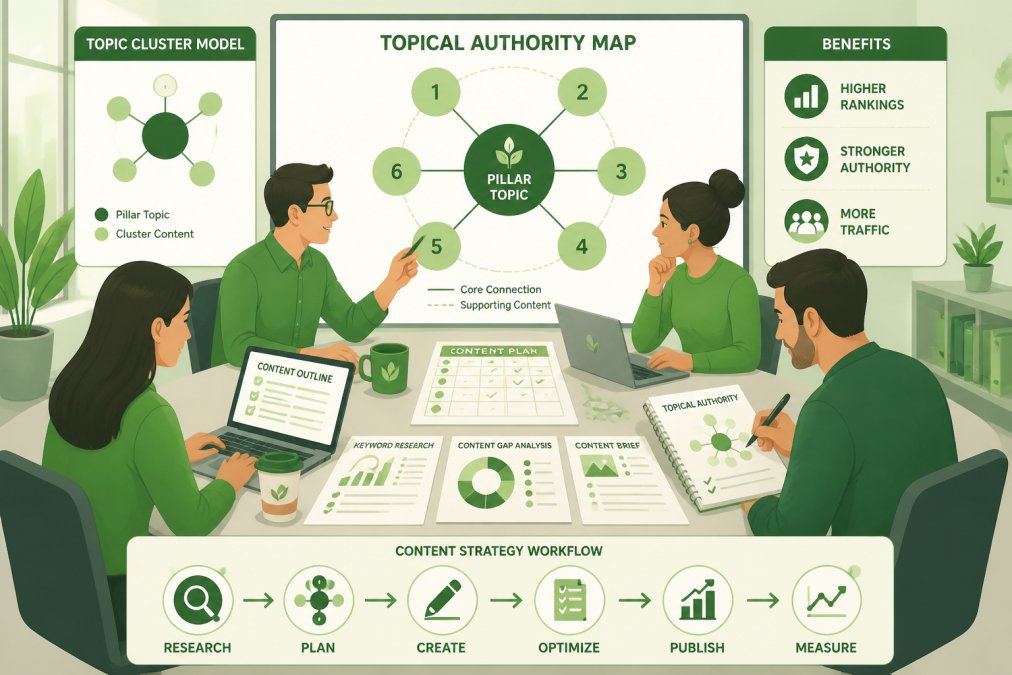
Building topical authority requires planning. Map out the topics your business covers. Identify the core topic, then break it into subtopics and specific keywords. Create content for each, linking them together around the core topic.
For example, if your core topic is "SaaS pricing models," your subtopics might include "value-based pricing," "usage-based pricing," and "tiered pricing." Each gets its own comprehensive post. They all link to each other and back to your main pricing pillar page. Google sees this interconnected content and recognizes you as an authority on SaaS pricing.
This approach builds domain authority faster than random content because you're signaling expertise in a defined area. It also drives more traffic because you're ranking for multiple related keywords, and readers trust sites that clearly specialize.
5. Fix Technical SEO Fundamentals
Technical SEO is the foundation. Without it, even great content won't rank. Technical issues prevent Google from crawling and indexing your site properly, which limits your visibility regardless of content quality.
Start with a technical audit. Use Google Search Console (free) to identify crawl errors, indexing problems, and mobile usability issues. This is your diagnostic tool. It shows you exactly what Google sees when it visits your site.
Common technical issues for new sites include slow page speed, missing XML sitemaps, poor mobile responsiveness, and duplicate content. Each one signals to Google that your site isn't ready for prime time.
Page speed matters because it's a ranking factor and a user experience signal. Slow sites lose visitors. Use Google PageSpeed Insights to identify speed bottlenecks. Often it's images that are too large, unoptimized code, or poor hosting. Fix the biggest issues first.
Ensure your site has a proper XML sitemap and that you've submitted it to Google Search Console. This tells Google which pages to crawl and how often to check for updates. It's a simple step that ensures new content gets indexed faster.
Mobile responsiveness is non-negotiable. More than half of searches happen on mobile devices. If your site doesn't work well on phones, Google ranks it lower. Test your site on mobile devices and fix any layout or usability issues.
6. Use the Best Domain Authority Checker Tools to Track Progress
Tracking domain authority helps you understand whether your efforts are working. The best domain authority checker tools give you visibility into your progress and show you how you compare to competitors.
Moz Pro pioneered the domain authority metric and remains one of the most reliable sources. It offers a free tier for verified site owners and paid plans for deeper analysis. The interface is beginner-friendly, making it accessible even if you're new to SEO.
Ahrefs provides detailed backlink analysis and domain authority estimates. It shows you exactly which sites link to you, the quality of those links, and opportunities to earn new ones. The data is comprehensive, though the pricing is higher than some alternatives.
Semrush offers a full SEO toolkit including domain authority tracking. It integrates with Google Search Console and provides ongoing monitoring of your progress. The platform is feature-rich but can be overwhelming for beginners.
Google Search Console is free and shows you real data about how Google sees your site. While it doesn't calculate domain authority directly, it shows you clicks, impressions, and rankings, the metrics that actually matter for your business.
| Tool | Best For | Key Feature | Cost |
|---|---|---|---|
| Moz Pro | Beginners | Domain Authority metric | See website for pricing |
| Ahrefs | Link analysis | Backlink database | See website for pricing |
| Semrush | Full SEO suite | Competitive research | See website for pricing |
| Google Search Console | Real data | Actual search performance | Free |
The most important tool is Google Search Console because it shows actual performance data. The others estimate authority. Use Search Console as your primary metric, and use a domain authority checker as a secondary indicator of progress.
How Long Does It Take to Increase Domain Authority?
Domain authority increases gradually. Most new sites see movement within 3-6 months if they're actively building backlinks and creating quality content. But the timeline varies based on your niche competitiveness and effort level.
Competitive niches take longer. If you're in SaaS, marketing, or finance, expect 6-12 months to see meaningful domain authority growth. Less competitive niches might show progress in 2-3 months.
The relationship between effort and results isn't linear. Your first backlinks and posts have minimal impact. After 20-30 posts and 10-15 quality backlinks, momentum builds. This is when you start seeing real ranking improvements.
Don't obsess over the timeline. Focus on consistent execution. One quality post per week and one strategic backlink per week compounds quickly. After six months of consistent effort, you'll have a foundation that supports faster growth.
Beyond Domain Authority: Focus on Real Traffic and Revenue
Here's the truth most guides won't tell you: domain authority is a vanity metric. It's useful as a proxy for authority, but it's not what pays your bills.
A site with domain authority 25 that ranks for high-intent keywords and converts visitors into customers is worth infinitely more than a site with domain authority 40 that gets no traffic. Google's algorithm has evolved. Domain authority matters, but it's not the whole story.
What actually matters is topical authority in your specific niche, content that ranks for keywords your customers search, and a user experience that converts. These drive real traffic and revenue.
When you optimize for domain authority specifically, you might build links from irrelevant sources just to boost the metric. When you optimize for business results, you build links from sources that send you actual customers. The second approach builds domain authority naturally as a byproduct.
Track your real metrics: organic traffic, keyword rankings, conversions, and revenue from organic search. Use domain authority as a health check, if it's stagnant, something's wrong. But don't let it distract you from what matters.
GrandRanker helps you focus on these real metrics by automating the work that builds domain authority as a side effect. Instead of manually researching keywords, creating content, and optimizing pages, you focus on strategy while the platform handles execution. The result is consistent content that ranks, builds topical authority, and drives customers from Google and ChatGPT.
Building domain authority for a new website takes time, but it's achievable with the right approach. Focus on creating content that establishes topical authority, earning quality backlinks from relevant sources, and optimizing your technical foundation. These activities build domain authority naturally while driving real traffic and customers. Start with one strategy, guest posting or broken link building, and execute it consistently. After three months, add a second strategy. The compounding effect of multiple approaches accelerates your growth significantly.
Frequently Asked Questions
How can I increase domain authority quickly for a new website?
Focus on earning high-quality backlinks from relevant, authoritative sites in your industry. Start with guest posting and broken link building, which are low-cost ways to build links without needing an established reputation. Simultaneously, optimize your on-page content for search intent, implement proper internal linking, and ensure your site's technical foundation is solid. Most new sites see measurable domain authority growth within 3-6 months of consistent effort, but traffic growth often comes faster than DA increases.
What's the difference between domain authority and actual traffic growth?
Domain authority is a metric created by SEO tool companies to estimate ranking potential, but it doesn't directly drive traffic. Two sites with identical domain authority can have vastly different traffic levels depending on their content quality, keyword targeting, and user experience. New sites often obsess over DA when they should focus on acquiring search traffic and customers. Ranking for high-intent keywords with lower competition typically brings revenue faster than chasing a higher DA number.
How long does it take to increase domain authority for a new website?
New websites typically enter Google's 'sandbox' period, where rankings are suppressed for 3-6 months regardless of optimization quality. Domain authority growth usually follows a similar timeline: expect 4-6 months before seeing meaningful DA increases. However, organic traffic can start arriving sooner if you target less competitive keywords. The key is consistency, publishing quality content and earning backlinks regularly compounds over time, but there's no shortcut past the initial waiting period.
Do I need expensive SEO tools to track domain authority?
No. Google Search Console is free and shows your actual search traffic, impressions, and click-through rates, metrics that matter more than domain authority. For backlink monitoring, Ahrefs and Moz Pro offer paid plans starting around $99-129/month, but free alternatives like Google Search Console and Bing Webmaster Tools cover the essentials. Focus your budget on content creation and outreach first; tools are secondary to the work itself.
This article was written using GrandRanker