 ultimate-guide
Domain Authority Timeline for New Websites: 2026 Guide
Table of Contents
- What Is Domain Authority and Why New Websites Start at Zero
- The Real Domain Authority Timeline for a New Website
- How Long Does SEO Take to Work for a Brand-New Domain
- Factors That Influence Your Domain Authority Growth Trajectory
- Link Building Strategies for New Websites That Actually Move DA
- How to Increase Domain Authority: A Step-by-Step Action Plan
- Domain Authority Checker Tools Worth Using in 2026
- Common Misconceptions About the Domain Authority Timeline
- Conclusion: Track the Right Metrics While DA Catches Up
Last Updated: May 30, 2026
Understanding the domain authority timeline for new website growth is one of the most misunderstood challenges in SEO. Most founders expect DA to climb within weeks of launching. It rarely does. This guide from GrandRanker breaks down exactly what to expect, when to expect it, and, more importantly, what to actually focus on while DA catches up. Below, we'll show you the phase-by-phase timeline, the factors that accelerate or stall progress, and the metrics worth tracking in the meantime.
Here's what most guides get wrong: Domain Authority is not a goal. It's a reflection of work you've already done. Treating it as a leading indicator is the single fastest way to misallocate your SEO budget.
What Is Domain Authority and Why New Websites Start at Zero
Domain Authority (DA) is a proprietary score developed by Moz that predicts how likely a website is to rank on Search Engine Results Pages (SERP), calculated on a logarithmic scale from 1 to 100. A brand-new domain begins at 1, not zero, but the practical effect is the same: no established link profile, no crawl history, and no trust signals for search engines to evaluate.
New websites start at the bottom because DA is entirely backward-looking. The score reflects the quantity and quality of backlinks pointing to your domain, the authority of those linking domains, and how your link profile compares to every other website Moz has indexed. There is nothing you can do on launch day to change that score immediately.
DA vs. Domain Rating: Moz, Ahrefs, and What Each Measures
The SEO industry uses two dominant authority metrics, and conflating them causes real strategic confusion.
Domain Authority (DA) is Moz's metric. It weights the number of unique linking root domains, the authority of those domains, and spam signals. Moz updates its DA scores roughly monthly during its crawl cycle.
Domain Rating (DR) is Ahrefs' equivalent. It focuses more narrowly on the raw strength of a domain's backlink profile relative to all other domains in the Ahrefs index. DR tends to be more volatile in early stages because Ahrefs crawls more frequently.
Neither metric is a Google ranking factor. Google has confirmed repeatedly that it does not use DA or DR in its algorithm. What both metrics attempt to approximate, imperfectly, is the same underlying signal Google uses: the quality and authority of your off-page SEO profile.
According to Moz's guide to Domain Authority, DA is best used as a comparative tool, not an absolute benchmark. Use it to compare your site against competitors in the same niche, not as a standalone target.
Why DA Is a Lagging Metric, Not a Ranking Factor
DA is a lagging indicator. This is the part most people get wrong.
A lagging metric reflects past activity. It tells you what happened, not what will happen. By the time your DA moves from 5 to 15, you've already done the work that caused it: published content, earned backlinks, built citations. The score is simply catching up to reality.
Leading indicators, by contrast, predict future performance. For a new website, the leading indicators that actually matter are: number of indexed pages, crawl frequency, referring domain growth rate, and keyword ranking trajectory. Track those. DA will follow.
The Real Domain Authority Timeline for a New Website
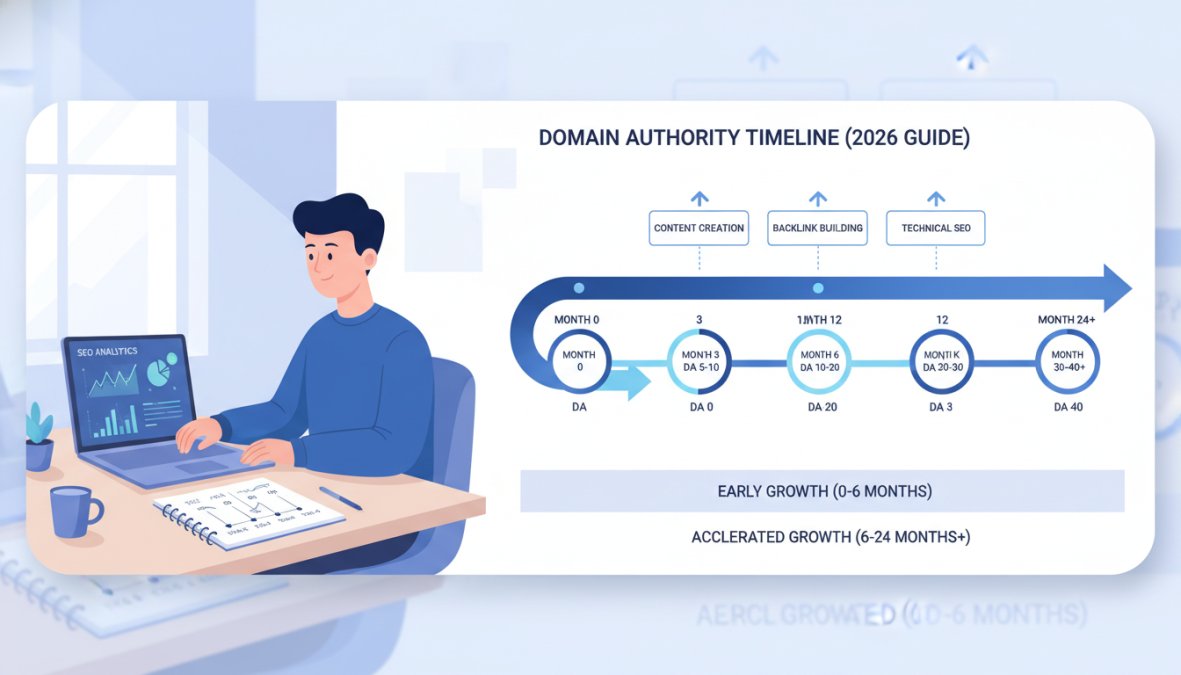
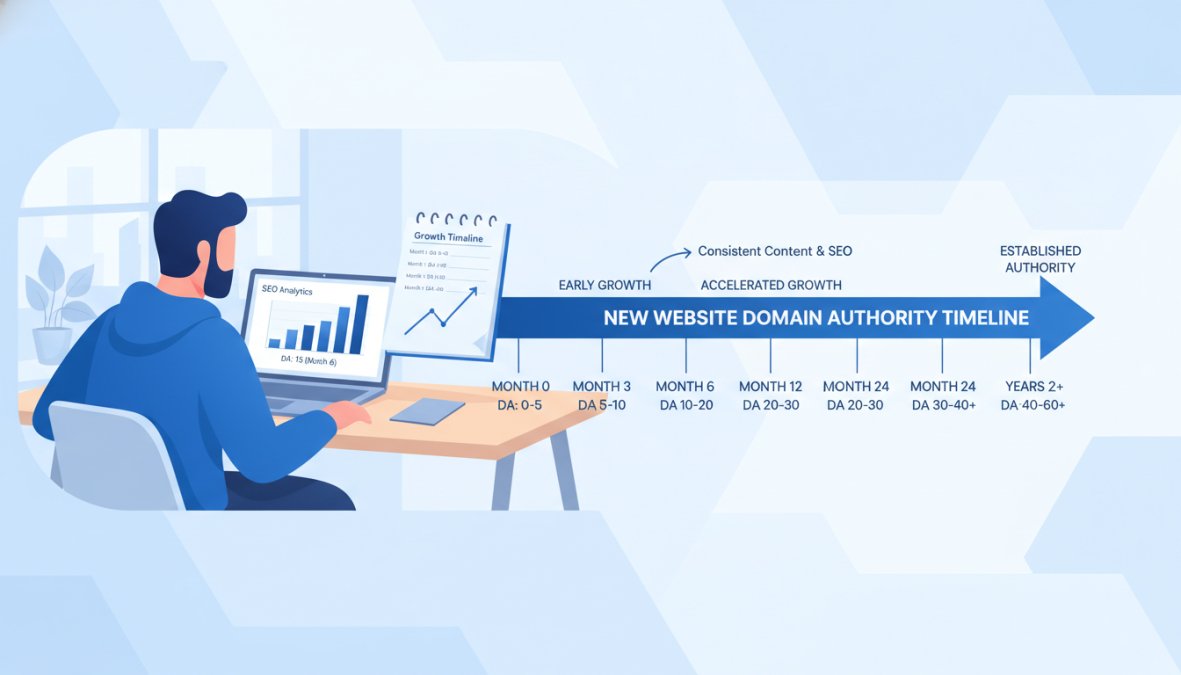
The domain authority timeline for new website projects follows predictable phases, though the pace varies significantly by niche, content investment, and link building strategy. Most new websites should plan for an 18-month runway before DA becomes a meaningful competitive signal.
Months 1-3: Crawl Cycles, Indexing, and the Waiting Game
The first three months are almost entirely technical. Googlebot needs to discover your site, crawl it, and index your pages before any authority signals can accumulate. For brand-new domains, this process takes longer than most founders expect.
During this phase:
- Submit your sitemap to Google Search Console immediately
- Ensure your robots.txt file is not blocking crawlers
- Publish at least 10-15 substantive pages to give crawlers something to index
- Set up Google Search Console and Ahrefs or Moz to establish baseline metrics
DA movement during months 1-3 is typically zero. This is normal. Moz's crawl cycle may not even register your domain yet. The work you do here, publishing content and building your first citations, creates the foundation for movement in the next phase.
Months 4-9: Early Link Profile Growth and First DA Movement
This is where the domain authority timeline for new website projects starts to show its first signals. If you've been actively building backlinks through guest posts, digital PR, and directory citations, Moz's crawl cycle will begin to reflect those links in your score.
Realistic expectations for months 4-9:
- DA 1 to 5: Achievable with basic citation building and 5-10 quality backlinks
- DA 5 to 15: Requires consistent link acquisition from relevant, mid-authority sites
- First keyword rankings in positions 20-50 begin appearing for long-tail targets
Many businesses find that the first meaningful DA jump happens between months 5 and 7, coinciding with Moz's indexing of their earliest earned backlinks. The growth is rarely linear. Expect plateaus followed by step-change jumps after crawl cycle updates.
Months 10-18: Authority Building and the DA Plateau Phenomenon
Here's where it gets interesting. Many new websites hit what practitioners call the DA Plateau: a period where DA stalls despite continued link building activity. This happens because the logarithmic scale makes each incremental DA point harder to earn than the last.
Moving from DA 10 to DA 20 requires substantially more link equity than moving from DA 1 to DA 10. The plateau is not a sign that your strategy is failing. It's a sign that you've reached the point where link quality matters more than link quantity.
To break through a DA Plateau:
- Audit your existing link profile for low-quality or spammy links
- Shift focus to earning links from domains with DR 50 or higher
- Pursue digital PR campaigns that generate editorial coverage
- Build topical authority through content clusters, not isolated pages
By month 18, websites with consistent investment in content quality and link building commonly reach DA 20-35, depending on the niche. Competitive industries like finance or legal take longer. Less competitive niches can move faster.
How Long Does SEO Take to Work for a Brand-New Domain
SEO for a brand-new domain typically takes 6 to 12 months to produce meaningful organic traffic, and 12 to 24 months to produce competitive keyword rankings in most niches. But that range is nearly useless without context, because the mechanisms driving the timeline differ sharply by industry. This section explains not just what to expect, but why the numbers are what they are.
The honest answer is that "SEO working" and "DA moving" are two different things. You can rank for long-tail keywords in months 2-4 without any meaningful DA movement. Organic traffic can grow steadily while your DA sits at 8. The metrics are related but not identical.
Why Niche Determines Timeline More Than Effort Does
Three structural forces explain why a SaaS startup and a local plumber face fundamentally different domain authority timelines, even with identical content and link-building budgets:
1. Competitor link velocity. In high-competition niches like finance or legal, the top-ranking domains are actively acquiring dozens of new referring domains every month. Your DA growth is always measured relative to the index, if competitors are growing faster than you, your relative score can stagnate or fall even while your absolute link count rises. In lower-competition niches, the reference pool is smaller and slower-moving, so the same link-building effort produces faster relative gains.
2. Editorial link availability. Some industries have dense ecosystems of trade publications, niche blogs, and industry associations that routinely link out to new entrants. SaaS and technology benefit from this: product review sites, integration directories, and developer communities create natural link opportunities that don't exist in the same volume for, say, a regional law firm. This is why SaaS sites often reach DA 25+ faster than finance sites despite finance being a higher-authority niche overall.
3. E-E-A-T scrutiny and content velocity. Google applies heightened scrutiny to Your Money or Your Life (YMYL) content, finance, health, legal, which means new sites in those categories face a longer trust-building runway before their content earns rankings, which delays the organic link acquisition that drives DA. A lifestyle blog can publish 30 posts and start earning links in month 3; a medical information site publishing the same volume faces a longer credibility gap before editorial links follow.
Industry-Specific Benchmarks: What DA Score to Expect by Niche
The domain authority timeline for new website projects varies sharply by industry. The table below reflects patterns observed across new-domain projects and should be used as directional guidance, not guarantees. Your actual trajectory depends on content investment, link-building consistency, and how aggressively your direct competitors are building authority.
| Industry | Typical DA at 12 Months | Typical DA at 24 Months | Primary Timeline Driver |
|---|---|---|---|
| Local services (e.g., single-city focus) | 15-25 | 25-40 | Citation density; smaller competitor pool |
| E-commerce (general product categories) | 10-20 | 20-35 | Product page link acquisition; review ecosystem |
| SaaS / Technology | 15-25 | 25-45 | Integration directories; developer community links |
| Finance / Legal | 8-15 | 15-30 | YMYL trust lag; high competitor link velocity |
| Health / Medical | 10-18 | 18-32 | YMYL scrutiny; slow editorial link availability |
| Lifestyle / Blog | 15-30 | 30-50 | High link availability; low competitor DA floor |
Reading the table correctly: The DA ranges assume consistent monthly link-building activity (roughly 5-10 new referring domains per month from relevant, mid-authority sources) and a content publishing cadence of at least 4-6 substantive pieces per month. Sites investing more aggressively, 15+ new referring domains per month through digital PR, can compress these timelines by 30-40%. Sites publishing sporadically or relying solely on directory citations will fall toward the lower end.
The local SEO exception: Local businesses operating in a geographically bounded market face a different competitive landscape than national or global players. A DA of 18-22 can be genuinely competitive for local search visibility in a mid-sized city, whereas the same score is invisible in a national finance query. Before setting a DA target, audit the top 5 organic results for your primary keyword and record their DA scores. That range, not an arbitrary number, is your actual benchmark.
The Compounding Effect: Why Month 18 Looks Nothing Like Month 6
One pattern that surprises most new website owners is how non-linear the growth curve feels. The first 12 months often feel slow because you're building infrastructure, indexed pages, crawl history, a thin link profile, that doesn't produce visible rankings or DA movement proportional to the effort invested.
Month 18 tends to look dramatically different for one reason: content compounds. A piece published in month 2 that earned 3 backlinks passively over the following year has now contributed to your link profile for 16 months. A guest post placed in month 4 may have generated secondary links as other sites cited the host publication. The links you built in months 1-6 are still accruing authority, and the content you published is still being discovered and linked to organically.
This is why the 18-month runway matters more than any single monthly metric. Teams that abandon their SEO investment at month 9, when DA is still low and rankings are still thin, are stopping precisely when the compounding effect is about to accelerate.
Factors That Influence Your Domain Authority Growth Trajectory
Several variables determine whether your domain authority timeline accelerates or stalls. Understanding them lets you intervene at the right point rather than waiting passively for scores to move.
Website Age, Content Quality, and On-Page Optimization
Website age is a genuine factor in authority building, but not because older domains are inherently trusted. Older domains have had more time to accumulate backlinks, citations, and crawl history. Age is a proxy for accumulated signals, not a direct ranking factor.
Content quality affects DA indirectly but powerfully. High-quality content earns organic backlinks over time. A well-researched, original piece on a technical topic will attract links from other sites in your niche without any active outreach. This is the compounding effect of content investment: pages that earn links passively continue building your link profile months or years after publication.
On-page optimization, including keyword targeting, internal linking structure, and page experience signals, does not directly affect DA. But it affects your ability to rank, which increases your visibility, which increases the likelihood of earning editorial backlinks. The relationship is indirect but real.
According to Google's Search Essentials documentation, content that demonstrates expertise, experience, authoritativeness, and trustworthiness (E-E-A-T) is more likely to rank well, which creates the conditions for natural link acquisition.
Negative SEO and How It Can Derail Your Timeline
Negative SEO is an underreported risk for new websites. A competitor or bad actor can point large volumes of low-quality, spammy backlinks at your domain, which can suppress your DA and, in severe cases, trigger a Google algorithm penalty.
New websites are particularly vulnerable because their link profiles are thin. A sudden influx of 500 spammy links stands out dramatically against a baseline of 20 quality links.
Protective measures:
- Monitor your backlink profile weekly using Ahrefs or Moz
- Set up Google Search Console alerts for manual actions
- Use Google's Disavow tool to reject clearly harmful links
- Document your link profile baseline in months 1-3 so anomalies are visible immediately
Negative SEO can add 3-6 months to your domain authority timeline if it goes undetected. Early monitoring is the only reliable defense.
AI-Driven Search and Its Impact on Authority Signals
AI-driven search is reshaping what "authority" means in 2026. Google's AI Overviews and tools like Perplexity pull answers from sources they consider authoritative, and the signals they use overlap with but are not identical to traditional DA metrics.
Being cited by AI assistants increasingly depends on structured content, clear entity definitions, and topical depth rather than raw link counts. A website with DA 25 but comprehensive, well-structured content on a specific topic can earn AI citations that a DA 60 generalist site does not.
This is where the domain authority timeline for new website owners gets more interesting. Building topical authority through content clusters, structured data, and clear entity signals can generate AI citations and organic traffic even before your DA reaches competitive levels. The two tracks, traditional SEO authority and AI citability, are increasingly worth pursuing in parallel.
Link Building Strategies for New Websites That Actually Move DA
Most link building advice is either too generic or too aggressive for new websites. The strategies that actually move DA in the first 18 months are specific, relationship-driven, and sustainable.
Digital PR, Guest Posts, and Citation Flow Tactics
Digital PR is the highest-use link building strategy for new websites. A single piece of original research or a compelling data story can earn coverage from publications with DR 60-80, producing more link equity than months of manual outreach.
Guest posting remains effective when done correctly. The key distinction is relevance: a guest post on a niche-relevant site with DR 30 outperforms a guest post on a generic DR 50 blog. Search engines evaluate the topical relationship between linking and linked domains.
Citation flow tactics, including local business directories, industry-specific listings, and chamber of commerce registrations, are particularly valuable for local businesses in Ljubljana and surrounding areas. Citations build Trust Flow, a Majestic metric that correlates with local search visibility.
Practical link building checklist for new websites:
- Submit to 10-15 high-quality, niche-relevant directories
- Identify 20 guest post targets with DR 25+ in your niche
- Create one piece of original research or data content per quarter
- Build relationships with 5-10 journalists or bloggers in your space
- Register your business with local directories relevant to Ljubljana and Slovenia
- Monitor competitor backlinks monthly and identify replicable opportunities
How to Increase Domain Authority: A Step-by-Step Action Plan
Increasing domain authority is a systematic process, not a single campaign. This action plan works for new websites aiming to move from DA 1 to DA 30 within 18 months.
Total Time: 18 months of consistent execution Difficulty: Intermediate
Step 1: Technical Foundation (Weeks 1-4) Ensure your site is fully crawlable, indexed, and free of technical errors. Submit your sitemap, configure Search Console, and fix any crawl errors. Expected result: full indexing of your core pages within 4-6 weeks.
Step 2: Content Infrastructure (Months 1-3) Publish a minimum of 15 substantive pages targeting specific, low-competition keywords. Build content clusters around 3-5 core topics. This creates the topical depth that both Google and AI systems reward.
Step 3: Citation and Directory Building (Months 1-4) Build 20-30 citations across authoritative directories. For local businesses in Ljubljana, include Slovenian business directories and local chamber listings. This establishes your Trust Flow baseline.
Step 4: Outreach and Guest Posting (Months 3-9) Execute a systematic guest posting campaign targeting 2-3 placements per month on relevant sites with DR 25+. Track referring domain growth in Ahrefs or Moz monthly.
Step 5: Digital PR and Earned Media (Months 6-18) Invest in at least one digital PR campaign per quarter. Original research, industry surveys, or newsworthy data stories generate editorial coverage that manual outreach cannot replicate.
Step 6: Link Profile Auditing (Ongoing) Review your backlink profile monthly. Disavow spammy links before they accumulate. Benchmark your DA against top competitors quarterly to assess your growth trajectory relative to the competitive landscape.
Domain Authority Checker Tools Worth Using in 2026
Several tools provide DA and DR data, each with different crawl frequencies and index sizes.
| Tool | Primary Metric | Update Frequency | Best For |
|---|---|---|---|
| Moz Link Explorer | Domain Authority (DA) | Monthly | DA tracking, spam score |
| Ahrefs | Domain Rating (DR) | Frequent crawl cycle | Backlink analysis, competitor research |
| Majestic | Trust Flow / Citation Flow | Regular | Trust and citation signals |
| SEMrush | Authority Score | Regular | All-in-one SEO strategy |
According to Ahrefs' guide to Domain Rating, DR is calculated by looking at the number of unique domains linking to a target website and the DR of those linking domains, then applying a logarithmic scale. This explains why early DA and DR growth feels slow: the logarithmic nature of the scale means the first 20 points are earned relatively quickly, while points 20-40 require exponentially more link equity.
For new websites, using two tools simultaneously (typically Moz for DA and Ahrefs for DR) gives a more complete picture of your link profile health than relying on a single metric.
Common Misconceptions About the Domain Authority Timeline
Most guides list the same three DA myths and move on. This section goes further: it addresses the misconceptions that actually cost new websites months of misdirected effort, including two that almost no competitor covers, the logarithmic plateau trap and the AI-search relevance shift.
Misconception 1: DA Directly Causes Rankings
DA does not cause rankings. This is the foundational confusion that distorts how most new website owners interpret their SEO progress.
DA correlates with rankings because high-DA sites tend to have strong link profiles, and strong link profiles do influence rankings. But the causal chain runs through the link profile itself, not through the DA score. A site with DA 40 built on low-quality, topically irrelevant links will underperform a DA 25 site with a tight, relevant link profile in a specific niche. Chasing the number without understanding what produces it is the error.
Misconception 2: Paying for Links Will Accelerate DA Safely
It will not. Google's link spam policies are explicit: paid links require the rel="nofollow" or rel="sponsored" attribute. Followed paid links violate Google's guidelines and can result in manual penalties that set your authority building back by months or years. Services offering "guaranteed DA 30 in 30 days" typically use private blog networks (PBNs) or link farms. Sites penalized for unnatural link schemes can lose organic traffic entirely, and recovery typically takes 6-12 months even after a successful reconsideration request.
Misconception 3: DA Updates in Real Time
Moz's crawl cycle means DA scores are updated roughly monthly. A backlink you earn today may not appear in your DA score for 4-6 weeks. This lag causes many founders to conclude their link building isn't working when it simply hasn't been reflected in the score yet.
As documented by Moz's explanation of how DA is calculated, the score is recalibrated against Moz's entire index each crawl cycle, which means your DA can drop even if your absolute link profile improves, simply because other sites in the index grew faster. This is the comparative nature of the metric, and it's another reason to treat DA as a directional signal rather than a precise target.
Misconception 4: The Logarithmic Scale Is Linear in Practice (The DA Plateau Trap)
This is the misconception most guides skip entirely, and it's the one that causes the most strategic confusion around the month 10-18 mark.
DA operates on a logarithmic scale. This means the effort required to move from DA 1 to DA 10 is fundamentally different from the effort required to move from DA 30 to DA 40, even though both represent a 10-point gain on paper.
Here's the practical implication: many new websites experience what practitioners call the DA Plateau, a period where DA appears to stall despite continued link-building activity. The plateau is not a sign that the strategy is failing. It's a mathematical property of the scale itself.
- DA 1-10: Achievable with basic citation building and a handful of quality backlinks. The logarithmic curve is relatively shallow here, so each new referring domain produces a visible score movement.
- DA 10-20: Requires consistent acquisition from mid-authority, topically relevant domains. Score movement slows noticeably even with the same monthly link volume.
- DA 20-30: Each additional point requires meaningfully more link equity than the last. A site moving from DA 20 to DA 30 typically needs links from higher-authority domains (DR 50+) rather than simply more links from the same tier of sources.
- DA 30-40 and beyond: At this range, incremental gains require editorial coverage from high-authority publications, sustained digital PR, and a link profile that demonstrates topical depth, not just volume.
The practical takeaway: if your DA has stalled between 15 and 25 despite consistent link building, the problem is almost certainly link quality and source authority, not link quantity. Auditing your referring domain profile for average DR and topical relevance will tell you more than doubling your outreach volume.
Misconception 5: DA Remains the Right Primary Metric in an AI-Driven Search Environment
This is the newest and least-discussed misconception, and it matters significantly for new websites launching in 2025-2026.
Google's AI Overviews and third-party AI assistants like Perplexity and ChatGPT pull answers from sources they consider authoritative. The signals they use overlap with traditional DA metrics, link authority, domain trust, content quality, but they are not identical. AI citation systems weight structured content, clear entity definitions, topical depth, and factual precision heavily. A website with DA 25 but comprehensive, well-structured content on a specific topic can earn AI citations that a DA 60 generalist site does not receive.
For new websites, this creates a parallel opportunity: building topical authority through content clusters, structured data markup, and clear entity signals can generate AI citations and referral traffic even before your DA reaches competitive levels. The two tracks, traditional link-based authority and AI citability, are increasingly worth pursuing simultaneously rather than treating DA as the single gate to organic visibility.
This does not mean DA is irrelevant. It means DA is one signal among several, and new websites that fixate on it as the primary KPI risk underinvesting in the content depth and structured data that AI-driven search increasingly rewards.
Conclusion: Track the Right Metrics While DA Catches Up
DA is a useful benchmark, but it's a poor daily KPI for a new website. The founders who grow fastest are the ones tracking leading indicators: indexed pages, referring domain count, keyword ranking trajectory, and organic click-through rate. DA will follow the work, not precede it.
Building authority from scratch is genuinely hard, especially when you're managing content creation, link outreach, and technical SEO simultaneously. GrandRanker automates the underlying work: keyword research, content creation, optimization, and publishing, so your domain authority timeline accelerates without consuming your core business hours. With 421+ founders already growing on autopilot, the platform is built specifically to boost domain authority and get your site cited by AI assistants like ChatGPT and Perplexity. Start your free trial with GrandRanker and let the system build your authority while you focus on what you do best.
Frequently Asked Questions
How long does it take to increase domain authority for a new website?
The domain authority timeline for a new website typically spans 6 to 18 months before meaningful DA movement is visible. The first 3 months are mostly spent getting crawled and indexed. Consistent link building and content quality efforts from months 4 onward begin to shift the needle. Because DA is a lagging metric that updates on Moz's crawl cycle, gains you make today may not reflect in your score for weeks or months.
What is a good domain authority score for a new website?
A DA of 10-20 is typical and realistic for a website under one year old. Rather than chasing a specific number, benchmark against direct competitors in your niche using tools like Moz or Ahrefs Domain Rating. In less competitive industries, a DA of 20-30 can be enough to rank well. In highly competitive niches like finance or SaaS, you may need DA 40+ to compete on core keywords.
Is domain authority a Google ranking factor?
No. Domain Authority is a third-party metric created by Moz, not a signal used by Google's algorithm. Google uses its own internal authority signals based on PageRank, link quality, content relevance, and user experience. DA is a useful proxy for estimating competitive strength, but improving your DA score does not directly cause higher keyword rankings. Focus on the underlying factors, quality backlinks, strong content, and solid on-page optimization, that improve both DA and actual rankings.
How can I improve my domain authority quickly using link building strategies for new websites?
The fastest legitimate ways to build domain authority include digital PR campaigns to earn editorial backlinks, guest posting on relevant industry sites, building citations in business directories, and creating linkable assets like original research or tools. For new websites, focus on link quality over quantity, a few links from high-authority domains outweigh dozens of low-quality ones. Tools like GrandRanker can automate content creation and optimization to support your link building efforts consistently.
Can negative SEO slow down my domain authority growth timeline?
Yes. If competitors or bad actors point spammy, low-quality backlinks at your site, it can suppress your link profile quality and slow DA growth. Monitor your backlink profile regularly using domain authority checker tools like Moz, Ahrefs, or Google Search Console. Use Google's Disavow Tool to reject harmful links. Catching and disavowing toxic links early prevents them from dragging down your trust flow and extending your authority building timeline.
This article was written using GrandRanker