 ultimate-guide
Best SEO Practices for Local Businesses 2026
Table of Contents
- Why Local SEO Matters More Than Ever in 2026
- Google Business Profile Optimization Tips That Drive Results
- How to Get Local Reviews in 2026
- AI Search Optimization for Local Businesses
- Build Citations Across Trusted Directories
- Create Location-Specific Content That Ranks
- Mobile-First Optimization for Local Discovery
- Local Link Building Strategies
- Track Local Rankings and Measure What Matters
- Common Local SEO Mistakes to Avoid
- Automate Local SEO for Consistent Growth
- Frequently Asked Questions
Last Updated: August 26, 2026
Why Local SEO Matters More Than Ever in 2026
Local SEO is no longer optional for businesses competing in their geographic markets. The numbers tell a clear story: 98% of consumers search online for nearby companies, up from 90% in 2019. More striking still, 80% of U.S. consumers search for local businesses weekly, with 32% searching daily. These aren't vanity metrics. They translate directly to foot traffic. 76% of near-me mobile searches lead to a store visit within 24 hours, meaning local search intent converts faster than almost any other search behavior.
But here's what most businesses miss: the landscape has shifted dramatically in just two years. Younger consumers, 18- to 24-year-olds, are abandoning Google for local discovery. Only 61% of that demographic uses Google for local business information anymore. Instead, 67% now turn to Instagram and 62% to TikTok. Generative AI adoption has exploded too. In a single year, the use of ChatGPT and similar tools for local recommendations climbed from 6% to 45%. This isn't a gradual trend. It's a paradigm shift happening right now.
At GrandRanker, we've analyzed how these changes affect ranking strategies and visibility across search platforms. The businesses winning in 2026 aren't just optimizing for Google. They're optimizing for AI assistants, social platforms, and a fragmented discovery ecosystem. The good news: the fundamentals of local SEO, the practices that drive results, remain consistent. What's changed is the execution and the channels where visibility matters most.
Below, we'll walk you through the best SEO practices for local businesses in 2026, backed by real data and case studies from businesses that moved the needle. These strategies work across all market sizes and business types, from single-location service providers to multi-location enterprises.
Google Business Profile Optimization Tips That Drive Results
Your Google Business Profile is the single most powerful asset in local SEO. Businesses appearing in the Google Local 3-pack, the three map results shown at the top of search, receive 126% more traffic and 93% more actions than those ranked positions four through ten. That's not a marginal difference. It's the difference between visibility and invisibility.
The profile itself is a direct channel to your customers. Google Business Profile actions have increased 41% year-over-year from 2025 to 2026, meaning more people are clicking directions, calling your business, and visiting your website directly from the profile. This growth reflects a shift toward profile-first discovery, users are trusting the profile data more than ever.
Optimization starts with the basics, but the details matter. Most businesses leave money on the table by treating their profile like a one-time setup task. It's not. Your profile is a living asset that compounds in value with consistent attention.
Choose Your Primary Category Strategically
Your primary category is the single most important profile element for local ranking. Most businesses choose the obvious category, "Restaurant" for a restaurant, "Dentist" for a dental practice. This is a mistake.
A Chicago restaurant made a small but precise change: they switched their primary category from the generic "Restaurant" to the specific "Italian Restaurant." Within 90 days, their Maps ranking moved from position 12 to position 2 for "Italian restaurant Lincoln Park." Direction requests jumped 312%, phone calls increased 184%, website clicks rose 89%, and reviews grew 56%. One category change. One business. Those are the results.
The principle is specificity. Google's algorithm rewards precision because it helps match user intent. When someone searches "Italian restaurant near me," Google prioritizes profiles that claim that exact category. A generic "Restaurant" category competes against every restaurant in the area. A specific category narrows the field and increases your relevance score.
The strategy: audit your primary category against the searches you want to rank for. If you're a family dentistry practice, "Family Dentist" ranks better than "Dentist." If you're a boutique fitness studio offering yoga, "Yoga Studio" beats "Fitness Center." Look at your search analytics and customer inquiries. What specific service or category do people actually search for when they find you? Make that your primary category.
Secondary categories matter too, but they're weighted less heavily. Use them to cover adjacent services, but never dilute your primary category to cast a wider net. Specificity wins.
Complete Every Profile Section
Incomplete profiles rank worse. Google treats missing information as a ranking penalty because it signals low business credibility. Every section you fill out is a signal that you're legitimate, active, and worth showing to searchers.
The sections that matter most are the ones customers use to decide: hours of operation, phone number, website, address, and photos. But there's more. Your profile should include your full service menu, business description, attributes (like "wheelchair accessible" or "takeout available"), and regular posts.
Photos are underutilized. Profiles with 10+ high-quality photos outrank those with fewer. Show your storefront, team, products, and customers in action. A Houston dental practice optimized their profile comprehensively, including category refinement, complete information, and a steady photo upload schedule. Within 60 days, they moved from position 9 to position 2 for "dentist Houston Heights." Maps impressions increased 220%, direction requests jumped 167%, appointment requests from the profile rose 140%, and reviews grew 177%.
The time investment here is minimal. Most of this work takes a few hours to complete initially, then 10-15 minutes per week to maintain.
Post Regularly to Your Profile
Google rewards active profiles. Posts signal that your business is current, engaged, and worth showing in search results. The algorithm tracks post frequency, recency, and engagement. A business posting twice a month will outrank an identical competitor posting once every six months, all else equal.
What should you post? Offers, events, product updates, customer testimonials, and timely announcements. Posts don't need to be long, a sentence or two with an image works. The goal is consistency and freshness. Posts expire after 7 days, so the cadence matters more than the volume.
A practical schedule: two posts per week. One product or service highlight, one customer testimonial or case study. This keeps your profile active without becoming burdensome. Tools like GrandRanker can automate profile post creation based on your business updates, ensuring consistency without manual effort.
How to Get Local Reviews in 2026
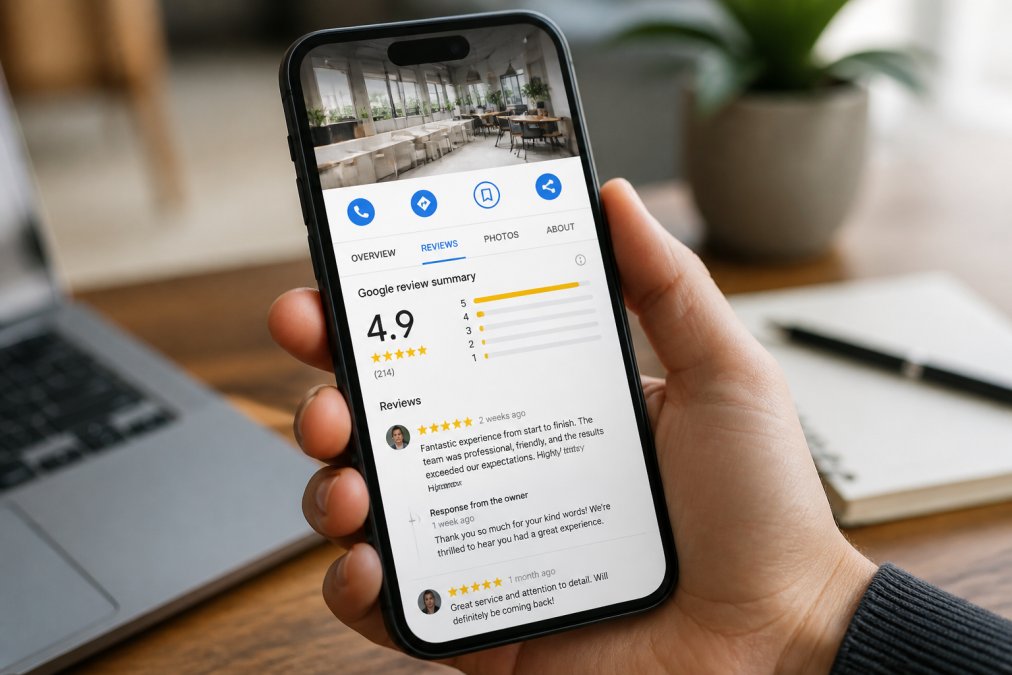
Reviews are the currency of local trust. 97% of consumers read reviews for local businesses, and 41% always read reviews when browsing for businesses, up from 29% the prior year. Star ratings have become an entry requirement. The average rating across all industries measured is 4.78 stars. Below 4.5, you're at a disadvantage. Above 4.7, you're competitive. The gap between 4.5 and 4.8 doesn't meaningfully differentiate you anymore. A high rating is table stakes, not a differentiator.
What actually matters now is review volume. In dense markets like New York, businesses ranked one to three carried a lower median review count than those ranked four to twenty. This suggests that proximity and recency outweigh review quantity in highly competitive areas. But in less saturated markets, volume matters more. Austin businesses carry a median of 317 reviews compared to 119 in New York, a 2.7x difference. The takeaway: review velocity and consistency matter more than raw count. A business adding reviews consistently will outrank one with a large historical count that's gone stale.
Automate Review Requests at Key Moments
Manual review requests don't scale. Automation does. The businesses growing reviews fastest are those triggering requests at moments when customers are most likely to respond: immediately after a purchase, service completion, or positive interaction.
The mechanics are straightforward. After a customer completes a transaction, send an automated SMS or email with a direct link to your Google review page. Timing is critical. Within 24 hours of the interaction, response rates are highest. After 48 hours, they drop significantly.
Platforms like GatherUp and Podium automate this workflow, but the principle is simple: remove friction. A direct link to your review page beats asking customers to find you on Google manually. One-click review requests convert at 3-5x higher rates than multi-step requests.
The volume effect is compound. If you're processing 50 customer interactions per month and converting 10% to reviews, that's 5 new reviews monthly. Over a year, that's 60 reviews, enough to move your ranking in most markets. At 20% conversion, it's 120 reviews annually. The difference between 10% and 20% conversion is usually just removing one step from the request process.
Respond to Every Review
Review responses are ranked signals. Google's algorithm treats response rate and response quality as ranking factors. A business responding to 100% of reviews outranks one responding to 50%, all else equal.
Responses should be brief, personalized, and action-oriented. For positive reviews, thank the customer and reinforce a key service or value prop. For negative reviews, acknowledge the issue, apologize if warranted, and offer a solution, ideally moving the conversation offline to resolve the problem privately.
Response time matters too. Responding within 48 hours signals engagement. Responding after a week signals you're not paying attention. Aim for same-day responses when possible.
AI Search Optimization for Local Businesses
The rise of generative AI in local search is reshaping how businesses get discovered. ChatGPT recommends only 1.2% of local business locations, compared with 35.9% visibility in Google's 3-pack for the same brand set. This gap is significant. But it's also an opportunity. Most businesses aren't optimizing for AI visibility at all, which means early movers have an advantage.
AI systems like ChatGPT, Claude, and Perplexity pull information from indexed web content, business profiles, and knowledge graphs. To get cited by AI, your business needs to be visible in these sources. The strategy has three components: ensure your Google Business Profile is complete and current, create location-specific content on your website, and build citations on trusted directories.
Content is the key differentiator. AI systems favor sources with original, detailed information over thin or duplicated content. A dental practice in Denver that publishes a detailed guide on "common orthodontic issues in teenagers" with location-specific insights will get cited by AI more often than one relying only on a profile description.
The practical implication: treat AI visibility as an extension of traditional SEO, not a separate channel. The same practices that improve Google rankings, specific content, citations, profile optimization, also improve AI visibility. The difference is that AI rewards depth and original insight more heavily than Google does.
Build Citations Across Trusted Directories
Citations are mentions of your business name, address, and phone number (NAP) on external websites. They're a trust signal. Consistent citations across authoritative directories tell Google that your business is real, established, and trustworthy.
The citation landscape has fragmented. Google still weights citations from major directories heavily, but the definition of "major" has expanded. Industry-specific directories now carry significant weight. A dental practice should have citations on ZocDoc, Healthgrades, and Zocdoc in addition to Yelp and Google. A local service business should be on Angi (formerly Angie's List) and Home Advisor.
The strategy is two-fold: audit existing citations for accuracy and completeness, then build new citations on high-authority directories relevant to your industry.
Accuracy matters more than volume. A single citation with incorrect information is worse than no citation at all because it creates conflicting signals. Before building new citations, audit your existing ones. Tools like BrightLocal and Semrush Local automate this process. Fix any inconsistencies in NAP data, business description, or category.
Then prioritize. You don't need citations on 50 directories. You need citations on 10-15 high-authority, industry-relevant directories with consistent, accurate information. Quality over quantity.
For multi-location businesses, citation management becomes complex. A car rental company like Avis with 1,700+ locations optimized individual map listings and citations across all locations while improving website location pages. The result: first-page rankings for 213 additional target keywords, leading to hundreds of thousands of new qualified leads. The investment was significant, but the return was massive.
Create Location-Specific Content That Ranks
Generic content doesn't rank. Location-specific content does. A blog post titled "10 Tips for Choosing a Dentist" competes against thousands of identical posts. A post titled "How to Choose a Dentist in Denver: A Guide for New Patients" competes against far fewer and signals local relevance to Google.
The principle applies across all content types. Service pages, blog posts, guides, FAQs, each should be tailored to your location and specific audience. Include your city name naturally in titles, headings, and introductions. Answer location-specific questions: "What are the best neighborhoods for families in Denver?" "How does the cost of living in Denver compare to other Colorado cities?" "What permits do you need to start a business in Denver?"
This content serves dual purposes. It ranks in local search results, and it gets cited by AI assistants answering location-specific questions. When someone asks ChatGPT "What's a good dentist in Denver?" the AI pulls from indexed content that mentions Denver dentists specifically.
The content doesn't need to be long. A 500-word guide on a specific local topic will outrank a generic 2,000-word post on the same topic. Specificity and relevance matter more than word count.
GrandRanker automates location-specific content creation by generating tailored posts for each location you serve, optimizing for local keywords and AI visibility simultaneously. This removes the bottleneck of manual content creation while maintaining consistency across locations.
Mobile-First Optimization for Local Discovery
Mobile-first indexing means Google crawls and ranks your website based on the mobile version first. For local search, this is critical because 73% of consumers use social media during their search for local businesses, and the majority of that traffic is mobile.
Mobile optimization isn't just responsive design. It's speed, usability, and local intent. Your website should load in under 3 seconds on 4G connections. Tap targets should be large enough to hit on a phone. Forms should be minimal, a single-field form converts better than a multi-step form on mobile. And every page should have a clear call-to-action: "Call," "Get Directions," "Book Now."
Location pages are particularly important. If you serve multiple locations, each location should have a dedicated page with local content, local reviews, a map, and a click-to-call button. A visitor landing on your Denver location page should never have to navigate to find your Denver phone number or address.
Mobile speed is a ranking factor. Tools like Google PageSpeed Insights will identify specific issues. Prioritize image optimization, lazy loading, and minified CSS and JavaScript. These changes often improve mobile speed by 30-50% without requiring a site redesign.
Local Link Building Strategies
Backlinks are a ranking factor, and local backlinks are weighted more heavily for local search. A link from a Denver-based news site to your Denver business carries more weight than a link from a national publication.
The strategy is to earn links from local sources: chamber of commerce directories, local business associations, local news outlets, and community organizations. The best links come from earned coverage, a local journalist writing about your business or a community organization featuring you as a resource.
This requires outreach. Build relationships with local journalists, bloggers, and community leaders. Offer expert commentary on local issues, sponsor local events, and participate in community initiatives. These activities generate coverage and links naturally.
The second strategy is to create linkable assets, content so useful or unique that other sites want to link to it. A comprehensive guide to "Starting a Small Business in Denver: A Complete Guide" published on your site might attract links from local business resources, libraries, and educational institutions.
For most local businesses, 5-10 quality local links will meaningfully improve rankings. You don't need hundreds of links. You need relevant, authoritative links from local sources.
Track Local Rankings and Measure What Matters
What gets measured gets managed. Most local businesses don't track their rankings systematically, which means they can't prove ROI or identify what's working.
Set up rank tracking for your target keywords in your target locations. Tools like BrightLocal, Semrush Local, and Moz Local provide location-specific rank tracking with visualization. Track 10-20 core keywords per location, the searches you actually want to rank for.
Beyond rankings, track the metrics that matter: Google Business Profile impressions, direction requests, phone calls, website clicks, and review volume. These are the actions that lead to customers. Rankings are a lagging indicator. Profile actions are the leading indicator that your optimization is working.
Set a baseline, implement changes, and measure impact over 30, 60, and 90 days. Most optimizations take 30-60 days to show measurable ranking changes. Some take longer. Patience and consistency matter more than quick wins.

Common Local SEO Mistakes to Avoid
The mistakes most businesses make are preventable. Awareness is half the battle.
Inconsistent NAP data: Your business name, address, and phone should be identical across your website, Google Business Profile, and all citations. Even minor variations, "John's Dental" vs. "John's Dentistry" or "Suite 100" vs. "Suite #100", create conflicting signals that confuse Google's algorithm.
Neglecting mobile optimization: If your website isn't fast and usable on mobile, you're losing ranking positions and customers. Mobile is no longer secondary. It's primary.
Ignoring reviews: Businesses that don't actively request and respond to reviews fall behind those that do. This is a consistency game. Over a year, the difference between a business with 10 new reviews and one with 100 new reviews is massive.
Vague or generic profile descriptions: Your Google Business Profile description should be specific and benefit-focused. "We provide dental services" loses to "We specialize in pediatric dentistry and orthodontics for families in Denver with same-day emergency appointments."
Inconsistent posting: Sporadic profile posts signal inactivity. Consistent posting, even if it's just twice monthly, signals an active, engaged business.
Ignoring location-specific content: Creating one generic blog post and calling it done doesn't work. Location-specific content ranks better and serves your actual audience better.
Automate Local SEO for Consistent Growth
Consistency is the limiting factor for most local businesses. The practices that work, regular profile updates, consistent content creation, citation management, review requests, require ongoing effort. This is where automation becomes valuable.
GrandRanker automates the repetitive, high-impact tasks: keyword research for local markets, content creation tailored to locations, profile post generation, and citation tracking. By removing manual work, you free up time to focus on strategy and customer relationships while maintaining the consistency that drives rankings.
The alternative is hiring a dedicated person or agency to manage local SEO. For businesses with 1-5 locations, automation is more cost-effective. For multi-location businesses, automation scales more efficiently than manual management.
The key is choosing tools that integrate with your existing workflow. If you're using WordPress, choose tools that publish directly to WordPress. If you're using Shopify, choose tools with Shopify integration. Integration removes friction and ensures consistency.
Local SEO in 2026 is more fragmented than ever, but the fundamentals remain consistent: optimize your Google Business Profile, build reviews and citations, create location-specific content, and measure results. The businesses winning are those treating local SEO as an ongoing practice, not a one-time project. Start with profile optimization and review generation, these two practices alone will move most businesses into competitive positions within 90 days. Then layer in content, citations, and link building as you scale. With GrandRanker, you can automate the entire process, ensuring consistency across all locations while you focus on what matters: serving your customers and growing your business. Start your free trial today and see how automated local SEO accelerates your growth across Google, AI assistants, and your local market.
Frequently Asked Questions
How is AI changing local SEO in 2026?
AI is reshaping local discovery in two critical ways. First, AI search engines like ChatGPT now influence how customers find local businesses, ChatGPT recommends only 1.2% of local business locations compared with 35.9% visibility in Google's 3-pack. Second, 45% of consumers now use generative AI for local recommendations, up from just 6% in 2025. This means optimizing for both Google and AI platforms is essential. AI search optimization for local businesses now requires structured data, consistent citations, and content that answers specific local intent questions.
What are the most important local ranking factors for 2026?
Proximity and relevance dominate local rankings more than review count. In dense markets like New York, businesses ranked one to three carried fewer reviews than those ranked four to twenty, proving that location matters most. Star rating is now an entry requirement, top-ranking businesses average 4.78 stars across all industries. Google Business Profile completeness, accurate NAP data across citations, and location-specific content are the three pillars. Mobile optimization and fast page load times also influence rankings since 76% of near me mobile searches lead to store visits within 24 hours.
How do I optimize my Google Business Profile for 2026?
Start by selecting a primary category that matches your exact service, not a generic one. A Chicago restaurant that switched from 'Restaurant' to 'Italian Restaurant' saw Maps ranking jump from position 12 to position 2 within 90 days. Complete every section: business description, hours, photos, service areas, and attributes. Post updates regularly, businesses that post weekly see significantly higher engagement. Respond to all reviews within 48 hours. Ensure your profile data matches your website, citations, and offline records exactly. Use Google Business Profile optimization tips like adding Q&A content and updating service offerings seasonally.
How do I know if my local SEO efforts are actually working?
Track three metrics: Maps impressions, direction requests, and phone calls directly from your Google Business Profile. Businesses in the Google local 3-pack receive 126% more traffic and 93% more actions than those ranked positions four through ten, so rank position is your primary indicator. Monitor weekly search rankings for your service plus location keywords. Set up conversion tracking to connect profile actions (clicks, calls, directions) to actual visits and sales. Most platforms provide these metrics automatically, use them to prove ROI to leadership and adjust your strategy quarterly.
Why should I invest in local SEO when younger audiences use social media instead of Google?
While 67% of 18- to 24-year-olds use Instagram for local business information and 62% use TikTok, 72% of all consumers still use Google for local searches. That means local SEO reaches a broader demographic and captures high-intent searches, 76% of near me mobile searches convert to store visits within 24 hours. Social media discovery is top-of-funnel awareness; Google local search is bottom-funnel conversion. The strongest strategy combines both: use social for brand awareness, Google for driving actual visits and sales. Ignoring Google local search means leaving 72% of your potential customers unfound.
Can AI-generated content actually rank for local SEO, or does Google penalize it?
Google does not penalize AI-generated content for being AI. An Ahrefs study of 600,000 top-ranking pages found 86.5% contained some AI-generated content, with no measurable ranking penalty. What matters is quality: depth, originality, helpfulness, and expertise. Low-effort AI content often fails the helpfulness bar, which creates the perception of an 'AI penalty.' Content combining AI assistance with human expertise, local insights, and genuine value ranks just as well as human-written content. For local businesses, AI can accelerate content creation, just ensure you add local expertise, specific examples, and genuine customer insights that AI alone cannot generate.
How to improve local search rankings in the United States?
Follow this sequence: (1) Claim and fully optimize your Google Business Profile with accurate category, complete information, and regular posts. (2) Build consistent citations across trusted directories with matching NAP data. (3) Generate reviews through automated requests, 97% of consumers read reviews for local businesses. (4) Create location-specific content on your website answering local search intent. (5) Ensure mobile optimization since 76% of near me searches happen on mobile. (6) Build local backlinks from community organizations and local media. Track rankings weekly and adjust based on which tactics move the needle for your business type.
What's the difference between local SEO and general SEO for my business?
Local SEO focuses on ranking for searches with geographic intent, 'plumber near me,' 'Italian restaurant Denver,' 'dentist hours.' General SEO targets broader topics without location. For local businesses, local SEO drives higher conversion rates because search intent is immediate: the customer is ready to visit or call. 80% of consumers search for local businesses weekly, and 32% search daily. General SEO builds authority and attracts traffic from anywhere. The best strategy uses both: optimize locally to capture high-intent, nearby customers, and build general authority to strengthen your overall domain and appear in AI search results.
This article was written using GrandRanker