 listicle
Best AI Writing Assistants for WordPress: 2026 Review
Table of Contents
- AI Writing Assistants for WordPress Sites: What You Need to Know
- Feature Comparison Table: Top AI Writing Assistants
- How We Evaluated AI Writing Assistants for WordPress
- Best AI Content Generator for WordPress: In-Depth Reviews
- GrandRanker: Complete SEO Automation from Keyword to Publishing
- Rank Math Content AI: SEO-First Content Generation
- Jetpack AI Assistant: Native Gutenberg Integration
- AI Engine: Multi-Model AI Integration for Advanced Users
- Writesonic: External Generation with One-Click Publishing
- AI Power: Bulk Content and WooCommerce Automation
- AI SEO Optimization Tools for WordPress: Technical Integration
- Native Plugins vs. External Tools: Which Approach Wins
- Security and Data Privacy in AI Writing Automation
- Implementation Roadmap: Getting Started Without Mistakes
- Which AI Writing Assistant Should You Choose?
- Conclusion
Best AI Writing Assistants for WordPress: 2026 Review
Last Updated: June 29, 2026
According to recent data from WordPress adoption trends, over 43% of websites now run on WordPress, making it the dominant CMS for content creators and businesses worldwide. Yet many WordPress site owners struggle with content production velocity, the ability to publish consistently without sacrificing quality. This is where an ai writing assistant for wordpress sites review becomes critical. At GrandRanker, we've analyzed the landscape of AI writing tools that integrate directly with WordPress, and what we found reveals a clear divide between tools that genuinely accelerate your workflow and those that create more friction than they solve.
The challenge isn't finding AI writing assistants, it's finding one that actually fits your WordPress environment without requiring constant context switching, API headaches, or manual formatting. This guide covers the top AI writing assistants designed specifically for WordPress sites, evaluates their real-world performance, and shows you exactly which tool matches your workflow.
AI Writing Assistants for WordPress Sites: What You Need to Know
WordPress content creators face a specific problem: most AI writing platforms exist outside your CMS. You draft in Writesonic, then copy-paste into WordPress. You generate in Jasper, then manually format. This workflow tax kills productivity. The best ai writing assistant for wordpress sites review solutions are those that eliminate this friction entirely, tools that live inside Gutenberg, publish directly, or integrate seamlessly with your publishing pipeline.
WordPress-native AI assistants fall into three categories: native plugins (built directly into WordPress), external platforms with WordPress connectors, and hybrid solutions that work both ways. Each approach has distinct advantages and limitations that we'll explore throughout this guide.
The real differentiator isn't the AI model powering the tool. Most use OpenAI's GPT-4, Anthropic's Claude, or Google's Gemini. What matters is integration depth, automation capability, and whether the tool respects your editorial workflow rather than imposing its own.
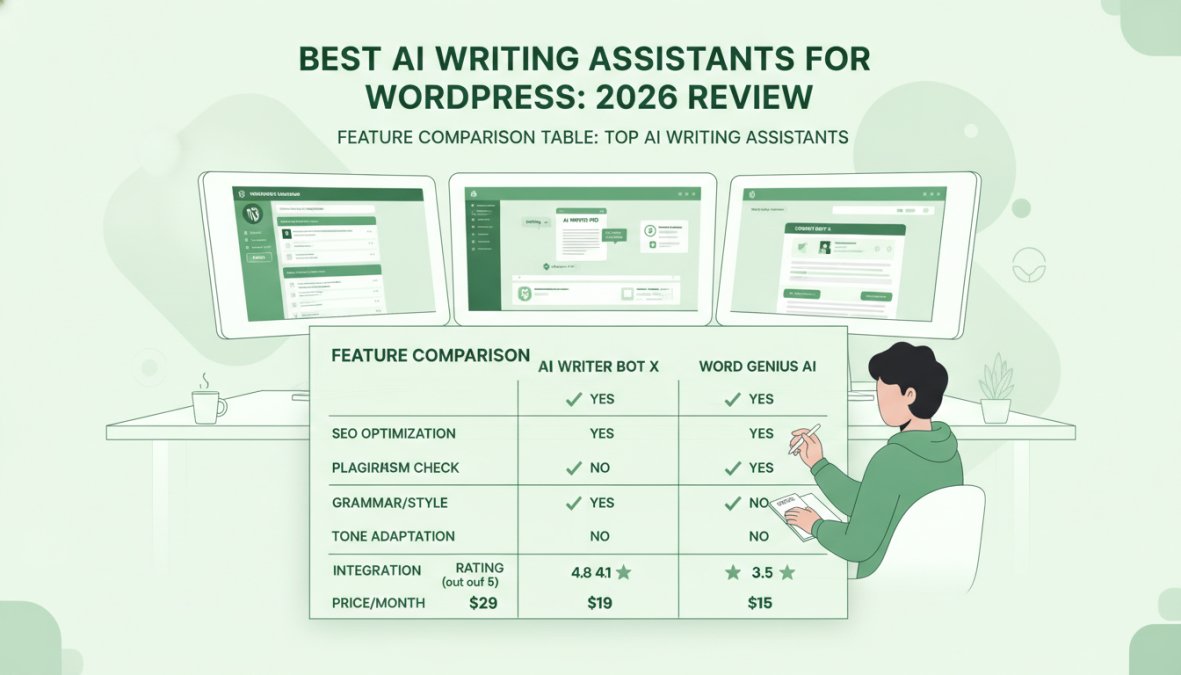
Feature Comparison Table: Top AI Writing Assistants
| Tool | Integration Type | Best For | Starting Price | Free Tier |
|---|---|---|---|---|
| GrandRanker | Native Plugin + SEO Automation | Founders scaling organic traffic | Free trial | Yes |
| Rank Math Content AI | Native Plugin (SEO-focused) | SEO professionals | $18.99/month | Free credits |
| Jetpack AI Assistant | Native Gutenberg Integration | Manual bloggers | Contact for pricing | Limited free |
| AI Engine | Native Plugin (Multi-model) | Advanced users needing flexibility | Free (Pro available) | Yes |
| Writesonic | External + WordPress Plugin | High-volume content teams | Free trial | Yes |
| AI Power | Native Plugin (Bulk operations) | WooCommerce stores | Free (Pro available) | Yes |
How We Evaluated AI Writing Assistants for WordPress
Our evaluation methodology prioritizes what actually matters to WordPress publishers. We tested each tool across five dimensions: integration depth (how seamlessly it works within WordPress), content quality (whether the output requires heavy editing), automation capability (bulk operations and scheduling), SEO optimization (whether it helps you rank), and user experience (can non-technical users operate it).
We spent time in each tool's editor, generated sample blog posts across multiple niches, measured output quality without editing, and tracked time-to-publish metrics. We also examined pricing transparency, whether you know what you're paying before signing up, and whether free tiers are genuinely usable or just expensive trials.
The tools reviewed here are those with meaningful WordPress integration. We excluded general AI writing platforms that require manual copy-paste workflows, as they don't solve the core problem WordPress users face: staying inside their CMS.
Best AI Content Generator for WordPress: In-Depth Reviews
GrandRanker: Complete SEO Automation from Keyword to Publishing
GrandRanker stands apart because it's built specifically for WordPress publishers who care about ranking in Google. This isn't a general writing assistant, it's an SEO automation platform that generates content optimized for search intent from the start. The platform handles keyword research, content creation, on-page optimization, and direct WordPress publishing without leaving the platform.
What makes GrandRanker different: it generates content that's already optimized for search. Most AI writing assistants produce content, then you optimize it. GrandRanker does both simultaneously. The tool analyzes top-ranking content for your target keyword, identifies the semantic gaps in current rankings, and generates posts that fill those gaps. You're not just getting content, you're getting competitive content designed to rank.
The WordPress integration is direct. Generate a post in GrandRanker, and it publishes straight to your WordPress site with proper formatting, internal linking suggestions, and featured image recommendations. No copy-paste. No HTML cleanup. For founders managing multiple sites or high-volume publishers, this automation compounds quickly.
The platform also handles the SEO multiplier effect: content that ranks on Google gets cited by AI assistants like ChatGPT and Claude. GrandRanker tracks this and helps you optimize for AI discoverability, ensuring your content appears when users ask ChatGPT or Perplexity questions in your niche.
Pros:
- Generates SEO-optimized content by default, not as an afterthought
- Direct WordPress publishing with zero manual formatting
- Keyword research and content creation in one workflow
- Tracks content performance across both Google and AI assistants
- Free trial available to test before committing
Cons:
- Requires learning a new platform (though the interface is intuitive)
- Positioned for founders and serious publishers, not casual bloggers
- Best value emerges at scale (3+ posts per week)
Best for: Founders and niche site owners who want to scale organic traffic without hiring writers or spending hours on optimization.
Rank Math Content AI: SEO-First Content Generation
Rank Math Content AI integrates directly into the WordPress editor as a native plugin, which means you never leave Gutenberg. This is its primary advantage: zero context switching. You're writing, and the AI assistant is right there in the sidebar, ready to help with drafting, optimization, or rewriting.
The tool is built specifically for SEO professionals. Every suggestion ties to search rankings. The plugin shows you the target keyword, search volume, keyword difficulty, and what top-ranking pages include. As you write, it scores your content against these competitors in real time. This is powerful if you understand SEO, overwhelming if you don't.
Rank Math includes a "Chat RankBot" feature that lets you ask SEO-specific questions: "What content gaps exist for this keyword?" or "How should I structure this article?" The bot pulls from Rank Math's knowledge base and current SERP data, giving contextual answers rather than generic AI responses.
The pricing starts at $18.99 per month when billed annually, and all users get free monthly credits for content generation. This makes it accessible for solo bloggers while scaling affordably for teams.
Pros:
- Native Gutenberg integration means never leaving your editor
- Real-time SEO scoring against actual competitors
- Free monthly credits included on all plans
- Excellent for content teams already using Rank Math SEO plugin
- Transparent pricing with no surprise costs
Cons:
- Heavily dependent on the Rank Math SEO plugin ecosystem
- Output quality varies significantly based on brief quality
- Less useful if you're not already optimizing for SEO
Best for: SEO-focused publishers and content teams who use Rank Math and want AI assistance without context switching.
Jetpack AI Assistant: Native Gutenberg Integration
Jetpack AI Assistant lives inside the WordPress block editor itself, making it the most seamless native experience available. There's no separate interface, no learning curve, no dashboard to navigate. You're in Gutenberg, you highlight text, and you get AI-powered rewriting, expansion, summarization, or tone adjustment.
The tool handles specific tasks well: rewriting a paragraph for clarity, adjusting tone from casual to professional, generating bullet-point summaries, or creating tables from unstructured text. For manual content creators who want AI assistance without full automation, this approach works.
However, Jetpack AI Assistant is not designed for content generation from scratch. It's a polish tool. You write the first draft, then use AI to improve it. This workflow suits experienced writers and editorial teams but doesn't solve the "I don't know what to write" problem that many WordPress publishers face.
Pros:
- Seamlessly integrated into the Gutenberg editor
- Excellent for quick editing and tone adjustment
- No separate platform to learn or navigate
- Includes spelling and grammar checking
- Works with any WordPress theme or plugin setup
Cons:
- Not ideal for full-article generation from scratch
- Pricing requires contacting Jetpack (no transparent pricing listed)
- Limited to rewriting and editing, not content strategy
Best for: Manual bloggers and editorial teams who write their own content and want AI polish without full automation.
AI Engine: Multi-Model AI Integration for Advanced Users
AI Engine is the most flexible WordPress plugin for developers and advanced users. It supports multiple AI models, OpenAI, Claude, Gemini, letting you choose which model powers each feature. This flexibility is powerful if you understand AI model differences. It's overwhelming if you just want to write.
The plugin goes beyond content generation. It includes chatbot functionality (with knowledge base support), image generation, and custom API endpoints for developers. You can build custom workflows that other plugins can't match. The internal API and REST endpoint support mean you can integrate AI into custom WordPress functionality.
For WooCommerce stores, AI Engine can generate product descriptions, meta tags, and category pages at scale. For publishers, it's overkill unless you need multi-model flexibility or custom AI workflows.
Pros:
- Supports multiple major AI models in one plugin
- Deep developer customization via API
- Free tier includes meaningful functionality
- Excellent for WooCommerce automation
- Can build custom AI workflows
Cons:
- Interface complexity deters non-technical users
- Requires understanding of API keys and model selection
- No guided workflows for common tasks
- Documentation assumes technical knowledge
Best for: Developers and advanced WordPress users who need custom AI integration or multi-model flexibility.
Writesonic: External Generation with One-Click Publishing
Writesonic operates outside WordPress but includes a dedicated WordPress plugin that enables one-click publishing directly to your site. This hybrid approach works well if you prefer drafting in a specialized platform but want frictionless publishing.
The Writesonic platform excels at template-based content generation. You select a template (blog post, product description, email, ad copy), fill in your parameters, and Writesonic generates multiple variations. The output is typically higher quality than generic AI because the templates guide the model toward specific formats and tones.
The WordPress plugin handles publishing: generate in Writesonic, click "Publish to WordPress," and the post appears in your draft queue with formatting intact. This eliminates copy-paste friction while keeping the AI generation in Writesonic's specialized environment.
Pros:
- Template library is extensive and well-designed
- One-click publishing to WordPress
- Good for scaling content production quickly
- Supports multiple languages and tones
- Free trial available
Cons:
- Requires switching between Writesonic and WordPress
- Less SEO-focused than Rank Math or GrandRanker
- Output quality depends heavily on template selection
- Pricing not transparent on main site (requires signup)
Best for: Content teams who draft externally and want fast, template-based publishing to WordPress.
AI Power: Bulk Content and WooCommerce Automation
AI Power is a WordPress plugin specifically designed for bulk operations. If you need to generate 100 product descriptions, 50 category page intros, or 20 blog posts at once, AI Power handles this efficiently. Most plugins are built for one-at-a-time content creation. AI Power batch-processes.
The plugin integrates directly with WooCommerce, generating product titles, descriptions, and short descriptions from your product data. For e-commerce sites with hundreds of SKUs, this automation saves weeks of manual work. It also supports bulk post generation for publishers looking to rapidly expand their content footprint.
The interface is dense and can intimidate non-technical users, but the capability is real. You're not limited by the UI design, you can automate at scale.
Pros:
- Bulk content generation at scale
- Direct WooCommerce integration
- Free tier with meaningful functionality
- Supports multiple AI models
- Handles repetitive tasks efficiently
Cons:
- Interface is complex and overwhelming
- Not designed for nuanced, editorial content
- Bulk output requires heavy quality review
- Less suitable for SEO-optimized content
Best for: E-commerce stores with WooCommerce and publishers who need rapid content scaling with bulk operations.
AI SEO Optimization Tools for WordPress: Technical Integration
AI content generation is only half the story. True SEO automation requires optimization: analyzing your content against competitors, suggesting internal linking, optimizing meta tags, and tracking performance. GrandRanker and Rank Math both handle this, but they approach it differently.
GrandRanker's approach is upstream optimization. Before content is written, the platform analyzes search intent and competitor content, then generates posts designed to rank from day one. This prevents the "write first, optimize later" workflow that wastes time.
Rank Math's approach is downstream optimization. You write in Gutenberg, and the plugin scores your content in real time, suggesting improvements to match top-ranking competitors. This works if you enjoy the writing process and want AI feedback. It's less efficient if you're trying to scale volume.
For WordPress sites in Ljubljana and across Europe, these tools are particularly valuable because they help you compete with larger, better-resourced sites. AI-driven optimization levels the playing field.
Native Plugins vs. External Tools: Which Approach Wins
This question has a clear answer: native plugins win for integrated workflows, external tools win for specialized capability.
A native plugin like Jetpack or AI Engine lives in your editor. Zero context switching. You're in Gutenberg, you generate, you publish. This is ideal if you want frictionless daily writing. The tradeoff: native plugins are generalists. They can't match the specialized capability of dedicated platforms.
An external tool like Writesonic or Jasper excels at specific tasks, template-based generation, brand voice customization, multi-channel content. But you're switching contexts: draft in Writesonic, copy the output, paste into WordPress, clean up formatting. This friction compounds when you're publishing multiple posts per week.
GrandRanker bridges this divide by being both. The platform handles specialized SEO optimization and keyword research, but publishing goes directly to WordPress with zero manual work. For publishers prioritizing speed and ranking potential, this hybrid approach wins.
Security and Data Privacy in AI Writing Automation
This is the part most guides skip. When you use an AI writing tool, your content passes through external servers. For most tools, this means your WordPress content, keywords, and site strategy flow through OpenAI's systems, Anthropic's systems, or Google's systems.
If you're writing about sensitive topics, medical advice, financial guidance, proprietary business strategies, this matters. Your data is encrypted in transit, but it's not private. OpenAI uses data from API calls to improve their models (though you can opt out for a premium fee). Anthropic has stricter privacy policies. Google's policies are opaque.
For most WordPress publishers, this isn't a blocker. But for agencies managing client sites or businesses with confidential strategies, evaluate the privacy policies carefully. GrandRanker and Rank Math both store data on their own servers rather than flowing directly through OpenAI, giving you more control over where your content lives.
Implementation Roadmap: Getting Started Without Mistakes
The biggest mistake WordPress publishers make is choosing a tool, then abandoning it after two weeks because they're using it wrong. Here's how to implement properly.
Week 1: Setup and Testing Install the tool (native plugin) or create an account (external tool). Generate 3-5 sample posts in your niche. Don't publish these, evaluate the output quality. Does the tone match your brand? Does the structure work for your audience? Are the facts accurate? This testing phase prevents wasting weeks on a tool that doesn't fit your needs.
Week 2: Workflow Integration Map how the tool fits into your existing workflow. If you use a content calendar, integrate the AI tool into that calendar. If you have an editorial process (draft → review → edit → publish), determine where the AI tool sits in that process. Does it replace your first draft? Does it supplement your existing writing? This clarity prevents confusion later.
Week 3: Quality Benchmarking Publish 2-3 AI-generated posts (with your editing). Track their performance: traffic, engagement, ranking improvements. This baseline matters because it lets you measure whether the tool is actually helping. Many publishers use AI tools but never measure the impact, so they don't know if it's worth the cost.
Week 4: Scaling Once you've validated quality and workflow, increase volume. If one post per week worked, try two. If the tool is handling 80% of the work, you can scale. If it's handling 40% and requiring heavy editing, you're not ready to scale yet.
Which AI Writing Assistant Should You Choose?
The answer depends on your specific situation. Here's how to decide.
Choose GrandRanker if: You're a founder or serious publisher who wants to scale organic traffic without hiring writers. You care about ranking in Google and getting cited by AI assistants. You want SEO optimization built into content generation, not bolted on afterward. You're willing to learn a new platform because the ROI justifies it.
Choose Rank Math Content AI if: You already use Rank Math SEO and want to stay in the Gutenberg editor. You understand SEO and want real-time optimization feedback. You prefer transparent pricing and don't want surprise costs.
Choose Jetpack AI Assistant if: You write your own content and want AI to help with editing and polish. You value simplicity and seamless integration with WordPress. You don't need full-article generation.
Choose AI Engine if: You're a developer or advanced user who needs multi-model flexibility. You run a WooCommerce store and need product description automation. You want to build custom AI workflows.
Choose Writesonic if: You prefer drafting in a specialized platform with extensive templates. You want one-click publishing to WordPress. You're generating high-volume content and need template-based consistency.
Choose AI Power if: You need bulk content generation at scale. You run WooCommerce and need product automation. You're comfortable with a complex interface for powerful capability.
Conclusion
The best ai writing assistant for wordpress sites review isn't a single answer, it's the tool that matches your workflow, your budget, and your publishing goals. What matters most is that you choose something, test it properly, and measure whether it's actually saving you time or just creating new friction.
For most WordPress publishers in Ljubljana and beyond, GrandRanker offers the best balance of automation, SEO integration, and WordPress-native publishing. It solves the specific problem WordPress publishers face: scaling content production without sacrificing ranking potential. The platform's direct WordPress integration, keyword research automation, and AI assistant citation tracking address the real bottlenecks in content operations.
Start with a free trial. Generate 3-5 sample posts. Measure the quality. If it fits your workflow, commit to the implementation roadmap above. If it doesn't, the other tools here offer proven alternatives. The key is moving from "thinking about AI writing" to "actually using AI writing" and measuring the impact.
The challenge of scaling content production without sacrificing quality or ranking potential is real. Most WordPress publishers either hire writers (expensive and slow to scale) or burn out trying to write everything themselves. GrandRanker solves this by automating keyword research, content creation, optimization, and publishing, all within a single platform with direct WordPress integration. Get started with a free trial and see how much faster you can scale organic traffic while maintaining the editorial quality your audience expects.
WordPress Usage Statistics and Market Share
EXTERNAL_LINK: SEO Best Practices for [Content Optimization | moz.com]
AI and Machine Learning in Content Creation
Frequently Asked Questions
Can AI-generated content rank well on Google when using an AI writing assistant for WordPress?
Yes, AI-generated content can rank if it's optimized properly. The key is using tools that incorporate SEO best practices, like keyword research, on-page optimization, and quality checks, into the generation process. Tools like GrandRanker and Rank Math Content AI are designed specifically to create search-engine-friendly content. Quality, relevance, and E-E-A-T signals matter more than whether content was written by AI or humans. Focus on user intent and comprehensive coverage rather than volume.
What's the best free AI writing assistant for WordPress sites?
Several free options exist: Jetpack AI Assistant offers basic drafting in the Gutenberg editor, AI Engine provides freemium access to multiple AI models, and Rank Math Content AI includes free monthly credits. Copy.ai offers a free tier with automation capabilities. The best choice depends on your needs, native integration (Jetpack), multi-model flexibility (AI Engine), or SEO focus (Rank Math). Most free tiers have usage limits, so consider paid upgrades as your content volume grows.
Do I need a separate AI tool if I already have a WordPress SEO plugin?
Not necessarily. Many modern SEO plugins like Rank Math include built-in AI content generation, eliminating the need for external tools. However, if your plugin lacks AI features or you need specialized capabilities, like bulk content generation, advanced brand voice customization, or multi-model AI support, a dedicated AI writing assistant adds value. The decision depends on your workflow, budget, and whether your current plugin meets all your content creation and optimization needs.
How do AI writing assistants integrate with WordPress and the Gutenberg editor?
Integration methods vary: native plugins (Jetpack, Rank Math, AI Engine) work directly in the Gutenberg editor for seamless drafting. External tools like Writesonic and Jasper use one-click publishing or automation platforms (Zapier, n8n) to push content to WordPress. Some tools like Wordable focus on formatting and publishing rather than generation. Native plugins offer the smoothest experience for manual editing, while external tools excel at scaling automated workflows. Choose based on whether you need in-editor convenience or high-volume automation.
Are AI writing assistants for WordPress worth the cost compared to free alternatives?
Paid tools typically offer superior features: higher quality output, better SEO optimization, bulk generation capabilities, and priority support. Free tools work for beginners or low-volume needs but often have usage limits and fewer customization options. GrandRanker, Rank Math Content AI, and Writesonic provide ROI through time savings and improved content performance. Calculate your content production costs and time investment, if you publish 4+ posts monthly, paid tools usually pay for themselves through efficiency gains and better search rankings.
This article was written using GrandRanker