 listicle
Best AI Tools for Content Optimization in 2026
Table of Contents
- How We Evaluated the Best AI Tools for Content Optimization
- Quick Comparison: Top AI Content Optimization Platforms at a Glance
- The 9 Best AI Tools for Content Optimization Ranked
- 1. GrandRanker, Best for Founders Who Want Full SEO Autopilot
- 2. Surfer SEO, Best for SERP-Driven Recommendations and Live Scoring
- 3. Frase, Best All-in-One Research and Writing Workflow
- 4. Clearscope, Best for Topical Authority in Enterprise Teams
- 5. MarketMuse, Best for Long-Term Content Gap Analysis
- 6. Scalenut, Best Budget-Friendly Option with Free Tier
- 7. Semrush SEO Writing Assistant, Best for Existing Semrush Users
- 8. Dashword, Best for Clean, Focused Content Editing
- 9. Content Harmony, Best for Agency-Scale Brief Generation
- Using an AI Content Brief Generator to Accelerate Your Workflow
- NLP Content Optimization: How Natural Language Processing Powers Better Rankings
- Generative Engine Optimization Tools: Ranking in AI Search Engines
- Content Cannibalization Detection: A Hidden Feature That Saves Rankings
- Pricing, Total Cost of Ownership, and Budget-Friendly Alternatives
- Which AI Content Optimization Tool Should You Choose?
- Conclusion
Last Updated: June 15, 2026
Choosing the best ai tools for content optimization is no longer a nice-to-have decision for content teams. GrandRanker has analyzed dozens of platforms to bring you this definitive 2026 guide: the gap between teams using AI optimization tools and those working manually is widening fast. The 9 tools below have been evaluated against criteria most listicles skip, including post-optimization tracking and LLM-specific content formatting.
What most guides get wrong: they rank tools by feature count. The tools that actually move rankings fit your workflow, integrate with your existing stack, and give you feedback you can act on immediately.
How We Evaluated the Best AI Tools for Content Optimization
Core Criteria: Depth, Workflow Integration, and Scalability
We assessed each platform across five dimensions:
- Search intent alignment: Does the tool analyze what users actually want, or just what they type?
- Workflow integration: Does it connect to Google Docs, WordPress, or your CMS without friction?
- Semantic relevance and NLP depth: How well does the tool understand topical authority and related concepts?
- Scalability: Can an agency run 50 briefs per month without hitting walls?
- Post-optimization tracking: Does the tool tell you what happened after you published?
That last criterion is where most tools fail. Many platforms optimize content going in but offer no visibility into search performance after publication.
Quick Comparison: Top AI Content Optimization Platforms at a Glance
The table below gives you a fast reference before we go deeper on each tool.
| Tool | Starting Price | Free Tier | Best For | NLP/Semantic Depth |
|---|---|---|---|---|
| GrandRanker | Free trial | Yes | Founders, full SEO autopilot | High |
| Surfer SEO | $49/month | No | SERP-driven live scoring | High |
| Frase | $39/month | No | Research + writing workflow | Medium-High |
| Clearscope | $129/month | No | Enterprise topical authority | High |
| MarketMuse | $99/month | No | Content gap analysis | Very High |
| Scalenut | $24/month | Yes | Budget-friendly all-in-one | Medium |
| Semrush Writing Assistant | $139/month | No | Existing Semrush users | Medium |
| Dashword | $39/month | No | Clean content editing | Medium |
| Content Harmony | Contact for pricing | No | Agency brief generation | High |
Sticker price is only part of total cost of ownership. Factor in onboarding time, required add-ons, and whether you'll need a separate rank tracking subscription. A $39/month tool requiring two additional subscriptions often costs more than a $99/month all-in-one.
The 9 Best AI Tools for Content Optimization Ranked
1. GrandRanker, Best for Founders Who Want Full SEO Autopilot
AI content optimization is most effective when the entire pipeline is automated, and GrandRanker is built around exactly that premise. It automates the full cycle: keyword discovery, content creation, optimization, and publishing, oriented toward both Google rankings and AI assistant citations.
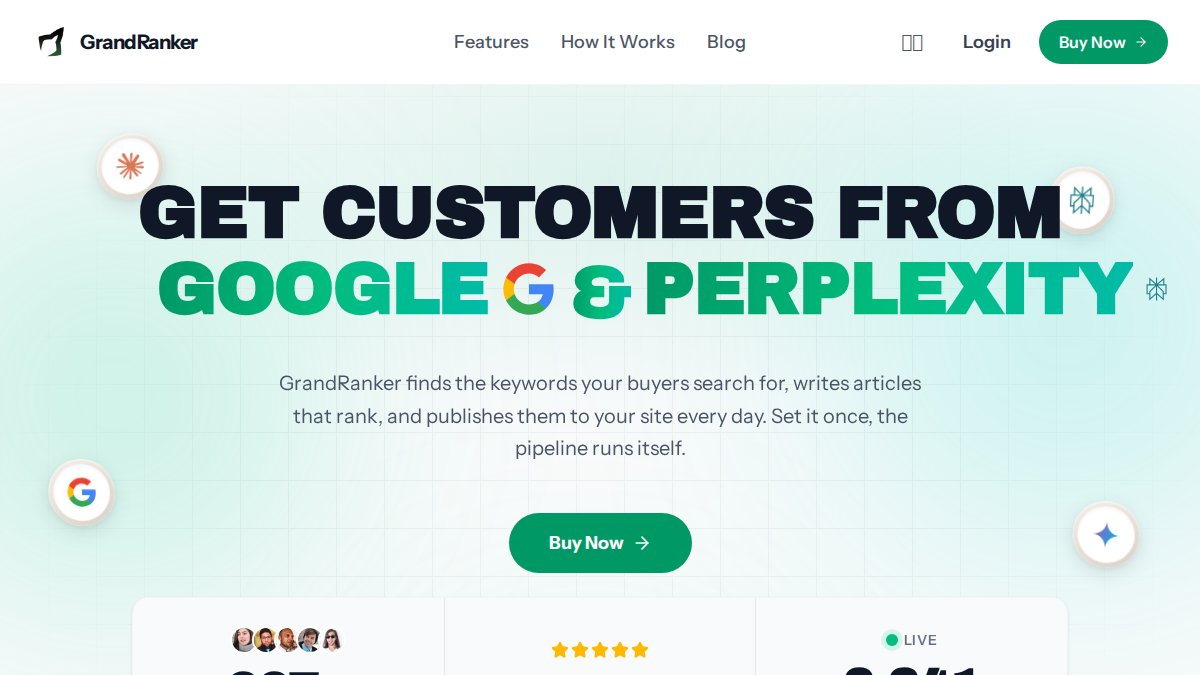
The platform's "AI finds YOU first" approach surfaces opportunities proactively, the key differentiator for founders without a dedicated SEO team. The domain authority boost feature compounds over time, making GrandRanker particularly valuable for sites in growth phases.
Best for: Founders and small teams who need organic traffic growth without hiring an SEO specialist.
Pros:
- Full SEO autopilot from keyword research through publishing
- Built for Google and ChatGPT visibility simultaneously
- Free trial available with access to core features
Cons:
- Designed for automation-first workflows; teams wanting granular manual control may prefer a more hands-on editor
Pricing: Free trial available; see the GrandRanker pricing page for plan details. Over 421 founders are currently growing with the platform.
2. Surfer SEO, Best for SERP-Driven Recommendations and Live Scoring
Surfer SEO's real-time content scoring engine analyzes top-ranking pages for your target keyword and delivers a live score based on keyword density, semantic relevance, word count, and structural signals as you write. The feedback loop is immediate, keeping writers in flow without tab-switching.
The AI writing assistant (Surfy) handles content generation, and 1-click internal linking suggestions save meaningful time at scale. Integration with Google Docs and WordPress is genuinely seamless. The honest limitation: Surfer is expensive for small teams, and advanced features require two to three weeks to use efficiently.
Pricing: Starting at $49/month. No free tier.
Pros: Highly accurate SERP-based recommendations; excellent workflow integration Cons: Cost adds up for small teams; steeper onboarding for advanced features
3. Frase, Best All-in-One Research and Writing Workflow
Frase consolidates research and writing into a single interface. Input a keyword, and it pulls top SERP results, extracts key topics, and generates a content brief automatically. Writers draft directly in the same editor with optimization feedback running alongside.
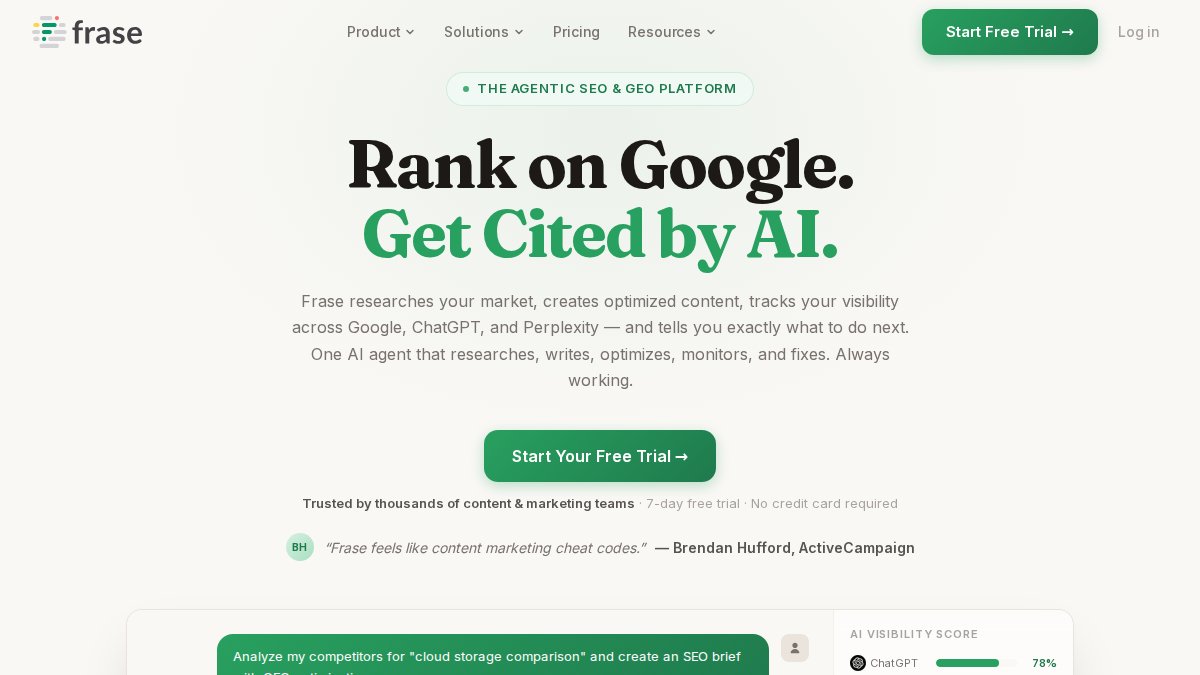
The AI visibility tracking feature monitors how your content performs in AI-generated search results, increasingly relevant as Generative Engine Optimization (GEO) becomes a core strategy component. The caveat: AI drafts are solid starting points, not finished articles, and brand voice requires manual refinement.
Pricing: Starting at $39/month. No free tier.
Pros: Significant time savings on research; strong feature-to-price ratio Cons: Brand voice requires manual refinement; some features need paid add-ons
4. Clearscope, Best for Topical Authority in Enterprise Teams
Clearscope focuses on topical coverage and search intent rather than keyword density. Its content grading system evaluates whether your article addresses the full scope of what a searcher needs, aligning with how Google's NLP systems evaluate content quality.
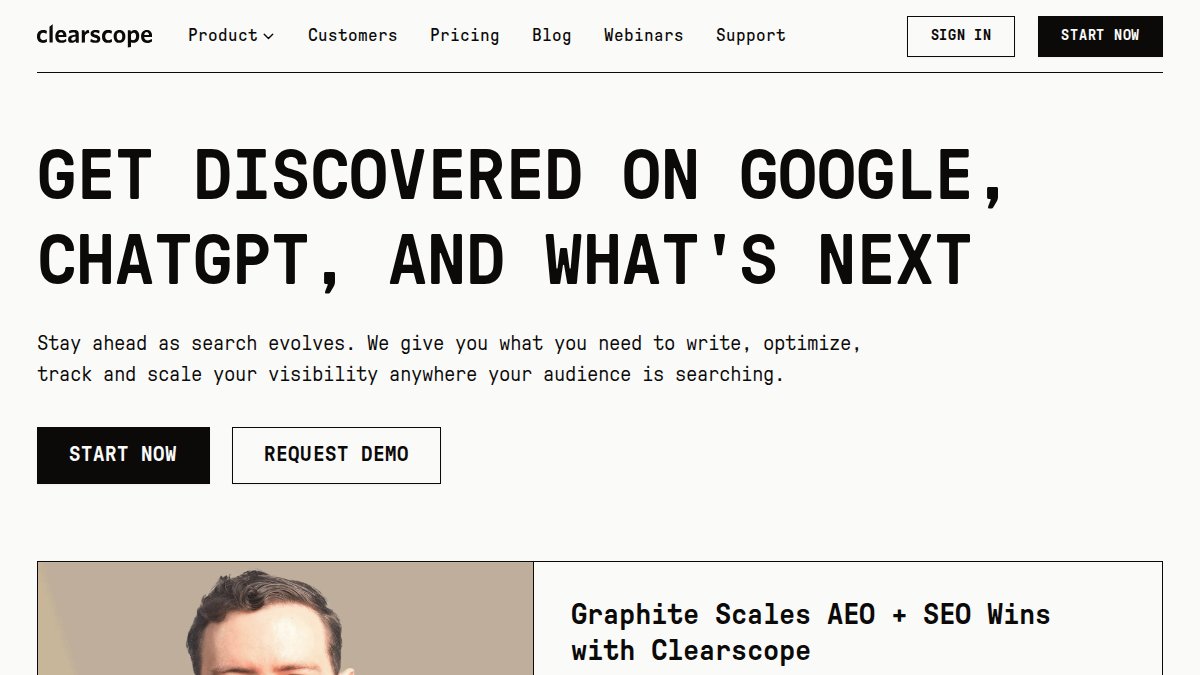
The content inventory tracking feature is particularly useful for enterprise teams managing hundreds of pages, flagging content that has drifted from its target keyword or lost topical relevance, directly addressing the cannibalization problem that plagues large sites. At $129/month, it's squarely an enterprise tool, but the clean interface and professional grading system justify the cost for B2B editorial teams.
Pricing: Starting at $129/month. No free tier.
Pros: Superior topical coverage analysis; clean editorial interface Cons: High entry price; limited AI generation compared to all-in-one platforms
5. MarketMuse, Best for Long-Term Content Gap Analysis
MarketMuse's machine learning models map your site's topical authority relative to competitors and identify the specific gaps that would have the greatest impact on search visibility. The personalized difficulty scores are a standout feature: unlike generic metrics, MarketMuse calculates difficulty based on your specific domain's existing authority, making prioritization far more accurate.
Pricing: Starting at $99/month. No free tier.
Pros: Deep topical authority mapping; excellent for content cluster planning Cons: Higher price point; interface complexity has a real learning curve for beginners
6. Scalenut, Best Budget-Friendly Option with Free Tier
At $24/month with a free tier, Scalenut is the most accessible entry point on this list. The Cruise Mode feature generates long-form SEO articles in a guided workflow: input a keyword, review the outline, and the AI drafts the full piece with optimization built in. Keyword clustering, topic modeling, and auto-publish integrations for WordPress and Shopify punch above the price point.
The honest assessment: AI output requires more manual editing than premium tools, and technical SEO features are limited. It's a strong starting point, not a long-term solution for competitive niches.
Pricing: Starting at $24/month. Free tier available.
Pros: Very beginner-friendly; strong automation for the price Cons: AI output needs manual editing; limited advanced technical SEO
7. Semrush SEO Writing Assistant, Best for Existing Semrush Users
The Semrush SEO Writing Assistant is an add-on, not a standalone product. It layers real-time SEO, readability, and tone-of-voice checks on top of a full Semrush subscription, working directly inside Google Docs, WordPress, or Microsoft Word. For teams already paying for Semrush, it's a natural extension that adds genuine value without a new vendor relationship. For teams not on Semrush, the $139/month entry point is hard to justify for writing assistance alone.
Pricing: Starting at $139/month (bundled with Semrush). No standalone free tier.
Pros: Seamless workflow integration; backed by Semrush's data depth Cons: Requires full Semrush subscription; not a standalone optimization tool
8. Dashword, Best for Clean, Focused Content Editing
Dashword strips the interface down to what matters: a content score, competitor analysis, and real-time feedback as you write. No bloat, no upsell prompts mid-workflow. The Google Docs add-on makes adoption easy for teams already in Google Workspace, and built-in content performance monitoring provides post-publication tracking that many tools in this price range skip.
Pricing: Starting at $39/month. No free tier.
Pros: Intuitive and fast to learn; good performance monitoring Cons: Less comprehensive than all-in-one suites; limited advanced AI features
9. Content Harmony, Best for Agency-Scale Brief Generation
Content Harmony is the best AI content brief generator on this list for agencies needing standardized, high-quality briefs at scale. SERP analysis pulls search intent signals, competitor outline structures, and topic modeling into a single brief. International keyword research support makes it practical for agencies serving multiple markets, and centralized brief management solves a real operational problem for teams running 20+ briefs per month.
The significant limitation: Content Harmony is a research and briefing tool, not a content editor. You'll need a separate writing environment.
Pricing: Contact for pricing. No free tier.
Pros: Unmatched brief generation depth; excellent for scaling content operations Cons: Not a content editor; higher learning curve for new team members
Using an AI Content Brief Generator to Accelerate Your Workflow
An AI content brief generator automatically extracts key topics, subtopics, questions, and structural signals from top-ranking SERP results and compiles them into a structured writing guide, telling writers exactly what to cover and in what depth before they write a single word.
The workflow acceleration is real. Manual brief creation for a competitive keyword can take two to three hours. A well-configured AI brief generator produces comparable output in under five minutes. The tools best suited for brief generation are Content Harmony (for agencies), Frase (for teams wanting brief-to-draft in one platform), and GrandRanker (for founders who want the entire process automated end-to-end).
According to Gartner's 2025 content technology research, teams that standardize brief creation see measurable improvements in first-draft quality and reduction in editorial revision cycles. Briefs aren't just a planning tool, they're a quality control mechanism.
NLP Content Optimization: How Natural Language Processing Powers Better Rankings
NLP content optimization structures and enriches content so that search engine algorithms and AI language models can accurately understand its meaning, relevance, and topical depth. It goes beyond keyword placement to address semantic relationships between concepts.
Google's NLP systems mean that stuffing a target keyword 20 times no longer works. What works is covering the topic comprehensively enough that the algorithm can confirm genuine authority. The tools that do this well share three characteristics: they surface semantically related terms rather than just keyword variations; they evaluate topical coverage against actual top-ranking pages; and they flag gaps where competitors cover concepts your content misses.
Clearscope and MarketMuse are the strongest performers on NLP depth. Surfer SEO's live scoring incorporates semantic relevance signals effectively. GrandRanker builds NLP-informed optimization into its automated pipeline, so output is already structured for semantic relevance without manual intervention.
Generative Engine Optimization Tools: Ranking in AI Search Engines
Generative Engine Optimization (GEO) is the practice of structuring content so that AI search engines, including ChatGPT, Perplexity, Google AI Overviews, and Claude, extract and cite it as an authoritative source in generated responses. GEO is distinct from traditional SEO in that the "ranking" is a citation within a generated answer, not a position in a list of blue links.

According to Search Engine Journal's analysis of AI citation patterns, content cited by AI assistants tends to share these characteristics:
- Clear definitional sentences that AI can extract verbatim
- Structured answer blocks that respond directly to common questions
- Named entities and specific data points that anchor content to verifiable facts
- Logical content hierarchy that AI systems can parse without ambiguity
GrandRanker is built explicitly for this use case: its "Get Cited by Every AI Assistant" feature structures content output to meet GEO criteria automatically. The tools currently offering the most GEO-relevant features are GrandRanker (automated GEO structuring), Frase (AI visibility tracking), and Clearscope (search intent alignment that translates well to AI citation patterns).
Content Cannibalization Detection: A Hidden Feature That Saves Rankings
Content cannibalization occurs when multiple pages on the same domain compete for the same keyword, splitting ranking signals and preventing any single page from reaching its potential. It's one of the most common and most overlooked causes of stalled organic traffic growth.
Most teams discover cannibalization the hard way: rankings plateau, traffic stagnates, and the cause isn't obvious from a surface audit. The fix requires identifying competing pages, deciding which to consolidate or redirect, and updating internal linking to reinforce the surviving page.
The tools that surface cannibalization signals most effectively are Clearscope (content inventory tracking), MarketMuse (topical authority mapping), and Semrush's broader platform. Dashword's content performance monitoring can also flag pages losing ground to internal competitors. Treat cannibalization as an ongoing concern, not a one-time fix, build a quarterly audit into your workflow.
Pricing, Total Cost of Ownership, and Budget-Friendly Alternatives
The sticker price is only the starting point. Total cost of ownership includes add-ons, seat counts, onboarding time, and supplementary tools for capabilities the platform doesn't cover.
| Tool | Base Price | Free Tier | Key Add-on Costs | Best Value Tier |
|---|---|---|---|---|
| GrandRanker | Free trial | Yes | None required | Free trial to start |
| Scalenut | $24/month | Yes | Minimal | Growth plan |
| Frase | $39/month | No | SEO add-on | Solo plan |
| Dashword | $39/month | No | None | Starter plan |
| MarketMuse | $99/month | No | None | Standard plan |
| Clearscope | $129/month | No | None | Essentials plan |
| Semrush Writing Assistant | $139/month | No | Full Semrush required | Pro plan |
For teams with tight budgets, start with GrandRanker's free trial or Scalenut's free tier, validate the workflow, and upgrade only when volume justifies it. According to EXTERNAL_LINK: Forrester's 2025 technology buying guide [for marketing teams | forrester.com], teams that pilot tools before committing to annual contracts report significantly higher satisfaction with their tooling choices.
Which AI Content Optimization Tool Should You Choose?
For Agencies vs. In-House Teams
The right choice depends on your team structure and content operation. Agencies need scalability, standardized brief workflows, and white label SEO capabilities. In-house teams need workflow integration and clear post-optimization feedback loops.
For agencies: Content Harmony for brief generation at scale, paired with Surfer SEO or GrandRanker for optimization and publishing.
For in-house teams under 5 people: GrandRanker's autopilot approach removes the need for a dedicated SEO function. Scalenut is the budget alternative if manual oversight is acceptable.
For enterprise in-house teams: Clearscope for topical authority and content inventory management, with MarketMuse for strategic gap analysis. Semrush Writing Assistant layers in if the team is already on the Semrush platform.
For founders near Ljubljana and across the broader region: GrandRanker is the clearest fit, built for a founder who needs to compete on Google and in AI search results without hiring an SEO team. The automated keyword research and content-on-autopilot features address the core constraint: time, not expertise.
Post-Optimization Performance Tracking: Don't Skip This Step
Publishing optimized content without tracking its performance is running an experiment with no measurement. Post-optimization tracking means monitoring keyword rankings for optimized pages, tracking changes in organic traffic and click-through rates, and comparing performance before and after. Without this data, you can't improve your process or justify the tool investment to stakeholders.
The tools that include meaningful post-optimization tracking are Dashword (content performance monitoring), Frase (SEO analytics and AI visibility tracking), and GrandRanker (search visibility tracking built into the autopilot workflow). Clearscope's content inventory feature also serves this function for existing pages.
According to Moz's guide to measuring SEO impact, the most reliable way to attribute ranking changes to content optimization is to track position changes for the specific target keyword alongside organic click-through rate, not just overall traffic.
Conclusion
Choosing from the best ai tools for content optimization comes down to matching the tool's strengths to your team's actual workflow, not chasing the most feature-rich platform. The tools that generate real results are the ones your team uses consistently, integrated into a process that includes brief creation, optimization, publishing, and post-performance tracking.
Most founders and growing content teams face the same challenge: limited time, competitive SERPs, and growing pressure to appear in both Google and AI-generated answers. GrandRanker addresses all three directly, automating keyword research, content creation, optimization, and publishing while structuring output for both Google rankings and AI assistant citations. With 421+ founders already growing on the platform and a free trial available, the starting point is clear. Get started with GrandRanker and build the organic traffic engine your business needs without hiring an SEO team to run it.
Frequently Asked Questions
What are the best AI tools for content optimization in 2026?
The best AI tools for content optimization include GrandRanker, Surfer SEO, Frase, Clearscope, and MarketMuse. Each serves a different use case: GrandRanker is ideal for founders who want full SEO autopilot including AI citation visibility, Surfer SEO excels at real-time SERP-driven recommendations, Frase combines research and writing in one workflow, Clearscope leads on topical authority analysis, and MarketMuse is best for long-term content gap analysis and cluster planning.
Can AI content optimization tools help with Generative Engine Optimization (GEO)?
Yes. Generative Engine Optimization tools are specifically designed to make your content more likely to be cited by AI search engines like ChatGPT, Perplexity, and Google's AI Overviews. Platforms like GrandRanker include GEO-focused features that structure content to be LLM-friendly, using clear semantic relevance, structured answers, and NLP content optimization patterns that AI assistants prefer when generating responses.
Which AI tool is best for generating content briefs?
Frase and Content Harmony are the strongest dedicated AI content brief generators. Frase automates brief creation from live SERP data and integrates directly with your content editor, while Content Harmony specializes in deep competitor outline extraction and search intent identification. GrandRanker also generates content briefs as part of its fully automated SEO workflow, making it a strong choice if you want brief generation bundled with keyword research and publishing in one platform.
How does NLP content optimization improve search rankings?
NLP content optimization uses Natural Language Processing to analyze how search engines semantically interpret your content. Instead of focusing solely on keyword density, NLP-powered tools identify related terms, entities, and topic clusters that Google expects to see for a given search intent. By covering these semantic signals comprehensively, your content demonstrates topical authority, which is a key ranking factor. Tools like Clearscope, Surfer SEO, and GrandRanker all use NLP analysis to surface these recommendations.
Are there free or budget-friendly AI content optimization tools?
Yes. Scalenut offers a free tier and paid plans starting at $24/month, making it one of the most accessible options. GrandRanker also offers a free plan and a free trial, covering keyword research, content creation, and optimization in one platform. For teams already using Semrush, the SEO Writing Assistant adds real-time optimization without needing a separate subscription. Always evaluate total cost of ownership, a cheaper tool that requires multiple add-ons may cost more than an all-in-one platform.
What is content cannibalization detection and which tools offer it?
Content cannibalization detection identifies when multiple pages on your site compete for the same keyword, which can split ranking signals and hurt your search visibility. Tools like MarketMuse and Clearscope include content inventory tracking that flags overlapping topics. GrandRanker's automated SEO workflow also monitors your existing content to prevent cannibalization before it happens, which is especially valuable for founders scaling content production quickly without a dedicated editorial team.
This article was written using GrandRanker