 listicle
Best AI Content Generator for Product Descriptions 2026
Table of Contents
- How We Evaluated the Best AI Content Generators for Product Descriptions
- Quick Comparison Table: Top AI Product Description Tools at a Glance
- AI Copywriting for E-Commerce: What Beginners Need to Know First
- Best AI Content Generators for Product Descriptions: Full Reviews
- GrandRanker, Best for SEO-Driven Product Content on Autopilot
- Hypotenuse AI, Best Specialized Tool for E-Commerce Catalogs
- Jasper AI, Best for On-Brand Marketing Teams
- Copy.ai, Best for High-Volume Short-Form Copy
- Writesonic, Best for GEO and AI Overviews Visibility
- Rytr, Best Budget Option for Solo Sellers
- Frase.io, Best for SERP Analysis and Search Intent Optimization
- Generate Product Descriptions in Bulk: Tools and Workflows That Work
- AI Product Description Generator Free: Best No-Cost Starting Points
- AI Product Description Examples: What Good Output Actually Looks Like
- Which AI Content Generator Should You Choose for Product Descriptions?
- Conclusion
Last Updated: April 30, 2026
Finding the best AI content generator for product descriptions is harder than most comparison guides admit. The market has exploded with options, and the differences between tools are genuinely meaningful depending on your use case. GrandRanker has helped 421+ founders navigate exactly this decision, and what we see repeatedly is that most sellers pick the wrong tool because they optimize for the wrong criteria. Below, we'll show you exactly how to match each tool to your actual workflow, with honest pros, cons, and pricing for every option.
Here's what most guides get wrong: they rank tools by feature count. The better question is whether the tool fits your catalog size, your SEO goals, and your budget. A solo Etsy seller has completely different needs from a Shopify store with 10,000 SKUs.
How We Evaluated the Best AI Content Generators for Product Descriptions
Picking the right tool requires a clear framework. We scored each platform across four dimensions that actually matter for e-commerce content: output quality, SEO capability, bulk generation support, and total cost of ownership.
Key Criteria: SEO, Bulk Output, E-Commerce Integrations, and Pricing
SEO capability means more than inserting a keyword. The best tools incorporate NLP-based semantic optimization, SERP analysis, and search intent matching. Tools that skip this step produce copy that reads well but ranks nowhere.
Bulk output separates hobbyist tools from serious e-commerce platforms. If you need to generate product descriptions in bulk for a catalog of 500+ items, a tool that requires manual prompting per product will cost you weeks of work.
E-commerce integrations determine whether the tool fits into your existing workflow. Native Shopify and WordPress connections matter. API access matters even more for custom implementations.
Pricing structure is where many buyers get burned. A low headline price with aggressive credit limits can become expensive fast. We looked at true cost at realistic usage volumes, not just the starter tier.
Quick Comparison Table: Top AI Product Description Tools at a Glance
| Tool | Starting Price | Free Tier | Best For | Bulk Generation |
|---|---|---|---|---|
| GrandRanker | Free trial | Yes | SEO-driven product content on autopilot | Yes |
| Hypotenuse AI | $19/month | Yes | E-commerce catalog management | Yes (batch) |
| Jasper AI | $39/month | No | On-brand marketing teams | Limited |
| Copy.ai | $29/month | Yes | High-volume short-form copy | Yes |
| Writesonic | $39/month | Yes | GEO and AI Overviews visibility | Yes |
| Rytr | $9/month | Yes | Budget solo sellers | Limited |
| Frase.io | $14.99/month | No | SERP analysis and search intent | Limited |
AI Copywriting for E-Commerce: What Beginners Need to Know First
AI copywriting for e-commerce is the practice of using machine learning models to generate product-focused text that converts browsers into buyers, typically by combining persuasive language patterns with SEO-relevant terminology. Understanding what these tools actually do, and what they cannot do, saves beginners from expensive mistakes.
The core value proposition is speed. Writing a single compelling product description manually takes 15-30 minutes. AI tools cut that to under two minutes. Across a catalog of 1,000 products, that difference is operationally transformative.
What AI cannot replace is product knowledge. The output quality is directly proportional to the quality of your input. Vague prompts produce vague descriptions. Detailed product attributes, target customer profiles, and brand voice guidelines produce genuinely usable copy.
According to Shopify's guide to product descriptions and conversion, product descriptions that address customer pain points and benefits outperform purely feature-based copy. AI tools that incorporate search intent data tend to produce this kind of benefit-led language more reliably than basic generators.
Common Mistakes Beginners Make With AI Product Copy
Most beginners make the same four errors:
- Publishing without editing. AI output is a first draft, not a finished product. Brand voice, accuracy, and tone all need a human pass.
- Ignoring keyword placement. Dropping a keyword into the prompt does not guarantee proper on-page SEO. Use tools with built-in optimization scoring.
- Using the same template for every product. Identical sentence structures across hundreds of listings trigger thin content flags in Google's crawlers.
- Skipping competitor SERP analysis. The best product descriptions address what competitors miss. Tools with SERP analysis features give you that edge automatically.
- Underestimating integration time. Connecting an AI tool to Shopify or WordPress takes setup time. Factor this into your decision, especially for bulk workflows.
Best AI Content Generators for Product Descriptions: Full Reviews
The tools below represent the strongest options available in 2026 across different use cases, team sizes, and budgets. Each review covers what the tool actually does well, where it falls short, and who should use it.

GrandRanker, Best for SEO-Driven Product Content on Autopilot
GrandRanker is an AI-powered SEO platform built specifically for founders who need to grow organic traffic without hiring a content team. It automates keyword research, content creation, optimization, and publishing in a single workflow, which is meaningfully different from tools that only handle the writing step.
What sets GrandRanker apart for product content is the combination of automated keyword research and content-on-autopilot publishing. Most AI writing tools require you to feed them keywords manually. GrandRanker finds those keywords itself, generates optimized content around them, and ensures your pages are positioned to be cited by AI assistants like ChatGPT and Perplexity, not just ranked on Google.
The domain authority boost feature matters more than most sellers realize. A single well-optimized product page is worth less than a site with consistent authority signals. GrandRanker builds both simultaneously.
Pricing: Free trial available. See the GrandRanker pricing page for current plan details.
Pros:
- Full SEO automation from keyword research through publishing
- Designed to get you cited by AI assistants (AEO/GEO built in)
- Content on Autopilot means no manual prompting per product
- Trusted by 421+ founders
Cons:
- Primarily optimized for organic SEO growth rather than standalone copywriting
Hypotenuse AI, Best Specialized Tool for E-Commerce Catalogs
Batch generation is where Hypotenuse AI earns its place on this list. The platform handles thousands of product descriptions simultaneously, pulling from your product data to generate consistent, brand-aligned copy at scale.
The Shopify and WordPress integrations are native and well-maintained, which matters for teams that need to push content directly into their CMS without manual export steps. The Content Detective feature adds a layer of factual grounding that generic generators lack.
Pricing: From $19/month, free tier available.
Pros: Specialized bulk workflows, strong e-commerce CMS integrations, 25+ language support. Cons: Less versatile for content types outside e-commerce. General-purpose tools like Jasper offer broader template libraries.
Jasper AI, Best for On-Brand Marketing Teams
Brand consistency at scale is Jasper's core strength. The Brand Voice feature trains the model on your existing content, so output maintains the same tone across product descriptions, blog posts, and ad copy. The Surfer SEO integration adds semantic optimization that most standalone generators skip.
The $39/month entry price is higher than several competitors, and the absence of a permanent free plan is a real limitation for budget-conscious sellers testing the water. For established marketing teams with brand guidelines and volume needs, however, Jasper justifies the cost.
Pricing: From $39/month. 7-day free trial only.
Pros: Excellent brand voice consistency, Surfer SEO integration, 50+ templates. Cons: Higher starting price, no permanent free plan.
Copy.ai, Best for High-Volume Short-Form Copy
Copy.ai excels at one thing: generating large volumes of short-form copy quickly. With over 90 templates and unlimited generation on Pro+ plans, it suits teams that need product descriptions, ad headlines, and social captions from a single platform.
The free tier is genuinely useful for testing, not a stripped-down demo. The workflow automation features are a meaningful differentiator for sales and marketing operations teams who want to connect AI generation to broader campaign workflows via Zapier or similar tools.
Pricing: From $29/month, free tier available.
Pros: Vast template library, unlimited generation on higher plans, good multi-language support. Cons: Blog and long-form output can lack accuracy. Nuanced brand voice requires significant human editing.
Writesonic, Best for GEO and AI Overviews Visibility
Writesonic is the only tool on this list that explicitly targets Generative Engine Optimization alongside traditional SEO. The GEO tracking feature monitors your brand's visibility in AI-generated answers from platforms like Perplexity and Google AI Overviews, which is increasingly where product discovery happens in 2026.
The catch: GEO features are locked to higher-tier plans. The free tier and base subscription are solid for standard product description generation, but you'll need to upgrade to access the visibility tracking that makes Writesonic genuinely distinctive.
Pricing: From $39/month, free tier available.
Pros: Combines SEO and GEO in one platform, 70+ templates, 25+ language support. Cons: GEO features require premium plan, credit-based pricing can escalate costs at high volume.
Rytr, Best Budget Option for Solo Sellers
At $9/month with a permanent free plan, Rytr is the most accessible entry point for solo sellers and early-stage stores. The 40+ use cases cover product descriptions, email subject lines, and social posts. The built-in plagiarism checker adds a layer of quality assurance that budget tools often omit.
The limitation is real: Rytr struggles with longer, more complex content. For product descriptions under 150 words, it performs reliably. For detailed technical product pages requiring structured content and SEO depth, you'll hit its ceiling quickly.
Pricing: From $9/month, permanent free plan available.
Pros: Lowest price point, permanent free plan, wide use case coverage, plagiarism checker included. Cons: Limited for complex or long-form product content. Lacks advanced SEO optimization features.
Frase.io, Best for SERP Analysis and Search Intent Optimization
Frase.io approaches product content from the SEO research side rather than the copywriting side. The SERP analysis engine extracts what top-ranking pages cover, then helps you build content that addresses the same search intent with greater depth.
For product category pages and collection descriptions where ranking matters as much as conversion, Frase's approach produces measurably better SEO outcomes than pure AI generation. The AI Agent with 80+ skills handles research, optimization, and drafting in a single workflow.
Pricing: From $14.99/month. 7-day free trial, no permanent free plan. Note that the SEO add-on is priced separately.
Pros: Strong SERP analysis, excellent search intent coverage, API access for custom integrations. Cons: Requires human oversight for brand voice. SEO add-on is an additional cost.
Generate Product Descriptions in Bulk: Tools and Workflows That Work
The ability to generate product descriptions in bulk is the single biggest operational lever for e-commerce teams managing large catalogs. A tool that requires individual prompting for each product is not a bulk solution, it's a manual process with AI assistance.
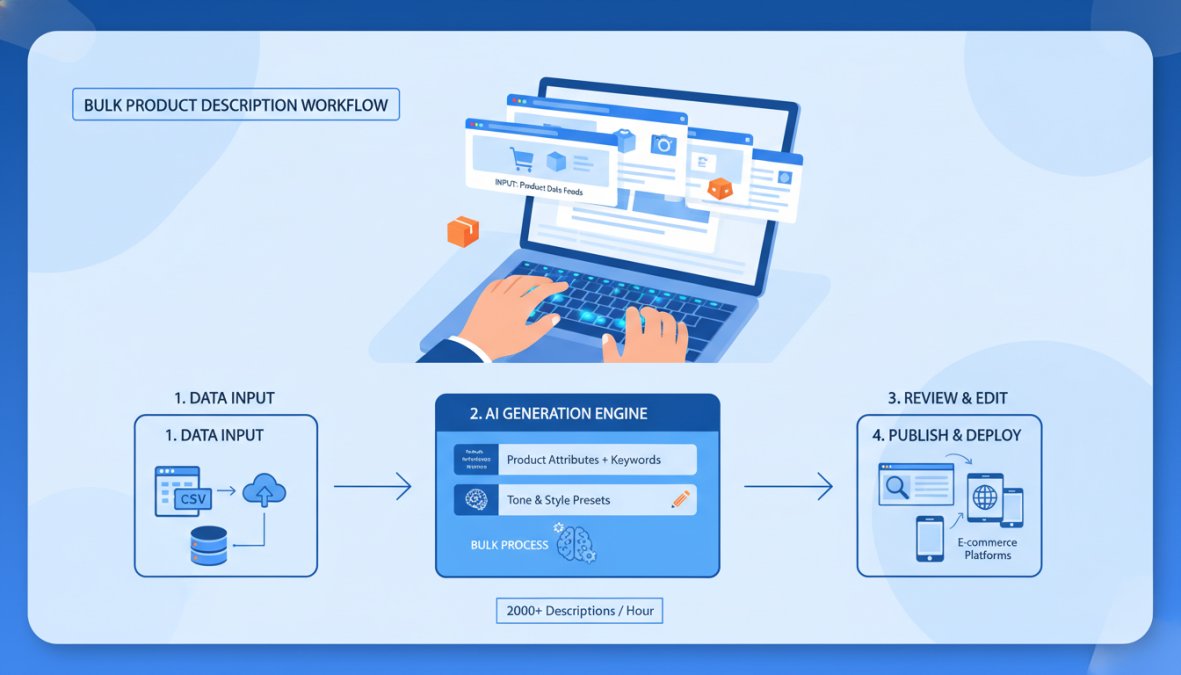
True bulk generation requires three components: structured product data input (CSV or API), batch processing capability, and consistent output formatting that maps to your CMS fields.
Step-by-Step: Setting Up a Bulk Generation Workflow for Beginners
Total Time: 2-4 hours initial setup, then largely automated.
- Export your product catalog as a CSV from Shopify, WooCommerce, or your PIM system. Include product name, category, key attributes, and target keywords.
- Choose a tool with batch input support. Hypotenuse AI and Copy.ai both accept CSV uploads for bulk generation. GrandRanker handles this within its automated content workflow.
- Create a master prompt template that maps CSV columns to description elements. Example: "Write a 120-word product description for [Product Name], a [Category] with [Attribute 1] and [Attribute 2], targeting customers who [Pain Point]."
- Run a test batch of 10-20 products before processing your full catalog. Review output for tone consistency, keyword placement, and factual accuracy.
- Set up a Zapier or Gumloop automation to push approved descriptions directly to your CMS, eliminating manual copy-paste steps.
- Schedule monthly re-generation for seasonal products or items with changing specifications.
AI Product Description Generator Free: Best No-Cost Starting Points
Several tools on this list offer genuinely functional free tiers, not just limited demos. For sellers testing AI-generated copy before committing budget, these are the best no-cost starting points:
- Rytr Free Plan: Generates up to a set monthly character limit across all use cases. Sufficient for testing 20-30 product descriptions per month.
- Copy.ai Free Plan: Includes access to core templates and limited monthly generation. Good for evaluating output quality on your specific product types.
- Writesonic Free Tier: Provides credits for testing the Article Writer and product description templates. The free tier is more generous than many competitors.
- Hypotenuse AI Free Tier: Allows limited batch generation, which is useful for testing the CSV workflow before upgrading.
- GrandRanker Free Trial: Covers the full SEO automation workflow including keyword research and content generation, giving a complete picture of what the platform does.
The honest advice here: free tiers are for evaluation, not production. Once you've validated that a tool's output style matches your brand, upgrade to a paid plan. The credit limitations on free tiers create inconsistent workflows that cost more time than they save.
AI Product Description Examples: What Good Output Actually Looks Like
Good AI-generated product copy does three things simultaneously: it addresses the customer's core need, incorporates relevant search terms naturally, and differentiates the product from generic alternatives. Here's the contrast:
Weak output (generic AI generation): "This high-quality leather wallet is perfect for everyday use. It features multiple card slots and a sleek design. Made from premium materials, it makes a great gift."
Strong output (SEO-optimized with search intent): "The Garrison Bifold Wallet holds 8 cards and a full cash compartment in 4mm slim Italian full-grain leather. Designed for professionals who refuse to carry a bulging wallet, it develops a personal patina over years of use. Available in cognac, black, and dark brown."
The difference is specificity. The second version answers the questions a buyer actually searches: how many cards, what leather type, what thickness, what colors. According to Nielsen Norman Group's research on e-commerce product pages, users scan product pages for specific attributes before reading descriptive copy. AI tools with SERP analysis built in tend to surface these attributes automatically because they appear in competing top-ranked pages.
The best AI content generator for product descriptions will consistently produce output closer to the second example, especially when given structured product data rather than vague prompts.
Which AI Content Generator Should You Choose for Product Descriptions?
The right choice depends on one primary variable: what you're optimizing for.
- Optimizing for SEO and long-term organic growth: GrandRanker is the strongest choice. The automated keyword research and content-on-autopilot publishing means your product pages build authority continuously, not just at launch.
- Managing a large catalog that needs bulk generation: Hypotenuse AI's batch workflows and Shopify integration make it the most operationally efficient option for catalog-heavy stores.
- Running a marketing team with strict brand guidelines: Jasper's Brand Voice feature and Surfer SEO integration justify the higher price for teams where consistency across channels is non-negotiable.
- Starting out on a tight budget: Rytr's $9/month plan and permanent free tier make it the lowest-risk entry point for solo sellers.
- Targeting AI Overviews and Perplexity visibility: Writesonic's GEO features are unique in this category and worth the premium for brands investing in generative engine optimization.
What most guides miss is that the best AI content generator for product descriptions is rarely the same tool for every business stage. Many operators start with Rytr or Copy.ai for speed and cost, then migrate to a platform like GrandRanker as SEO becomes a primary growth channel. That migration path is worth planning for from the start.
As documented in Google's Search Central guidance on helpful content, content that demonstrates genuine expertise and addresses user needs directly outperforms thin, keyword-stuffed pages regardless of how it was generated. The tool you choose should make it easier to meet that standard, not harder.
The real differentiator in 2026 is not which tool generates the most words. It's which tool positions your product pages to be found by customers searching on Google and cited by AI assistants answering shopping queries. Those are increasingly the same optimization problem, and platforms built for both simultaneously have a structural advantage.
Writing product descriptions at scale is one of the most time-consuming tasks in e-commerce, and doing it without SEO infrastructure means your copy never finds the customers it was written for. GrandRanker solves both problems at once: its content-on-autopilot system handles keyword research and content generation automatically, while its AI citation optimization ensures your product pages get surfaced by ChatGPT, Perplexity, and Google AI Overviews alongside traditional search rankings. Start your free trial with GrandRanker and build a product content engine that works while you focus on your business.
Frequently Asked Questions
Which AI is best for writing product descriptions?
The best AI content generator for product descriptions depends on your needs. Hypotenuse AI leads for large e-commerce catalogs with bulk generation and Shopify integration. GrandRanker excels when you need SEO-optimized descriptions that rank on Google and get cited by AI assistants. For budget-conscious beginners, Rytr offers a free plan, while Copy.ai suits teams needing high-volume short-form copy. Start with a free trial to test output quality before committing.
Is there a free AI product description generator I can use right now?
Yes, several tools offer free tiers for generating product descriptions. GrandRanker, Copy.ai, Writesonic, Rytr, Hypotenuse AI, and Simplified all have free plans or free trials. Rytr's permanent free plan is particularly useful for solo sellers on a tight budget. Keep in mind that free plans typically cap the number of words or outputs per month, so they work best for testing or low-volume needs before upgrading.
Can AI write SEO-friendly product descriptions that actually rank?
Yes, but only if the tool incorporates keyword research, NLP, and semantic optimization, not just basic content generation. Tools like GrandRanker automate keyword research and content optimization together, helping descriptions rank on Google and appear in AI Overviews. Frase.io adds SERP analysis to align copy with search intent. The key is pairing AI-generated copy with proper on-page SEO practices rather than publishing raw AI output without review.
How do I generate product descriptions in bulk using AI?
To generate product descriptions in bulk, choose a tool that supports batch processing, Hypotenuse AI and Copy.ai are strong options. Start by preparing a spreadsheet with product names, key features, and target keywords. Upload this data into the tool's bulk generation workflow. After generation, review outputs for brand voice consistency and accuracy before publishing. For WordPress or Shopify stores, look for tools with direct CMS integrations to streamline the publishing step and avoid manual copy-pasting.
What makes a good AI-generated product description?
A strong AI product description addresses search intent, highlights the product's core benefit in the first sentence, and naturally includes relevant keywords without keyword stuffing. It should match your brand voice, include sensory or emotional language where appropriate, and end with a subtle call to action. AI copywriting for e-commerce works best when you provide the tool with specific inputs, target audience, key features, tone, rather than relying on generic prompts that produce generic output.
This article was written using GrandRanker