 listicle
AI SEO Automation Platform: Top 10 Tools for 2026
Table of Contents
- What Is an AI SEO Automation Platform (and Why It Matters Now)
- Quick Comparison: Top AI SEO Automation Platforms at a Glance
- The Best AI SEO Software Tools Reviewed
- 1. GrandRanker, Best for Founders Who Want Organic Traffic on Autopilot
- 2. Frase, Best End-to-End Content Pipeline
- 3. Surfer SEO, Best for Data-Driven On-Page Optimization
- 4. Semrush, Best Full-Stack Marketing Operating System
- 5. Ahrefs, Best for Backlink Monitoring and Technical Depth
- 6. MarketMuse, Best for Topical Authority Mapping
- 7. SE Ranking, Best All-in-One Suite for Agencies
- 8. Scalenut, Best Budget-Friendly All-in-One Option
- 9. Alli AI, Best for No-Code Technical SEO Deployment
- 10. WriterZen, Best for Keyword Clustering on a Tight Budget
- How to Automate SEO Tasks Without Losing Human Oversight
- AI SEO Strategy Implementation: From Setup to Scalable Growth
- How to Choose the Right AI SEO Automation Platform for Your Business
- Conclusion: Which AI SEO Automation Platform Should You Start With?
Last Updated: May 25, 2026
Choosing the right AI SEO automation platform is one of the highest-use decisions a founder or marketing team can make in 2026. At GrandRanker, we've analyzed dozens of tools across the full SEO stack, from keyword clustering to agentic content deployment, and the quality gap between the best and the rest is wider than most guides admit. Below, we'll show you exactly how the top 10 platforms compare, what each one actually does well, and which one fits your specific situation. But first, here's what most comparison lists get wrong: they treat all SEO automation as equivalent, when the real distinction is between tools that automate individual tasks and tools that run full agentic SEO workflows autonomously.
According to Gartner's 2025 Marketing Technology report, AI-driven workflow automation is now the top investment priority for digital marketing teams. The shift from manual SEO to automated, AI-powered systems isn't a trend, it's a structural change in how organic traffic gets won.
An AI SEO automation platform is software that uses machine learning, natural language processing, and agentic AI to automate one or more stages of the SEO process, including keyword research, content creation, technical audits, rank tracking, and competitor benchmarking, without requiring manual intervention at each step.
What Is an AI SEO Automation Platform (and Why It Matters Now)
An AI SEO automation platform is a software system that replaces or augments manual SEO workflows with AI agents capable of researching, creating, optimizing, and monitoring content at scale. The defining characteristic of a modern platform isn't just that it has AI features, it's that those features connect into a coherent workflow that reduces human time-on-task.
The distinction matters because the SEO landscape in 2026 is fundamentally different from three years ago. Google's AI Overviews, Perplexity, and other AI search engines now answer queries directly, which means ranking isn't just about appearing in the top 10 blue links. It's about getting cited by LLM-based answer engines. Tools that optimize only for traditional SERP visibility are already leaving organic traffic on the table.
The practical implication: your SEO platform needs to handle topical mapping, LLM integration signals, and content optimization for AI-driven answers, not just keyword density and backlinks. That's a significantly higher bar than most legacy tools meet.
A common mistake is buying a tool because it has an "AI" label, then discovering it's just a GPT wrapper around a content brief generator. True agentic SEO platforms execute multi-step workflows autonomously: they research keywords, cluster topics, generate drafts, audit for technical issues, and push updates, without a human approving every step.
Quick Comparison: Top AI SEO Automation Platforms at a Glance
Before examining each tool in depth, here's how the top 10 stack up across the criteria that matter most for data-driven decisions.
| Platform | Starting Price | Free Tier | Best For | Agentic Workflows |
|---|---|---|---|---|
| GrandRanker | Free trial | Yes | Founders, autopilot growth | Yes |
| Frase | $39/month | No | End-to-end content pipeline | Partial |
| Surfer SEO | $79/month | No | On-page optimization | No |
| Semrush | $139.95/month | No | Full-stack enterprise | Partial |
| Ahrefs | $29/month | No | Backlink + technical depth | Partial |
| MarketMuse | $99/month | Yes | Topical authority mapping | Partial |
| SE Ranking | $65/month | No | Agency all-in-one | No |
| Scalenut | $39/month | No | Budget all-in-one | No |
| Alli AI | Contact for pricing | No | No-code technical SEO | Yes |
| WriterZen | $27/month | No | Keyword clustering | No |
The Best AI SEO Software Tools Reviewed
The tools below are ranked by their overall value as a complete AI SEO automation platform, not just their feature count. Each review reflects the tool's actual workflow capabilities, not marketing copy.

1. GrandRanker, Best for Founders Who Want Organic Traffic on Autopilot
GrandRanker is the top pick for founders and small teams who need SEO to run without constant oversight. The platform automates keyword research, content creation, optimization, and publishing in a single connected workflow, which means organic traffic growth happens in the background while you focus on the business itself.
What separates GrandRanker from every other tool in this list is its explicit focus on AI search visibility. The platform is built to get you cited by AI assistants like ChatGPT and Perplexity, not just ranked on Google. That's the right target for 2026, where a meaningful portion of discovery happens inside LLM-based answer engines rather than traditional SERPs.
The 421+ founders already using GrandRanker are a credibility signal worth noting. That's not enterprise adoption, it's a founder-specific use case being validated at scale.
Key features:
- Automated keyword research and topical clustering
- Content creation and optimization on autopilot
- Domain authority growth through systematic publishing
- AI-first visibility: optimized to get cited by every major AI assistant
Pros:
- Full-stack automation from research to publishing
- Built specifically for AI search engine visibility
- Free trial available with no commitment required
- Designed for non-SEO specialists who want results without the learning curve
Cons:
- Best suited for founders and small teams; enterprise teams with complex CMS workflows may need additional integrations
Pricing: Free trial available. See the GrandRanker pricing page for current plan details.
Best for: Founders and small teams who want organic traffic growth on autopilot without hiring an SEO specialist.
2. Frase, Best End-to-End Content Pipeline
Frase automates the full content lifecycle: SERP research, competitor analysis, brief generation, long-form drafting, and AI visibility tracking across major search engines. At $39/month, it's one of the most complete content pipelines at this price point.
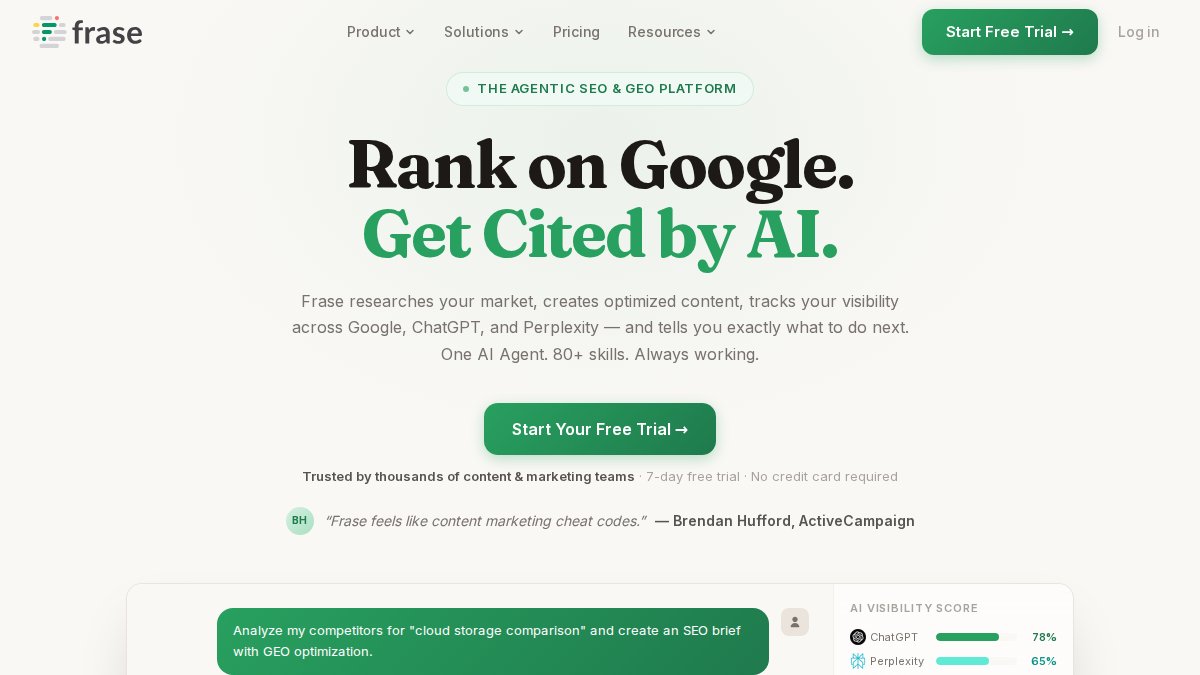
The platform's GEO (Generative Engine Optimization) features are genuinely useful, tracking how your content performs in AI-generated answers, not just traditional rankings. What most reviews miss is that Frase's real strength is speed: a skilled content team can compress a full content production cycle from days to hours.
The limitation is that Frase doesn't have a permanent free tier, and its SERP analysis depth is solid but not at the level of Semrush or Ahrefs for competitive research.
Pros: Covers all six stages of the SEO content pipeline; strong AI search visibility focus Cons: No free tier; advanced competitor analysis requires supplementing with other tools Pricing: From $39/month
3. Surfer SEO, Best for Data-Driven On-Page Optimization
Surfer SEO's core value is its NLP-powered content editor, which scores your content in real time against the top-ranking pages for your target keyword. The ranking correlation data is industry-leading: no other tool gives you a more precise blueprint for what a top-ranking page looks like structurally.
The honest limitation: Surfer is an on-page optimization tool, not a full AI SEO automation platform. Keyword research and rank tracking often require paid add-ons, and the $79/month entry price feels steep for what is essentially a content scoring layer. Teams that already have a keyword strategy and just need to optimize individual pieces will find it excellent. Teams looking for end-to-end automation should look elsewhere.
Pros: Industry-leading on-page optimization data; Google Docs and WordPress integration Cons: Core keyword research requires add-ons; expensive for small teams with usage limits Pricing: From $79/month
4. Semrush, Best Full-Stack Marketing Operating System
Semrush is the closest thing to a complete marketing operating system in this list. Its AI Visibility Toolkit tracks brand presence in AI search, ContentShake AI handles content generation and optimization, and the platform's keyword and backlink databases are among the largest available.
The catch is complexity. Semrush's pricing structure is genuinely confusing, with many features gated behind add-ons that push the real monthly cost well above the $139.95 starting price. For enterprises consolidating multiple marketing channels, the breadth justifies the cost. For smaller teams, the overhead is significant.
Pros: Unmatched data breadth; consolidates SEO, PPC, content, and social in one platform Cons: Complex pricing; many critical features require add-ons Pricing: From $139.95/month
5. Ahrefs, Best for Backlink Monitoring and Technical Depth
Ahrefs built its reputation on the quality of its backlink index, and that reputation is still deserved. The platform's AI URL detection feature, which monitors how AI search engines crawl your content, is a smart addition for 2026. Technical site audits and rank tracking are reliable and precise.
The friction point: Ahrefs' AI features are largely sold as separate, costly add-ons. The base $29/month plan is genuinely useful for backlink monitoring and keyword research, but building a complete AI SEO automation workflow on Ahrefs requires significant additional investment.
Pros: World-class data accuracy; excellent for competitive research and technical SEO Cons: AI features are add-ons; less suitable as a standalone content automation platform Pricing: From $29/month
6. MarketMuse, Best for Topical Authority Mapping
Topical authority is how modern SEO works: you don't rank individual pages, you build comprehensive coverage of a subject area that signals expertise to both Google and AI search engines. MarketMuse is the most sophisticated tool available for this specific task.
The platform's personalized difficulty scores account for your existing content inventory, not just generic competition data. That means the recommendations are actually calibrated to your site, not a generic competitor. The trade-off is a steep learning curve and a $99/month price point that positions it firmly in the mid-market.
Pros: Superior content strategy data; effective for identifying topical gaps Cons: Steep learning curve; high price point relative to content-only tools Pricing: From $99/month (free tier available)
7. SE Ranking, Best All-in-One Suite for Agencies
SE Ranking's strongest selling point for agencies is its white-label capability combined with a comprehensive toolset that covers rank tracking, technical audits, AI-powered content creation, and an AI visibility tracker for AI search engines. At $65/month, it undercuts Semrush significantly while covering most of the same ground.
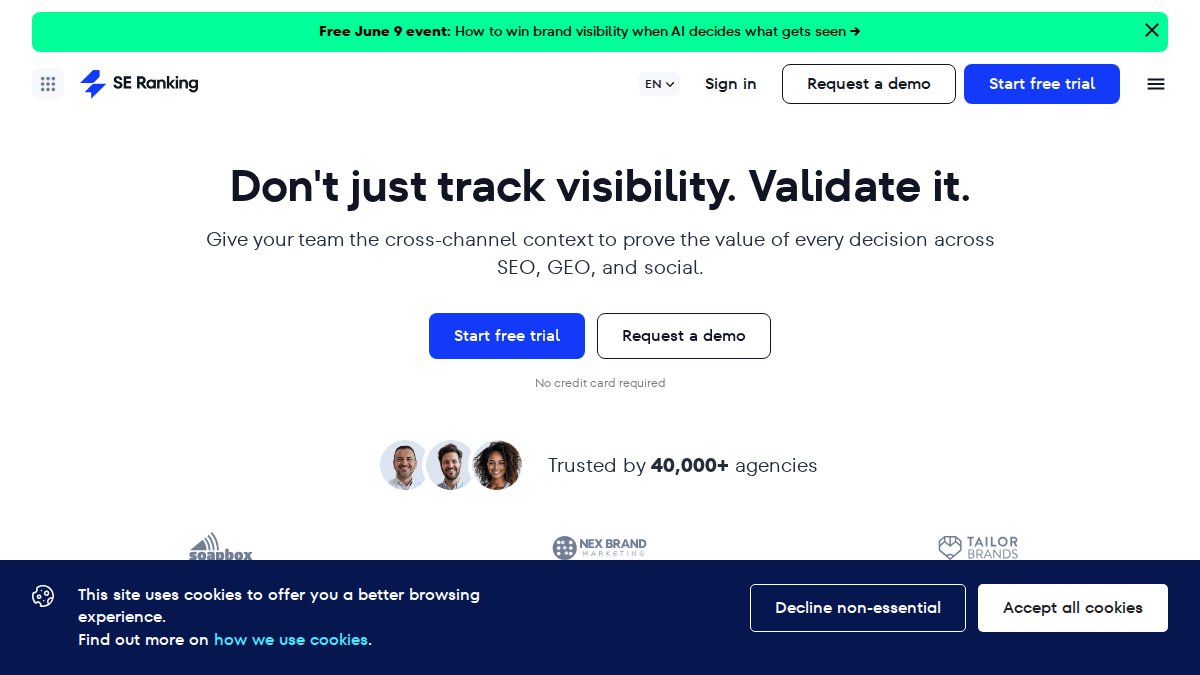
The caveat: advanced AI features often require paid add-ons, which erodes the value proposition at scale. For agencies managing 10-50 client sites with standard SEO needs, SE Ranking is an excellent choice. For agencies pushing into agentic SEO workflows, the platform's automation depth is limited.
Pros: More affordable than enterprise suites; strong white-label options Cons: Advanced AI features require add-ons; automation depth is limited Pricing: From $65/month
8. Scalenut, Best Budget-Friendly All-in-One Option
Scalenut's Cruise Mode is the feature that earns its place in this list: it generates SEO-optimized blog posts in minutes, complete with keyword clustering, NLP optimization, and auto-publishing to WordPress and Shopify. At $39/month, the value-to-feature ratio is genuinely strong.
The honest limitation is SERP analysis depth. Scalenut's competitive intelligence doesn't match what you'd get from Semrush or Ahrefs. For content operations where you already know your keyword targets and need volume at low cost, Scalenut delivers. For strategic competitive research, supplement it.
Pros: Excellent value; strong GEO focus; auto-publishing integrations Cons: SERP analysis depth is limited compared to premium tools Pricing: From $39/month
9. Alli AI, Best for No-Code Technical SEO Deployment
Alli AI solves a specific and expensive problem: deploying technical SEO changes across large websites without developer involvement. The platform automates site-wide meta tag optimization, schema deployment, and technical fixes through a no-code interface with enterprise-grade CMS integrations.
The trade-off is narrow focus. Alli AI is not a content creation or keyword research tool. It's a technical SEO execution engine. For enterprises and agencies managing complex sites where developer dependency is a bottleneck, it's genuinely valuable. For smaller sites where technical SEO isn't the primary constraint, the cost-benefit doesn't hold.
Pros: Significantly reduces developer dependency; automates repetitive technical tasks at scale Cons: No content creation features; pricing requires direct contact Pricing: Contact for pricing
10. WriterZen, Best for Keyword Clustering on a Tight Budget
WriterZen's automated keyword clustering and topic discovery features are its core value proposition, and at $27/month, it's the most accessible entry point in this list. The guided workflows make it genuinely usable for SEO beginners without a steep learning curve.
The limitation is clear: WriterZen lacks the site audit capabilities, competitive depth, and technical SEO features that a complete AI SEO automation platform requires. It's a keyword research and content planning tool with AI writing assistance, not a full automation stack.
Pros: Very cost-effective; intuitive interface; solid keyword clustering Cons: No advanced site audit or technical analysis capabilities Pricing: From $27/month
How to Automate SEO Tasks Without Losing Human Oversight
Most teams that try to automate SEO tasks completely end up with one of two failure modes: content that is technically optimized but editorially hollow, or workflows so rigid that a single algorithm update breaks the entire pipeline. The solution is not less automation, it is a deliberate architecture that separates the decisions a machine should own from the decisions a human must own.

Human-in-the-Loop (HITL) Workflows: A Practical Decision Framework
Human-in-the-loop (HITL) SEO workflows are automation systems that execute tasks autonomously but pause at defined decision gates for human review before proceeding. The key word is defined. Vague instructions to "review before publishing" are not a HITL workflow, they are a manual process with extra steps. A real HITL architecture specifies exactly which outputs trigger a review, who reviews them, what criteria they use, and what happens if no one responds within a set window.
A practical way to design this is to sort every SEO task into one of three buckets:
Fully automate (no human gate required):
- Rank tracking data collection and alert generation
- Crawl error detection and flagging
- Internal link opportunity identification
- Keyword clustering from a pre-approved seed list
- Scheduled content refresh triggers based on rank decay thresholds
Automate with async human approval (review within 24-48 hours):
- Long-form content drafts before first publish
- Meta title and description batch updates across more than 20 pages
- New topic cluster additions to the content calendar
- Schema markup deployments on high-traffic pages
Human-led with AI assistance (AI informs, human decides):
- Strategic pivots in response to a competitor's new content push
- Brand voice and positioning decisions in content
- Decisions to pursue or abandon a keyword cluster based on business context
- Any content touching regulated topics (legal, medical, financial)
The reason most HITL implementations fail is that teams start with the third bucket and try to automate it before the first two buckets are running cleanly. Automate the deterministic tasks first. Once those are stable, the humans in your workflow have cognitive bandwidth to actually review the things that need judgment.
The approval latency problem: One underappreciated failure mode in HITL workflows is approval bottlenecks. If your workflow requires a human to approve content drafts before publishing, and that human is unavailable for three days, your entire content pipeline stalls. Design around this with two mechanisms: a defined escalation path (if reviewer A does not respond within 48 hours, reviewer B is notified), and a "hold queue" in your CMS where approved-but-not-yet-scheduled content buffers against gaps.
Post-Deployment Maintenance: Preventing AI Drift in Live SEO Workflows
This is the section almost no guide covers, and it is where most agentic SEO implementations quietly fail six months after launch.
"AI drift" in SEO automation refers to the gradual degradation of workflow outputs as the conditions the workflow was designed for change, without the workflow itself being updated. The AI agents keep running. The content keeps publishing. The rankings keep declining. And because the system looks healthy from a process standpoint, the problem is often invisible until the traffic drop is significant.
The four most common causes of AI drift in SEO workflows are:
-
Keyword intent shift: Search intent for a target keyword changes (a navigational query becomes transactional, or a broad informational query fragments into more specific long-tail variants), but the keyword clustering logic in your platform was set up under the old intent pattern. The content your agents produce is optimized for how people used to search, not how they search now.
-
Competitor content improvement: A competitor publishes a substantially more comprehensive piece on a topic your automated content covers. Your content does not automatically update in response. Without a monitoring trigger tied to competitor content changes, your pages lose position gradually and the workflow never flags it.
-
LLM model updates in your platform: The AI models powering your content generation tool are updated by the vendor. Output style, structure, and quality can shift meaningfully between model versions. If you are not running periodic quality audits on a sample of AI-generated content, you may not notice the change until it shows up in engagement metrics.
-
Algorithm signal weighting changes: Google's ranking signals shift with core updates. A workflow calibrated to optimize for one set of signals may actively work against you after a major update if the optimization logic is not reviewed.
A sustainable post-deployment maintenance schedule:
| Cadence | Task | What You Are Checking For |
|---|---|---|
| Weekly | Rank tracking alerts review | Pages dropping more than 5 positions in 7 days |
| Weekly | Crawl error digest | New 4xx/5xx errors, indexing drops |
| Monthly | Content quality sample audit | Review 10-15 AI-generated pieces for brand voice, factual accuracy, and structural quality |
| Monthly | Crawl budget analysis | Orphaned pages, crawl traps, pagination issues |
| Quarterly | Keyword clustering logic review | Does current clustering still reflect actual search intent? |
| Quarterly | Competitor content gap scan | Have competitors published comprehensive content on your target clusters? |
| Bi-annually | Full workflow audit | Does the automation architecture still match your content strategy and business goals? |
Automated content refresh cycles are the most underused feature in most SEO platforms. Most platforms that include rank tracking can be configured to trigger a content refresh workflow when a page drops below a defined rank threshold, for example, falling out of the top 5 for its primary keyword. Instead of waiting for a quarterly review to catch this, the platform flags the page, queues it for an AI-assisted refresh, and routes it through your HITL approval gate before republishing. This closes the loop between monitoring and execution that most teams manage manually.
The honest reality of post-deployment maintenance is that it requires someone to own it. Automation reduces the labor, but it does not eliminate the need for a human who reviews the weekly digests, acts on the monthly audits, and makes the quarterly strategic calls. The teams that get the most from AI SEO automation are not the ones who set it up and walk away, they are the ones who treat the maintenance schedule as a core part of their SEO workflow, not an afterthought.
AI SEO Strategy Implementation: From Setup to Scalable Growth
Integrating AI Agents Into Your Existing Marketing Stack
The most common reason AI SEO automation implementations underdeliver is not the platform, it is the integration architecture. Teams buy a capable tool, configure it in isolation, and then spend months manually exporting data between systems that should be talking to each other automatically. The result is a workflow that is faster than fully manual SEO but nowhere near the efficiency ceiling the platform is capable of.
Before configuring any AI SEO platform, map the data flows between four systems: your SEO platform, your CMS, your analytics stack, and your CRM or project management tool. Every integration decision should answer one question: where does this data need to go next, and does it get there automatically or manually?
A practical integration sequence for most teams:
-
CMS connection first. Connect your AI SEO platform to your CMS (WordPress, Shopify, Webflow, or a headless CMS via API) before anything else. Automated publishing is the highest-leverage integration because it removes the manual step that most often breaks content pipeline momentum. Verify that the integration preserves your existing URL structure, category taxonomy, and author attribution, these are the details that cause problems at scale.
-
Analytics pipeline second. Pipe rank tracking and organic traffic data into your primary analytics dashboard (Google Analytics 4, Looker Studio, or a BI tool like Tableau or Metabase). The goal is a single view where SEO performance data sits alongside conversion and revenue data, not in a separate platform tab that gets checked separately.
-
Content calendar automation third. Configure your keyword clustering outputs to feed your content calendar automatically. In practice, this means your SEO platform's topic cluster recommendations should populate a content backlog in your project management tool, Asana, Jira, Notion, or Linear, rather than requiring someone to manually transfer them. Most enterprise-grade SEO platforms support this via Zapier, Make (formerly Integromat), or native API connections.
-
Technical audit routing fourth. Set up technical audit alerts to route directly to your development or engineering queue. A crawl error that sits in an SEO platform dashboard until someone checks it is a crawl error that does not get fixed. An alert that automatically creates a Jira ticket assigned to the responsible engineer gets fixed on the same cadence as any other engineering task.
-
CRM integration last, but do not skip it. This is the integration step that transforms SEO from a traffic metric into a revenue attribution system.
Connecting SEO to CRM: The Integration Most Guides Skip
Connecting your SEO platform's performance data to your CRM (Salesforce, HubSpot, or Pipedrive) is the single integration that most SEO guides do not cover, and it is the one that most directly answers the question every executive asks: what is SEO actually worth to the business?
The mechanism works like this: UTM parameters on organic traffic are passed through to your CRM's lead source field when a visitor converts. Over time, you accumulate data on which content pieces, keyword clusters, and topic categories generate not just traffic, but qualified leads and closed revenue. This lets you make content investment decisions based on revenue contribution rather than ranking position alone.
In HubSpot, this requires ensuring your organic traffic sources are correctly attributed in the traffic analytics report and that lead source data is being captured at the contact level. In Salesforce, it typically requires a custom field for organic content source mapped from your marketing automation layer (Marketo, Pardot, or HubSpot Marketing Hub).
The practical output of this integration is a report that shows, for example, that your "enterprise pricing" content cluster generates three times the pipeline value per visit compared to your "beginner guide" cluster, which directly informs where your AI content agents should be producing more content.
Security, Data Privacy, and Compliance Considerations
Security and data privacy are the least-discussed dimensions of AI SEO platform selection, and the most consequential for businesses handling customer data, operating in regulated industries, or managing content that contains proprietary competitive intelligence.
The risk is specific and underappreciated: most AI SEO platforms process your content drafts, keyword data, site analytics, and sometimes your CMS credentials through third-party large language model APIs, typically OpenAI, Anthropic, or Google's Gemini API. When your content strategy document, your unpublished product roadmap, or your customer-derived keyword research is sent to one of these APIs for processing, it is subject to that API provider's data retention and training policies, not just your SEO platform's privacy policy.
This is not a theoretical risk. It is a contractual and compliance question that most procurement processes for marketing tools do not ask.
Three questions to ask every AI SEO vendor before signing a contract:
-
Where is my data processed? Does the platform process content and keyword data on its own infrastructure, or does it pass that data to third-party LLM APIs? If third-party APIs are used, which ones, and under what data processing agreements?
-
What is the data retention policy for content sent to AI processing? Some LLM API providers retain submitted content for a defined period for safety monitoring or model improvement. Enterprise API agreements (such as OpenAI's enterprise tier) typically include zero data retention provisions. Does your SEO platform use enterprise-tier API agreements, or consumer-tier agreements with standard retention terms?
-
Is the platform compliant with the regulations that apply to your business? For businesses operating in the European Union, GDPR compliance is a legal requirement for every tool in your stack that processes personal data. For businesses in regulated industries (healthcare, financial services, legal), additional sector-specific requirements may apply. Ask for a Data Processing Agreement (DPA) before deployment, not after.
As documented in the European Data Protection Board's guidelines on AI systems, organizations using AI tools that process personal data must conduct data protection impact assessments and ensure adequate contractual protections with processors. A DPA with your SEO platform vendor is the minimum contractual protection, it does not substitute for understanding what that vendor's upstream API agreements actually cover.
Enterprise-specific security considerations:
For enterprise teams connecting AI SEO platforms to production CMS environments, the attack surface is larger than most security reviews account for. An AI SEO platform with write access to your CMS can, in principle, publish content, modify existing pages, or alter metadata at scale, which means a compromised platform credential or a misconfigured automation rule is a content integrity risk, not just a data privacy risk.
Minimum security controls for enterprise deployments:
- Use a dedicated CMS service account with the minimum permissions required (publish access only, no admin access) for your SEO platform integration
- Enable audit logging on all automated publishing actions so every AI-generated content deployment is traceable
- Require two-factor authentication on the SEO platform account that holds CMS credentials
- Review and rotate API keys and OAuth tokens on a defined schedule (quarterly is a common enterprise standard)
- If your SEO platform supports IP allowlisting for API access, enable it
For most small teams and founders, these controls are overkill. For any team managing a site with significant existing traffic, a brand with reputational exposure, or content that touches regulated topics, they are baseline hygiene.
How to Choose the Right AI SEO Automation Platform for Your Business
The right AI SEO automation platform for your business depends on three variables: your current SEO maturity, your team's technical capacity, and whether your primary constraint is content volume, technical SEO, or competitive intelligence.
Use this decision framework:
If you're a founder or small team with limited SEO expertise: Start with GrandRanker. The full-stack automation from keyword research to publishing removes the need for SEO expertise, and the AI-first visibility features are built for the 2026 search landscape where ChatGPT and Perplexity citations matter as much as Google rankings.
If your primary constraint is content quality and on-page optimization: Surfer SEO or Frase, depending on whether you need a full content pipeline (Frase) or a precision optimization layer for existing content (Surfer).
If you're an agency managing multiple client sites: SE Ranking's white-label capabilities and comprehensive toolset at $65/month is the most defensible choice at that price point.
If technical SEO at scale is the bottleneck: Alli AI's no-code deployment is the only tool in this list specifically designed to solve that problem without developer dependency.
If topical authority building is your strategic priority: MarketMuse's content inventory analysis and personalized difficulty scores are genuinely superior to what any other tool provides for this specific use case.
The mistake to avoid is buying the most feature-rich platform and using 20% of its capabilities. A focused tool used well outperforms a comprehensive platform used poorly, every time.
Conclusion: Which AI SEO Automation Platform Should You Start With?
The honest answer is that the best AI SEO automation platform is the one that matches your actual workflow, not the one with the longest feature list. For most founders and small teams, that means a platform that automates the full cycle, research through publishing, without requiring constant oversight. For agencies and enterprises, it means a platform with the depth to handle competitive intelligence, technical audits, and white-label reporting at scale.
As noted by Search Engine Journal's 2026 SEO industry survey, the fastest-growing segment of SEO investment is in AI-powered workflow automation, with teams prioritizing tools that reduce manual task time while improving content quality and AI search visibility simultaneously.
The platforms in this list cover the full spectrum from $27/month keyword clustering tools to enterprise-grade full-stack systems. The comparison table and decision framework above should make the right choice clear for your situation. If you're still uncertain, start with a free trial before committing to an annual plan.
Growing organic traffic in 2026 requires more than publishing good content: it requires a systematic AI SEO automation platform that handles keyword research, content creation, technical optimization, and AI search visibility in a connected workflow. GrandRanker automates all of these stages on autopilot, from finding the keywords your customers are searching to getting your content cited by ChatGPT and Perplexity. Get started with GrandRanker and start building organic traffic that compounds without requiring your daily attention.
Frequently Asked Questions
What is an AI SEO automation platform?
An AI SEO automation platform is software that uses artificial intelligence and agentic workflows to handle time-consuming SEO tasks, such as keyword research, keyword clustering, technical SEO audits, content optimization, and automated reporting, with minimal manual input. Instead of running each task separately, these platforms connect the entire SEO workflow so teams can focus on strategy while the AI handles execution and data-driven decisions at scale.
Can AI fully automate SEO tasks, or is human oversight still needed?
AI can automate the majority of repetitive SEO tasks, crawl budget analysis, meta tag optimization, backlink monitoring, and content generation, but human-in-the-loop (HITL) workflows remain essential. AI models can misread search intent, produce off-brand content, or miss nuanced competitive context. Best practice is to use automation for execution and scale, while a human reviews strategic decisions, approves content before publishing, and monitors performance after deployment.
Which AI SEO software tools are best for small businesses and founders?
For small businesses and founders, the best AI SEO software tools balance affordability with automation depth. GrandRanker is purpose-built for founders who want organic traffic growth on autopilot, including automated keyword research and content publishing. WriterZen starts at $27/month and is beginner-friendly for keyword clustering. Scalenut at $39/month offers an all-in-one content pipeline. All three offer strong ROI tracking without requiring a dedicated SEO team or technical expertise.
How does AI SEO strategy implementation affect search rankings?
Effective AI SEO strategy implementation can meaningfully improve SERP visibility by ensuring consistent content output, faster technical issue resolution, and smarter topical mapping. Platforms that automate keyword clustering and content optimization help build topical authority faster than manual workflows allow. However, results depend on implementation quality, tools must be configured correctly, content must be reviewed for accuracy, and post-deployment maintenance must catch ranking fluctuations before they compound into traffic losses.
Is it safe to integrate an AI SEO automation platform with other marketing tools?
Most leading AI SEO automation platforms offer integrations with CMS platforms like WordPress and Shopify, as well as broader marketing stacks. Security and data privacy vary by vendor, always check whether the platform stores your content data, how it handles API credentials, and whether it complies with GDPR if you operate in Europe. Platforms like Semrush and SE Ranking have enterprise-grade security practices, while newer tools should be evaluated carefully before connecting to production environments.
This article was written using GrandRanker