 comparison
AI-Powered SEO vs Manual Keyword Research for SaaS
Table of Contents
- AI-Powered SEO vs Manual Keyword Research for SaaS: The Core Differences
- Manual Keyword Research Process for SaaS: Pros and Cons
- Benefits of AI in SEO for SaaS: Speed, Scale, and Data Precision
- AI SEO Tools for SaaS: What You're Actually Paying For
- Cost of AI SEO Tools vs Manual Research Time: A Practical Comparison
- The Human Element: Why Search Intent Still Requires Empathy
- Building a Hybrid Approach: When to Use AI, When to Use Manual Strategy
- Scaling Your SaaS Growth: Why Automation Matters Now
- Conclusion: Making the Right Choice for Your SaaS
AI-Powered SEO vs Manual Keyword Research for SaaS
Last Updated: July 26, 2026
When it comes to growing organic traffic for SaaS companies, the choice between AI-powered SEO and manual keyword research has become critical. At GrandRanker, we've analyzed how both approaches perform in real-world SaaS environments. The data reveals a nuanced picture: neither strategy wins universally. The right choice depends on your team's resources, growth stage, and tolerance for automation. Below, we'll show you how to evaluate each approach and build a hybrid strategy that drives customers to your product.
AI-Powered SEO vs Manual Keyword Research for SaaS: The Core Differences
Manual keyword research relies on practitioners analyzing search volume, competition, and intent across spreadsheets and SEO tools. AI-powered keyword research automates this process, identifying patterns, predicting trends, and clustering keywords by semantic similarity at a pace humans cannot match. The best SaaS companies aren't choosing one or the other, they're using AI to handle volume while applying human expertise to decisions that move the needle.
What Traditional Manual Keyword Research Looks Like
A typical workflow starts with brainstorming seed keywords, then plugging terms into SEO tools like SEMrush or Ahrefs to record search volume, difficulty, and competitor analysis. Most teams research 200-400 keywords per quarter, spending 2-3 hours weekly analyzing 50-100 terms. This hands-on approach forces deep market understanding. You notice how competitors frame solutions, what language resonates with your ICP, and which pain points appear across multiple keywords. The output is a curated list reflecting both research and educated guesses about conversion potential.
How AI-Powered Keyword Research Changes the Game
AI platforms ingest millions of search queries and identify opportunities across semantic clusters in minutes. Instead of researching 50 keywords, you get 500 ranked by predicted ROI. The system predicts search intent, identifies long-tail variations, and flags emerging keywords before they become competitive. Some platforms estimate conversion probability based on your product category and existing ranking data. What takes a human researcher a full day takes AI seconds.
Manual Keyword Research Process for SaaS: Pros and Cons
Advantages of Manual Research
Manual keyword research forces deep market understanding. When you analyze competitor content for 20 keywords, you internalize how your market speaks, what objections recur, and where positioning gaps exist. This knowledge becomes the foundation for content that resonates with your ICP, not just content that ranks.
Nuance and context are the manual researcher's superpower. You catch when a high-volume keyword targets a different buyer persona than your product serves. You notice when competitors rank for a keyword but their content is weak, a signal the opportunity is real. You understand the difference between a keyword that ranks easily and one that converts. These judgment calls are nearly impossible to automate because they require understanding your specific product, market position, and sales motion.
Manual research also excels in niche SaaS markets with proprietary terminology. If you're building compliance software for financial institutions, the keywords that matter might not appear in general search data. Your domain expertise, knowing that "regulatory reporting" and "audit trail management" are actual pain points, becomes more valuable than any algorithm.
Limitations and Hidden Costs
The capacity ceiling is real. A single researcher can thoroughly analyze 400-600 keywords per quarter. For a SaaS company targeting multiple buyer personas and use cases, that's insufficient coverage. You'll miss long-tail keywords that each drive 5-10 qualified leads but collectively represent 30% of organic traffic.
Time cost compounds quickly. If your researcher spends 15 hours per week on keyword analysis, that's 780 hours annually, roughly half an FTE salary. Add premium tool subscriptions ($1,500-$3,000 annually), and you're at $20K-$30K per year minimum. The real hidden cost is opportunity: those hours could go toward content strategy, competitive analysis, or content creation, activities that directly impact revenue.
Manual research also creates bottlenecks. When one person owns keyword research, updates happen quarterly. The market shifts, competitors emerge, search behavior changes, but your keyword list stays static. AI systems can refresh recommendations weekly or monthly, keeping pace with market changes.
Benefits of AI in SEO for SaaS: Speed, Scale, and Data Precision
Automation and Workflow Efficiency Gains
AI handles volume so your team focuses on strategy. Instead of spending 15 hours weekly researching keywords, your team spends 2-3 hours reviewing AI recommendations and making strategic calls. That's a 7x efficiency gain. The platform identifies 500 opportunities; you evaluate 50 based on strategic fit. Time saved can redirect toward content creation, conversion optimization, or product-market fit work.
Automation also removes bottlenecks. Keyword recommendations update continuously. When a new competitor enters your market or search behavior shifts, you get new data within days, not months. Your content strategy can respond faster.
Predictive Analytics and Search Intent Accuracy
Beyond volume and difficulty, AI platforms analyze actual search queries and predict intent with accuracy. When you search "SaaS project management," are you looking to buy, comparing options, or researching the category? AI can tell by examining queries that appear together, ranking content, and user behavior signals.
This matters because search intent determines whether a keyword is worth targeting. A high-volume keyword with "research" intent might not convert for a product sales page. AI flags this automatically. It identifies which keywords cluster around "comparison" intent (good for comparison content), "problem-solution" intent (good for educational content), and "product evaluation" intent (good for demo pages and case studies).
For SaaS, this precision is critical. Your product serves multiple use cases. AI can separate keywords by use case automatically, showing which keywords signal interest from your highest-value buyer personas.
SaaS-Specific Keyword Clustering and Semantic Search
Modern AI keyword tools organize keywords into semantic clusters reflecting how search actually works. Instead of a flat list of 500 keywords, you get 40 clusters, each representing a distinct topic or buyer journey stage. One cluster might be "free project management tools" (top-of-funnel), another "best project management for remote teams" (mid-funnel), another "Asana vs Monday.com" (bottom-of-funnel).
This clustering is invaluable for SaaS content strategy. It shows exactly which topics you need to cover and in what order to guide prospects from awareness to decision. It reveals gaps, maybe there's a big cluster around "team collaboration software" but nothing targeting "distributed team management," even though that's a distinct buyer segment.
Semantic clustering also improves content efficiency. Instead of writing 500 blog posts, you write 40 comprehensive guides, each targeting an entire cluster. One guide covers all variations of "project management for remote teams", different long-tail keywords and angles, in one piece. Search engines recognize this as comprehensive topic coverage, improving rankings across the entire cluster.
AI SEO Tools for SaaS: What You're Actually Paying For
Core Features That Drive ROI
AI-powered SEO platforms provide keyword discovery at scale, predictive analytics estimating search volume and intent, and competitive analysis automation. Most platforms include content optimization guidance: paste your draft, and the system analyzes top-ranking content for your target keyword, recommending changes based on what search engines and users expect.
The platform you choose determines which features are useful for your situation. A bootstrapped startup might only need keyword discovery and search intent analysis. A growth-stage SaaS company might need competitive analysis and content optimization. An enterprise might need all of it plus integrations with your CMS and analytics platform.
Integration Into Your Existing Workflow
The best AI SEO tools integrate into your existing workflow rather than replace it. A good platform either integrates with SEMrush, Ahrefs, or Moz or complements them. It pulls data from your Google Search Console to understand which keywords you already rank for and which are close to breaking into the top 10. It connects to your analytics platform to show which keywords actually drive conversions, not just traffic.
Integration also matters for content management. If you're using WordPress or a headless CMS, the platform should connect directly so you can publish optimized content without manual steps. Before choosing a platform, ask: Will this tool work with our existing stack, or will it create extra work?
Cost of AI SEO Tools vs Manual Research Time: A Practical Comparison
Hidden Costs of Manual Keyword Research
When evaluating whether to invest in an AI platform, most teams only look at platform cost. They miss the real expense: human time. A mid-level marketer costs $60K-$90K annually. If 30% of their time goes to keyword research, that's $18K-$27K per year in salary. Add premium tool subscriptions ($1,500-$3,000 annually), and you're at $20K-$30K per year minimum.
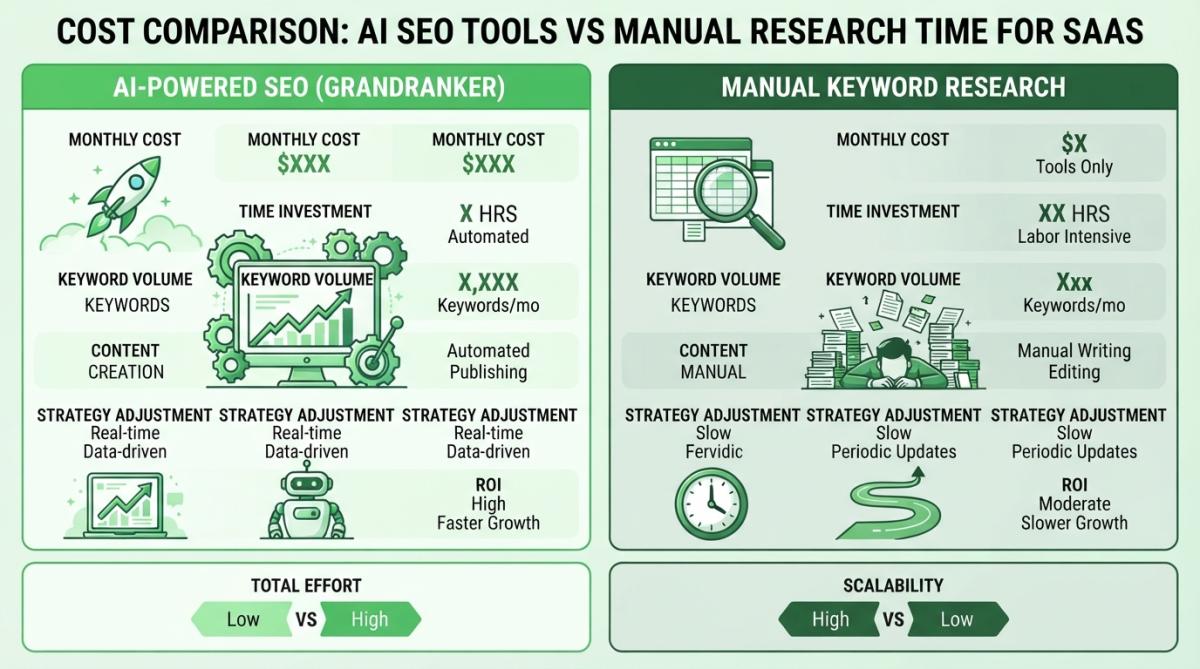
There's also opportunity cost. Those hours could go toward content creation, conversion optimization, or strategic planning, activities that directly impact revenue. For a SaaS company, one additional high-converting blog post might generate $50K-$200K in annual revenue.
There's also the cost of delayed decisions. If you research keywords quarterly, you miss market shifts that happen monthly. A competitor launches a new product category; search volume for related keywords spikes. By the time you notice and create content, the opportunity window has closed.
AI Platform Investment vs Time Savings ROI
An AI-powered SEO platform typically costs $200-$2,000 per month. For a team spending 15 hours weekly on keyword research, the AI platform can reduce that to 2-3 hours weekly, 600 hours per year saved. At a blended rate of $75/hour, that's $45,000 in annual time savings. Even at $2,000 monthly ($24,000 annually), the ROI is positive in year one.
The real value isn't just time savings, it's the quality of decisions made with better data. An AI platform identifying 500 keyword opportunities instead of 100 also identifies opportunities your competitor missed. If just 10 additional keywords each drive 5 qualified leads monthly, that's 50 additional leads monthly. At a 10% conversion rate and $5,000 average contract value, that's $300,000 in additional annual revenue.
For very small teams or bootstrapped startups, a $2,000/month platform is prohibitive. Starting with manual research and upgrading to AI as you grow makes sense. For teams with 2+ marketers or serious growth targets, the ROI of AI tools is almost always positive.
The Human Element: Why Search Intent Still Requires Empathy
AI Hallucination Risks in Keyword Data
AI systems are powerful but not infallible. One critical risk is "hallucination", when an AI model confidently presents inaccurate data. In keyword research, this might look like: the platform predicts 500 monthly searches when the real number is 50, or it classifies a keyword as "high-intent purchase" when it's actually "research."
These errors happen because AI models extrapolate patterns from historical data that don't always hold. A keyword with 100 searches in 2024 might have 500 in 2026, but the algorithm might overestimate based on growth trajectory. Or a keyword might shift intent, what was once a research query might become a product evaluation query as the market matures.
Treat AI recommendations as starting points, not gospel. When an AI platform flags a keyword as high-ROI, investigate further. Run it through multiple tools. Check Google Trends to see if search volume is actually rising. Read the top 10 ranking pages to assess intent yourself.
Maintaining Brand Voice and Nuance in B2B SaaS
An AI system can identify that "project management software" is high-volume, but it can't tell you whether targeting that keyword aligns with your positioning. If you're positioning as "the project management tool for remote teams," the broad keyword might attract the wrong audience, agencies, in-house teams, enterprises.
A skilled researcher would flag this and recommend focusing instead on "remote team project management" or "distributed team collaboration software", keywords signaling the right buyer. This judgment requires understanding your product, market, and competitive positioning. AI cannot do this alone.
Similarly, AI can tell you what topics to cover but not how to cover them in your brand voice. It can recommend adding a "security" section because competitors do, but it can't tell you whether emphasizing security matters for your buyer. A human researcher who understands your customers knows your ICP cares most about integration flexibility, not security features.
Building a Hybrid Approach: When to Use AI, When to Use Manual Strategy
Top-of-Funnel vs Bottom-of-Funnel Keywords
The most practical hybrid approach divides your keyword strategy by buyer journey stage. For top-of-funnel keywords, broad, high-volume terms signaling early-stage awareness, AI excels. These keywords have clear intent patterns and less nuance. "What is project management," "benefits of team collaboration software," "how to manage remote teams", AI can identify dozens and you can create comprehensive guides covering all variations.
For bottom-of-funnel keywords, specific product comparisons, use-case-specific solutions, high-intent purchase keywords, manual research and human judgment matter more. "Asana vs Monday.com," "best project management for agencies," "project management for nonprofits", these require understanding your competitive positioning and specific buyer. You need to know whether you can win against competitors ranking for "Asana vs Monday.com" or if you should focus on "Asana alternative for nonprofits" instead.
A practical allocation: use AI to identify and prioritize 80% of your top-of-funnel keywords. Use manual research to refine and validate your bottom-of-funnel strategy.
Competitor Analysis and SERP Analysis: AI Advantage
An AI system can analyze the top 10 ranking pages for 100 keywords in an hour. It identifies common sections, content length, keyword density, and backlink profiles across all competitors simultaneously. A human researcher would spend a week doing this for just 10 keywords.
Use AI for this heavy lifting. Let it tell you: "For this keyword, the top 3 results all have 'Implementation' sections averaging 400 words. They all mention 'ROI' and 'integration.' The average word count is 2,800." Now you have a data-driven content brief. Where manual judgment comes in: interpreting the competitive landscape. The data says the top 3 results are comparison pages, but maybe your positioning is stronger as an educational guide. The data says average word count is 2,800, but maybe you can rank with 1,500 words of higher-quality content.
Content Strategy Refinement: Where Human Judgment Wins
After AI identifies and organizes your keyword opportunities, humans refine the strategy. You look at keyword clusters and ask: Which align with our product roadmap? Which address pain points our sales team hears most? Which position us favorably against main competitors?
You also decide content format and distribution. AI might flag that "project management for remote teams" has high search volume, but you decide: Should this be a 3,000-word guide, a comparison table, a video tutorial, or case studies? The answer depends on your audience, capabilities, and distribution channels.
Content strategy refinement also ensures consistency with your product roadmap. Maybe AI identifies a keyword cluster around "project management for nonprofits" with decent volume. But your roadmap doesn't include nonprofit-specific features for 18 months. Manual judgment says: skip this cluster for now, revisit it when the product is ready.
| Strategy Element | AI Strength | Manual Strength | Recommended Approach |
|---|---|---|---|
| Keyword Discovery | Identifies 500+ opportunities at scale | Finds niche, proprietary terms | Use AI for volume; supplement with manual for your niche |
| Search Intent Classification | Predicts intent patterns across thousands of keywords | Understands your specific buyer nuance | AI for classification; manual validation for high-value keywords |
| Competitive Analysis | Analyzes top 10 pages for 100 keywords in minutes | Understands strategic positioning | AI for data; humans for strategic interpretation |
| Content Prioritization | Ranks by predicted ROI and search volume | Aligns with product roadmap and sales motion | AI for initial ranking; humans for final prioritization |
| Long-Tail Keywords | Discovers emerging variations at scale | Understands market terminology and jargon | AI for discovery; manual for validation in specialized verticals |
| Keyword Validation | Checks historical trends and patterns | Validates intent through actual search behavior | AI for trends; manual spot-checks for critical keywords |
Scaling Your SaaS Growth: Why Automation Matters Now
Handling Long-Tail Keywords at Scale
Long-tail keywords are where most SaaS growth lives. A single high-volume keyword like "project management software" might drive 50 qualified leads monthly. But 50 long-tail keywords like "project management for marketing teams," "project management for design agencies," "project management for nonprofits" might collectively drive 200 qualified leads. Manual research can't scale to 50 long-tail keywords per use case. You'd need a dedicated researcher full-time. AI handles this effortlessly, identifying all variations, clustering them by semantic similarity, and prioritizing by predicted ROI.
This scalability is critical for SaaS companies because your product likely serves multiple buyer personas, use cases, and industries. An all-in-one project management tool serves agencies, in-house teams, nonprofits, and freelancers. Each persona has its own keyword landscape. Manually researching keywords for all four personas would take months. AI does it in days.
Staying Ahead of Algorithmic Updates
Google updates its algorithm constantly. Some updates are minor; others shift ranking factors significantly. Manual keyword research creates a static list that becomes outdated. By the time you realize an update has changed search intent for a keyword cluster, months have passed.
AI-powered systems that continuously update recommendations help you stay ahead. When Google prioritizes content freshness, the system flags which ranked keywords need updated content. When a new SERP feature appears for your target keywords, the system alerts you to optimize for it. When search volume for a keyword spikes due to a market shift, you get notified immediately.
This continuous monitoring is especially valuable for SaaS companies in fast-moving markets. Cybersecurity, AI, and fintech companies see keyword landscapes shift monthly. Manual research can't keep pace.
Conclusion: Making the Right Choice for Your SaaS
The question isn't whether AI-powered SEO or manual keyword research is better in absolute terms. It's which approach, or which combination, serves your specific situation. Early-stage startups with limited budgets should start with manual research, focusing on deep understanding of their niche. Growth-stage companies with multiple personas and use cases should invest in AI tools to scale their keyword strategy. Mature SaaS companies should use AI for volume and automation while maintaining manual oversight on strategic decisions.
The most successful SaaS companies use AI to handle the mechanical work of keyword discovery, clustering, and competitive analysis, work that's expensive and time-consuming to do manually. They use human judgment to validate AI recommendations, align keywords with product strategy, and ensure content reflects their brand voice and market positioning.
If you're ready to implement this hybrid approach, GrandRanker automates keyword research, content creation, and optimization while keeping you in control of strategy. The platform identifies high-ROI keyword opportunities, clusters them by buyer journey stage, and provides content briefs based on competitive analysis. You focus on deciding which keywords align with your roadmap and refining content strategy, the decisions that move the needle. Start free and see how automation can scale your keyword strategy without sacrificing the judgment that drives conversions.
The challenge with growing organic traffic for SaaS is that keyword research at scale requires both speed and strategic judgment. Manual research forces you to choose between depth and coverage. AI-powered tools give you both, but only if you validate recommendations against your specific market and positioning. GrandRanker combines automated keyword discovery, semantic clustering, and competitive analysis with straightforward dashboards that let your team make strategic calls quickly. Get started with a free trial and build a keyword strategy that scales with your SaaS.
Frequently Asked Questions
Can AI fully replace manual keyword research for SaaS companies?
AI excels at scale and speed, but the best approach is hybrid. AI-powered SEO tools handle volume, search volume analysis, and predictive analytics efficiently. However, human judgment remains critical for understanding buyer psychology, niche terminology, and brand positioning. For SaaS, where search intent directly impacts conversion rates, combining AI's data-driven precision with human nuance on high-value keywords typically outperforms either approach alone.
What are the main risks of AI hallucination in keyword research for SaaS?
AI systems can generate plausible-sounding but inaccurate search volume estimates, misinterpret search intent for niche SaaS terms, or suggest keywords that don't align with your product's actual capabilities. Compliance-heavy industries face additional risk if AI misses regulatory language. Always validate AI-suggested keywords against real SERP analysis and competitor positioning before investing content resources. This is why verification remains essential even with automation.
How much time does manual keyword research actually take vs using AI SEO tools?
Manual research for a SaaS company typically requires 10-20 hours weekly for thorough competitor analysis, search volume validation, and intent mapping. AI-powered SEO tools can complete initial keyword discovery, clustering, and SERP analysis in minutes, freeing your team for strategy refinement. The real ROI comes from redirecting that time toward content optimization and conversion-focused testing rather than data collection.
Which approach is better for long-tail keywords in competitive SaaS niches?
AI-powered keyword research wins here. AI tools excel at identifying long-tail keyword clusters and semantic variations at scale, critical for SaaS where buyers search with specific problem statements. Manual research struggles to uncover these patterns efficiently. AI's predictive analytics can surface emerging long-tail opportunities before competitors, giving you a first-mover advantage in content strategy.
How do I measure ROI when switching from manual keyword research to AI SEO tools?
Track three metrics: (1) Time saved per week on keyword discovery and analysis, (2) Increase in qualified organic traffic to conversion-focused landing pages, (3) Improvement in search visibility for high-intent keywords. Most SaaS teams see measurable traffic increases within 6-8 weeks. Document baseline metrics before switching, then compare conversion rates and cost-per-lead from organic traffic to prove business impact to leadership.
This article was written using GrandRanker