 how-to
5 Steps to Build an SEO Strategy for Mid-Sized Companies
Table of Contents
- Step 1: Define Your SEO Goals and Audit Your Current Position
- Step 2: Conduct Keyword Research Aligned to Your Business Model
- Step 3: Build Your Content Strategy and Content Calendar
- Step 4: Optimize Technical SEO and Site Structure
- Step 5: Implement Measurement and Reporting Systems
- SEO Tools for Mid-Sized Companies: Automating Your Workflow
- Creating Your SEO Strategy Template for Mid-Sized Business
- Common Mistakes Mid-Sized Companies Make With SEO
- Conclusion: From Strategy to Results
Last Updated: August 17, 2026
Step 1: Define Your SEO Goals and Audit Your Current Position
The foundation of any effective SEO strategy for mid-sized companies starts with clarity about what you're actually trying to achieve. Too many teams jump into keyword research and content creation without first understanding their current position or setting realistic goals. This is the mistake that derails most efforts before they gain momentum.
Begin by defining your SEO objectives in measurable terms. Are you trying to increase organic traffic by a specific percentage? Generate a certain number of qualified leads? Improve rankings for high-intent keywords in your core product categories? Your goals should align directly with your business outcomes, not just vanity metrics like total impressions.
Next, conduct a thorough audit of your current SEO position. This means understanding which keywords you already rank for, where you're appearing on the first page versus page three, and which pages drive the most organic traffic. Many mid-sized companies discover they're already ranking for valuable keywords they didn't know about. You're looking for quick wins alongside long-term opportunities.
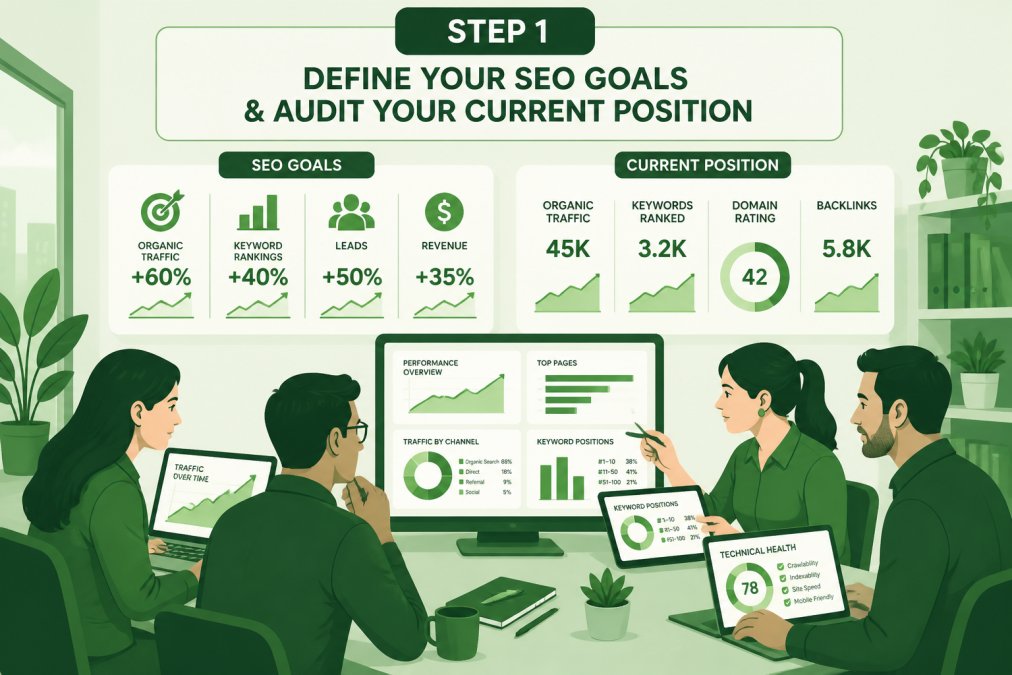
Document your current domain authority, backlink profile, and technical health. Check for crawl errors, broken links, and indexation issues that might be holding back your visibility. This baseline becomes your reference point for measuring progress. At GrandRanker, we've found that teams working across competitive markets often underestimate how much low-hanging fruit exists in their existing content performance data.
Step 2: Conduct Keyword Research Aligned to Your Business Model
Keyword research isn't about finding the highest-volume terms. It's about finding the terms that match your business model and where you can realistically compete. A mid-sized SaaS company shouldn't be chasing the same keywords as enterprise software vendors. Your advantage lies in specificity and relevance to your actual offering.
Start by mapping keywords to your business stages: awareness, consideration, and decision. Awareness keywords help you reach people discovering your industry. Consideration keywords target people comparing solutions. Decision keywords capture people ready to buy. Most mid-sized companies neglect awareness and consideration, then wonder why they can't build a sustainable organic pipeline.
Research your competitor's keyword gaps. Where are they not ranking? What topics do they ignore? These gaps often represent opportunities where a focused mid-sized player can dominate. Look for keyword clusters, related terms that address the same user intent. Rather than targeting isolated keywords, you're building authority around topic areas.
Consider search volume in context of your market size. A keyword with 500 monthly searches might be perfect for a mid-sized company serving a niche industry. A keyword with 50,000 monthly searches might be impossible to rank for if you're competing against established leaders. The goal is matching keyword difficulty to your domain authority and resources.
Document your target keywords in a structured format: primary keywords (your core focus), secondary keywords (supporting terms), and long-tail variations (specific, lower-volume phrases). This organization makes it easier to build content around related topics and helps your team stay aligned on priorities.
Step 3: Build Your Content Strategy and Content Calendar
Your content strategy translates keyword research into an actual publishing plan. Without structure, content efforts become reactive and scattered. A mid-sized company needs a calendar that balances quick-win content with long-term authority building.
Start by mapping your target keywords to content types. Some keywords warrant comprehensive guides. Others fit better as how-to articles, case studies, or product comparisons. Match content format to search intent. If people searching a keyword want quick answers, a 10,000-word guide won't rank, they'll bounce immediately.
Build a content calendar that spans at least three months, ideally six. Consistency matters more than volume. Publishing two quality pieces monthly outperforms publishing five rushed pieces. Your calendar should show publication dates, assigned owners, target keywords, and content type. This prevents bottlenecks and keeps accountability clear.
Prioritize content by potential impact. High-volume keywords with low competition should come first. Keywords that address pain points in your sales cycle deserve priority. Topics that support multiple keywords through one comprehensive piece are more efficient than single-keyword articles.
Plan for content clusters, one comprehensive pillar article supported by multiple cluster articles linking back to it. This structure signals topical authority to search engines and helps readers navigate related content. For example, if "SEO strategy for mid-sized companies" is your pillar, cluster articles might cover individual steps, tools, common mistakes, and measurement approaches.
Step 4: Optimize Technical SEO and Site Structure
Technical SEO creates the infrastructure that allows your content to rank. A beautifully written article won't rank if your site has crawl errors, slow page load times, or poor internal linking structure. Mid-sized companies often neglect this layer, focusing entirely on content while their technical foundation crumbles.
Ensure your site structure is logical and crawlable. Your information architecture should make sense to both users and search engines. Deep pages buried under multiple menu levels are harder to discover and rank. Aim for a structure where important pages are three clicks or fewer from the homepage.
Implement proper internal linking. Link from high-authority pages to target pages you want to rank. Use descriptive anchor text that includes your target keywords naturally. Internal links pass authority and help search engines understand your site's topical structure. This is one of the most underutilized ranking factors available to mid-sized companies.
Optimize page speed. Google considers Core Web Vitals, loading speed, visual stability, and responsiveness, as ranking factors. Compress images, minimize JavaScript, use a content delivery network, and enable browser caching. Even modest improvements in page speed can improve rankings and reduce bounce rates.
Ensure mobile responsiveness. Most organic traffic comes from mobile devices. Your site must display and function properly on phones and tablets. Test across devices and use Google's Mobile-Friendly Test tool to identify issues.
Implement schema markup for your content type. Product schema for e-commerce, article schema for blog posts, FAQ schema for common questions. Schema helps search engines understand your content and can improve click-through rates from search results.
Step 5: Implement Measurement and Reporting Systems
You can't improve what you don't measure. Mid-sized companies often struggle here because they're tracking too much data without clear connection to business outcomes. Your measurement system should answer one question: Is this driving business value?
Set up Google Analytics 4 and Google Search Console if you haven't already. These free tools provide essential data on organic traffic, keyword rankings, click-through rates, and user behavior. Configure goals or conversions that match your business objectives. If your goal is lead generation, track form submissions. If it's e-commerce, track purchases. If it's content consumption, track time on page and pages per session.

Create a monthly reporting dashboard that tracks key metrics: organic traffic, rankings for target keywords, conversion rate from organic traffic, and ROI if applicable. Compare month-over-month and year-over-year to identify trends. Don't just look at total traffic, segment by page, keyword, and traffic source to understand what's actually working.
Establish a feedback loop between SEO performance and your sales team. Which keywords and content are generating high-quality leads? Which are generating traffic but no conversions? This intelligence guides your content priorities and helps you focus on keywords that actually drive business value.
Track competitor rankings for your target keywords. Are they gaining ground? Losing ground? This competitive context helps you understand whether your efforts are moving the needle relative to the market.
| Metric | Frequency | Owner | Business Impact |
|---|---|---|---|
| Organic traffic | Monthly | Marketing | Revenue indicator |
| Target keyword rankings | Bi-weekly | SEO lead | Visibility measure |
| Conversion rate from organic | Monthly | Analytics | ROI measure |
| Pages indexed | Monthly | Technical SEO | Crawl health |
| Domain authority | Monthly | SEO lead | Authority trend |
SEO Tools for Mid-Sized Companies: Automating Your Workflow
Mid-sized companies operate in a tight zone. You have more resources than startups but less budget than enterprises. Your tool stack should reflect this reality, powerful enough to handle your needs, but not so complex that you're drowning in data.
For keyword research, consider tools that combine volume data with competitor analysis and difficulty scoring. You need to understand not just what keywords exist, but whether you can realistically rank for them given your current authority.
For rank tracking, you want a tool that monitors your target keywords consistently and alerts you to significant changes. Sudden drops often indicate technical issues or algorithmic changes worth investigating immediately.
For content optimization, tools that analyze top-ranking pages for your target keywords are invaluable. They show you content length, keyword usage, backlink profiles, and structural elements that correlate with rankings. This prevents guessing about what Google wants.
For technical SEO auditing, automated crawlers identify issues your team might miss. Crawl errors, broken links, duplicate content, missing meta tags, these tools catch the problems that slow your progress.
For backlink analysis, you need visibility into your own link profile and your competitors'. Where are your competitors getting links? What anchor text are they using? This intelligence guides your link-building strategy.
GrandRanker handles keyword research, content optimization, and publishing automation in one platform. For mid-sized companies, this integration reduces tool sprawl and the time spent moving data between systems. The platform's AI-powered approach to content creation addresses the challenge many teams face: your content team is stretched thin, but you can't afford to hire more writers.
Creating Your SEO Strategy Template for Mid-Sized Business
A template ensures consistency and prevents your SEO strategy from becoming a scattered collection of tactics. Your template should capture your goals, target keywords, content calendar, technical priorities, and measurement approach in one place.
Start with your business objectives. What revenue or growth target are you trying to achieve? How does SEO contribute? Be specific. "Increase organic traffic" is vague. "Generate 50 qualified leads per month from organic search" is actionable.
Document your target audience and their search behavior. What problems are they trying to solve? What keywords do they use? What content format do they prefer? This audience insight drives every downstream decision.
List your target keywords organized by priority and content type. Include search volume, difficulty, and the business value of each keyword. This keeps your team focused on high-impact opportunities rather than chasing every possible keyword.
Map your content calendar for the next quarter. Include publication dates, assigned owners, target keywords, and expected outcomes. This visibility prevents bottlenecks and keeps accountability clear.
Outline your technical SEO priorities. What issues are holding you back? What improvements would have the biggest impact? Prioritize ruthlessly, you can't fix everything at once.
Define your measurement approach. Which metrics matter most to your business? How often will you review progress? Who owns reporting? Clear ownership prevents metrics from being ignored.
Common Mistakes Mid-Sized Companies Make With SEO
Mid-sized companies often make predictable mistakes that derail their SEO efforts. Understanding these pitfalls helps you avoid them.
The first mistake is treating SEO as a short-term tactic rather than a long-term strategy. Companies launch SEO initiatives expecting results in 30 days, then abandon the effort when rankings don't immediately improve. SEO typically takes 3-6 months to show meaningful results, longer in competitive industries. Patience and consistency matter more than intensity.
The second mistake is publishing content without a strategic purpose. Your team writes about topics they think are interesting rather than topics that align with your business goals and keyword research. This creates a content library that doesn't support your business objectives. Every piece of content should serve a specific purpose: ranking for a target keyword, supporting a sales conversation, or building topical authority.
The third mistake is neglecting technical SEO while obsessing over content. A beautifully written article won't rank if your site has crawl errors or slow page speed. Technical SEO and content SEO are equally important. Both require attention.
The fourth mistake is ignoring internal linking. Your high-authority pages have authority to share. Strategic internal linking passes that authority to pages you want to rank. Many mid-sized companies publish content but never link to it from relevant pages, missing an easy ranking boost.
The fifth mistake is chasing every keyword rather than focusing on keywords you can actually win. Your domain authority limits which keywords you can realistically rank for. Focus on keywords where you have a chance to reach the first page. Build authority gradually, then tackle more competitive keywords.
The sixth mistake is failing to connect SEO to business outcomes. Your team tracks rankings and traffic but never measures whether SEO is generating qualified leads or revenue. This disconnect makes it hard to justify SEO investment or identify what's actually working.
Conclusion: From Strategy to Results
Building an SEO strategy for mid-sized companies requires balancing ambition with realism. You're competing against well-funded enterprises and scrappy startups simultaneously. Your advantage lies in strategic focus, consistent execution, and willingness to measure what matters.
The five-step approach outlined here, defining goals, conducting keyword research, building content strategy, optimizing technical SEO, and measuring results, creates a framework that mid-sized companies can execute without needing a massive in-house team or unlimited budget.
Start with Step 1. Understand where you are and where you want to go. Then move methodically through the remaining steps. Each builds on the previous one. Rushing through the foundation to get to content creation typically results in wasted effort.
Building an SEO strategy for mid-sized companies doesn't require choosing between hiring a large agency or doing everything yourself. GrandRanker automates the most time-intensive parts of the process, keyword research, content creation, optimization, and publishing, so your team can focus on strategy and measurement. The platform's AI-powered approach to content generation combined with built-in SEO optimization means your content is both high-quality and search-engine optimized from day one. Start your free trial with GrandRanker and see how automation can accelerate your organic growth while your team focuses on what truly requires human judgment: strategy, analysis, and business alignment.
Frequently Asked Questions
How does an SEO strategy differ for mid-sized companies versus small businesses?
Mid-sized companies have more resources to invest in SEO but face higher competition and complexity. Small businesses often compete on niche keywords and local search. Mid-sized companies need systematic keyword research across multiple buyer journey stages, stronger technical foundations, and coordinated content teams. Your SEO strategy should reflect your team size, budget, and competitive landscape. Focus on keywords with commercial intent that match your sales cycle and build authority faster through topic clusters and internal linking.
What are the most important SEO metrics for mid-sized companies to track?
Track organic traffic, keyword rankings, conversion rate from organic search, and cost per acquisition from SEO. Monitor Core Web Vitals (page speed, mobile usability) since these affect rankings. Measure click-through rate from search results to understand title and meta description performance. For mid-market companies, focus on metrics that connect to revenue: qualified leads from organic search, customer acquisition cost, and lifetime value of organic customers. Use Google Analytics 4 to track user behavior beyond just visits.
How long does it take to see results from an SEO strategy for a mid-sized company?
Most mid-sized companies see modest ranking improvements within 3-6 months and meaningful traffic increases within 6-12 months. Timeline depends on competition level, content quality, technical foundation, and how aggressively you execute. Competitive industries take longer; niche markets show faster results. Quick wins come from fixing technical issues and targeting low-competition keywords. Long-term authority builds through consistent content creation and backlink acquisition. Start measuring progress monthly but expect significant ROI conversations around month 9-12.
Can AI tools like GrandRanker handle niche industry terminology and compliance requirements?
AI-powered SEO tools work best when trained on your industry's specific language and compliance context. GrandRanker can be configured with your terminology, regulatory requirements, and brand guidelines to generate content that ranks while maintaining accuracy. The key is providing clear input about your industry's constraints during setup. For highly regulated industries (finance, healthcare, legal), always have subject matter experts review AI-generated content before publishing. Automation accelerates your workflow, but human expertise ensures compliance and credibility remain intact.
This article was written using GrandRanker