 listicle
10 Effective SEO Strategies for Marketing Teams
Table of Contents
- 1. Build a Keyword Research and Targeting Strategy
- 2. Develop a Technical SEO Checklist for Marketers
- 3. Create Content That Targets Search Intent
- 4. Establish an SEO Workflow for Marketing Teams
- 5. Build High-Quality Backlinks and Domain Authority
- 6. Optimize for Mobile-First Indexing and Page Speed
- 7. Create SEO Reporting Templates for Stakeholders
- 8. How to Measure SEO Success and ROI
- 9. Implement On-Page Optimization Across Your Site
- 10. Use Local SEO and Semantic Search Strategies
Last Updated: August 16, 2026
1. Build a Keyword Research and Targeting Strategy
Effective SEO starts with understanding what your audience is actually searching for. 10 effective SEO strategies for marketing teams begins here because without proper keyword research, every other tactic falls flat. Your team needs to align keyword intent with audience behavior, then prioritize those keywords by search volume and conversion potential.
Start by identifying search queries that match your business goals. Not every high-volume keyword is worth targeting. A query with 50,000 monthly searches might be irrelevant if those searchers aren't your customers. Instead, focus on keywords where search intent aligns with what you offer.
Many marketing teams waste months optimizing for keywords that sound important but deliver zero conversions. The fix is straightforward: research the top-ranking pages for your target keywords. If those pages are listicles and yours is a product page, you're competing in the wrong arena. Match your content format to what Google already ranks for that query.
According to Google's Search Quality Rater Guidelines, search intent determines ranking success more than keyword frequency. This means your keyword strategy must account for whether searchers want information, a product, a local business, or a navigation page.
Prioritization matters equally. Build a scoring system that weighs search volume against keyword difficulty, conversion intent, and your current domain authority. Tools like Google Search Console show which keywords already drive traffic to your site, start there. These are quick wins where small optimizations generate immediate results.
2. Develop a Technical SEO Checklist for Marketers
Technical SEO is where many marketing teams stumble. They optimize content brilliantly but ignore the foundation, crawlability, indexability, and structured data. Without these basics, even exceptional content won't rank.
Start with a crawlability audit. Google's crawler needs to access every page on your site. Check for robots.txt files blocking important sections, broken internal links, and redirect chains. Screaming Frog SEO Spider offers a free version that crawls up to 500 URLs, showing you exactly where technical problems exist.
Indexability is the next layer. Use Google Search Console's Index Coverage report to identify pages Google hasn't indexed. Common culprits include thin content, duplicate pages, and noindex tags on pages you want ranked. Fix these issues and resubmit your sitemap.
Schema markup and structured data tell search engines what your content means. Add schema for your content type, articles, products, FAQs, local businesses. This helps Google understand context and can trigger rich snippets in search results. Yoast SEO makes this simple for WordPress users; for other platforms, use JSON-LD structured data directly in your page code.
Google's Structured Data Testing Tool validates your schema implementation. Run every important page through it before publishing.
A technical SEO checklist your team should follow:
- Mobile responsiveness (test on actual devices, not just browser tools)
- Page load speed under 3 seconds (measure with Google PageSpeed Insights)
- HTTPS enabled across all pages
- XML sitemap submitted to Google Search Console
- Core Web Vitals passing (Largest Contentful Paint under 2.5 seconds)
- No 404 errors linking from internal pages
- Canonicalization implemented for duplicate content
3. Create Content That Targets Search Intent
Content creation without understanding search intent is like throwing darts blindfolded. You might hit the board, but you won't hit the target.
Search intent falls into four categories: informational (users want to learn), navigational (users want a specific site), commercial (users comparing options), and transactional (users ready to buy). Your content format must match the dominant intent for your target keyword.
If your keyword has informational intent but you're publishing a product page, you've already lost. Google will rank blog posts and guides ahead of you because that's what searchers actually want. Reverse this by creating content that answers the question users are asking.
Build topical authority through content clusters. One pillar page covers your main topic broadly. Cluster content pieces dive deeper into specific subtopics, linking back to the pillar. This structure signals to Google that you're a comprehensive authority on the topic, not just a page with one article.
For example, a pillar page on "email marketing" connects to clusters on "email segmentation," "automation workflows," and "deliverability best practices." Each cluster article links back to the pillar, creating a web of related content Google recognizes as authoritative.
Clearscope helps teams optimize content for topical relevance. It analyzes top-ranking pages and suggests terms and topics your content should include. This ensures you're covering what searchers expect while avoiding gaps competitors exploit.
Content that ranks combines three elements: it matches search intent, covers the topic comprehensively, and provides something unique competitors miss. That third element, your unique angle, is what drives citations from AI assistants like ChatGPT and Claude. GrandRanker automates this process by identifying content gaps and generating optimized pieces that rank and get cited.
4. Establish an SEO Workflow for Marketing Teams
SEO fails when responsibilities are unclear and processes are manual. Without a structured workflow, your team duplicates work, misses deadlines, and produces inconsistent results.
Define clear roles. Who handles keyword research? Who creates content? Who optimizes for technical SEO? Who monitors rankings and reports to leadership? Assign these responsibilities explicitly. In larger teams, you might have specialists for each area. Smaller teams need people wearing multiple hats, but the roles should still be clear.
Build approval workflows that don't bottleneck progress. A typical workflow looks like: keyword research → content creation → SEO optimization → internal review → final approval → publishing → monitoring. Each step should have a clear owner and timeline. Without timelines, work stalls.
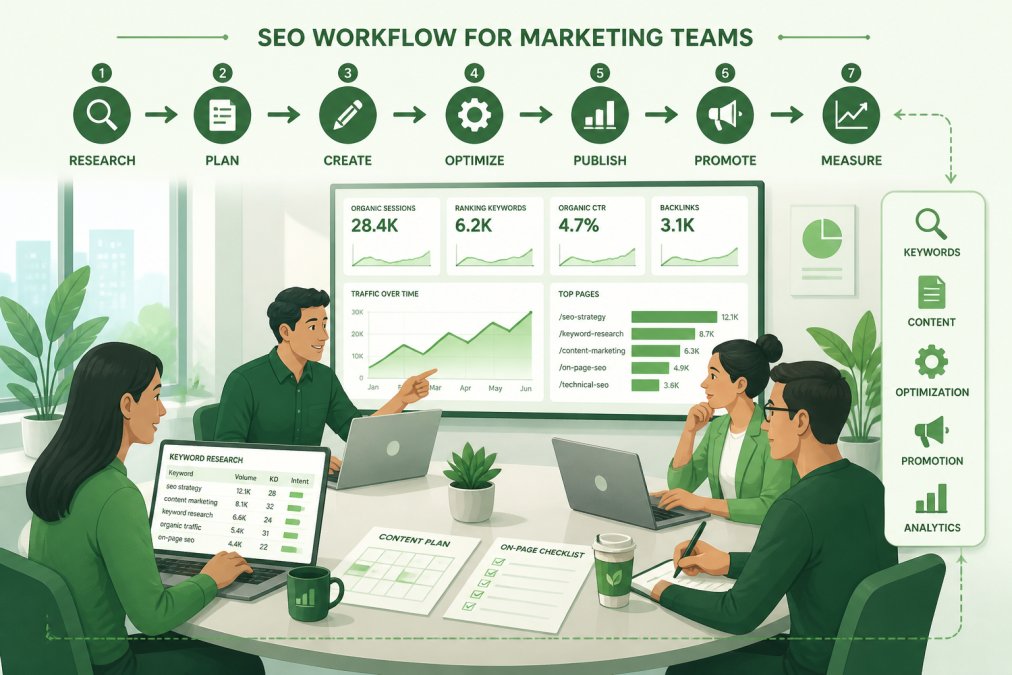
Automate repetitive tasks to free up team capacity. Manual keyword research, content optimization, and publishing consume hours weekly. Tools like GrandRanker automate keyword discovery, content creation, and on-page optimization, reducing manual work. Your team shifts from execution to strategy.
A simple workflow template for your team:
| Stage | Owner | Timeline | Tools |
|---|---|---|---|
| Keyword Research | SEO Lead | 1 week | Google Search Console, Ahrefs |
| Content Brief | Content Manager | 3 days | Clearscope, search intent research |
| Content Creation | Writer | 2 weeks | GrandRanker, Clearscope |
| SEO Optimization | SEO Specialist | 3 days | Yoast SEO, schema validation |
| Publishing | Content Manager | 1 day | CMS, monitoring setup |
5. Build High-Quality Backlinks and Domain Authority
Backlinks remain one of Google's top ranking factors. A page with authoritative inbound links ranks higher than identical content without them. But not all links are equal.
Develop a sustainable link acquisition strategy that doesn't rely on buying links or spammy directories. Start by auditing your current backlink profile using Ahrefs or Moz Pro. Identify which pages link to you, their authority level, and the anchor text they use. This baseline shows where you stand.
Next, analyze competitor backlinks. Which sites link to them but not you? Reach out to those sites with a reason they should link to you. Maybe you've published newer research, a more comprehensive guide, or a resource their audience needs. Personalized outreach converts better than mass emails.
Create linkable assets, content so valuable other sites want to reference it. Original research, comprehensive guides, and tools attract backlinks naturally. A study showing industry trends, a free calculator your audience needs, or a detailed framework competitors don't have generates inbound links without asking.
use brand mentions and link equity. When someone mentions your brand online without linking, reach out and ask for a link. These "unlinked mentions" are quick wins. Similarly, when you link internally, you pass link equity to important pages. Strategic internal linking amplifies the authority of your highest-priority content.
Local SEO plays into domain authority too. If you serve specific geographic areas, build local citations and backlinks. Being listed in local directories, earning links from local news outlets, and getting mentioned in community resources strengthens your local authority signal.
6. Optimize for Mobile-First Indexing and Page Speed
Google indexes the mobile version of your site first. If your mobile site is slower, less functional, or missing content, your rankings suffer. Mobile optimization isn't optional, it's foundational.
Core Web Vitals measure user experience. Largest Contentful Paint (LCP) should load under 2.5 seconds. Cumulative Layout Shift (CLS) should stay below 0.1 to avoid content jumping as the page loads. First Input Delay (FID) should be under 100 milliseconds. These metrics directly impact rankings and user engagement.
Test your site's Core Web Vitals using Google PageSpeed Insights. It shows which metrics are failing and provides specific recommendations. Common fixes include compressing images, deferring non-critical JavaScript, and using a content delivery network (CDN) to serve assets from servers closer to users.
Mobile responsiveness goes beyond metrics. Your site should function perfectly on phones: buttons should be tappable, text should be readable without zooming, and navigation should be intuitive. Test on actual mobile devices, not just browser emulation. Real-world performance differs significantly.
User engagement signals matter. Dwell time, how long users stay on your page, and bounce rate influence rankings. A fast, mobile-friendly page keeps users engaged. A slow, broken mobile experience sends them to competitors.
GrandRanker's platform ensures content is optimized for mobile-first indexing. It generates content formatted for readability on all devices and integrates with your publishing workflow, eliminating manual mobile optimization work.
7. Create SEO Reporting Templates for Stakeholders
Leadership doesn't care about keyword rankings. They care about business outcomes: traffic, leads, revenue. Your SEO reporting needs to connect metrics to results.
Track organic traffic, SERP features, and search visibility. Google Analytics 4 shows which organic keywords drive traffic and how that traffic converts. Search Console reveals your ranking positions and click-through rates. Together, these tools paint a complete picture.
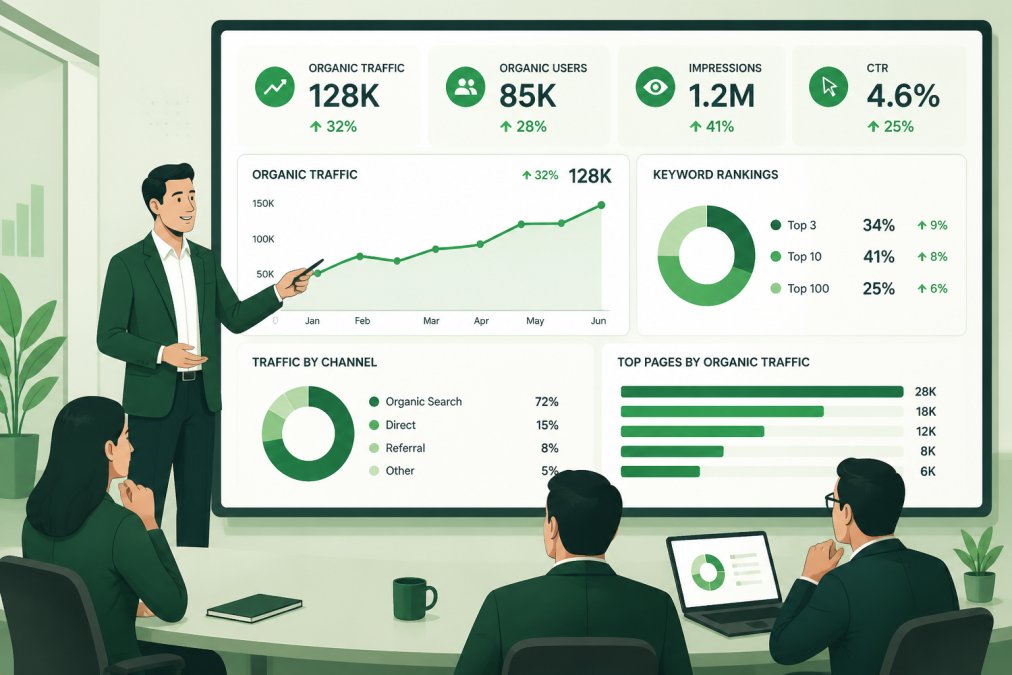
Build templates that show trend lines, not just raw numbers. A dashboard showing organic traffic up 35% month-over-month is more compelling than "1.2M sessions." Include comparisons: traffic this month versus last month, this quarter versus last year. Context makes data meaningful.
Connect SEO metrics to business outcomes. If organic traffic increased 40% but conversions stayed flat, something's wrong. Maybe you're ranking for the wrong keywords. Maybe your landing pages aren't converting. Dig deeper. Your reporting should highlight these gaps.
Include SERP feature tracking. How many of your keywords show featured snippets? How many appear in the local pack? Rich results increase click-through rates. Track them separately because they indicate content quality and topical authority.
A monthly reporting template should include:
- Organic traffic (month-over-month and year-over-year)
- Top 10 keywords by traffic volume
- New keywords ranking in top 10
- Ranking improvements and declines
- Backlinks acquired
- Technical issues resolved
- Content published and performance
Share this report monthly with stakeholders. It keeps SEO visible and justifies continued investment.
8. How to Measure SEO Success and ROI
Measuring SEO success requires defining what success looks like before you start. Without clear KPIs, you can't prove ROI.
Define KPIs aligned to business goals. If your goal is brand awareness, track branded search volume and branded traffic. If it's lead generation, track organic traffic to landing pages and conversion rates. If it's revenue, calculate the lifetime value of customers acquired through organic search.
Attribution modeling matters here. A customer might discover you through organic search, leave, return through email, and convert. Which channel gets credit? First-touch attribution credits the initial organic visit. Last-touch credits the final email. Multi-touch attributes credit across all touchpoints. Choose the model that matches your business.
Calculate conversion rate optimization by tracking how organic traffic converts at each stage of your funnel. Maybe organic visitors convert to leads at 8% but only 2% become customers. This tells you where to focus: either improve lead quality or fix your sales process.
Dwell time and bounce rate indicate content quality. If users land on your page and leave immediately, Google notes this. If they stay and explore multiple pages, it signals relevance. Track these metrics in Google Analytics to identify underperforming content.
ROI calculation is straightforward: (Revenue from organic - Cost of SEO) / Cost of SEO. If SEO costs $5,000 monthly and generates $50,000 in attributed revenue, your ROI is 900%. That's compelling to leadership.
9. Implement On-Page Optimization Across Your Site
On-page optimization is where your keyword strategy meets execution. Every page needs proper optimization to rank.
Meta descriptions should be 150-160 characters, include your target keyword naturally, and compel clicks. A weak meta description loses clicks to competitors. A strong one improves click-through rate by 20-30%.
Header tags structure your content. Use H1 once per page for your main topic. Use H2s for major sections and H3s for subsections. Include keywords naturally in headers, they signal topic relevance to Google. But don't stuff keywords; headers should read naturally for humans first.
Canonicalization prevents duplicate content penalties. If multiple URLs show the same content, specify which is the canonical version. This consolidates ranking signals to one URL instead of splitting them across duplicates.
Improve user engagement by writing scannable content. Short paragraphs, bullet lists, and bold key phrases make content easier to consume. Longer average time on page signals quality to Google.
Reduce bounce rate by matching page content to search intent. If someone searches "how to optimize for mobile" and lands on a product page, they bounce. But if they land on a comprehensive guide addressing their question, they stay. Intent matching eliminates bounces.
Internal linking distributes link equity and guides users through your content. Link from high-authority pages to important pages you want to rank. Use descriptive anchor text that includes keywords when natural.
10. Use Local SEO and Semantic Search Strategies
Local SEO targets customers in specific geographic areas. If you serve customers in particular regions, local optimization drives qualified traffic.
Local pack optimization appears when someone searches "services near me." Get listed in Google Business Profile with accurate business information, categories, and photos. Encourage customer reviews, they influence local rankings significantly. Respond to all reviews, positive and negative. This signals active management to Google.
Build local citations by listing your business in directories like Yelp, Apple Maps, and industry-specific directories. Consistent name, address, and phone number across all citations strengthens local authority.
Semantic search understands the meaning behind queries, not just keywords. If someone searches "best coffee near me," Google understands they want nearby cafes with good reviews, not just pages containing those words. Write content that answers questions comprehensively, covering related topics and concepts.
Performance metrics tracking reveals what's working. Monitor which keywords drive traffic, which pages convert best, and which channels generate revenue. Use this data to refine your strategy quarterly.
Google's Local Services Ads guidelines outline requirements for appearing in local results. Review these guidelines to ensure your business profile meets all requirements.
Implementing 10 effective SEO strategies for marketing teams requires coordination, but the payoff justifies the effort. Teams that systematize SEO, defining workflows, tracking metrics, and optimizing continuously, see 3-5x organic traffic growth within 12 months. GrandRanker accelerates this by automating keyword research, content creation, and optimization, letting your team focus on strategy while the platform handles execution. Start a free trial to see how automation transforms your SEO workflow and gets your content cited by AI assistants.
Frequently Asked Questions
How do you integrate SEO into a marketing team's workflow?
Integrate SEO by defining clear roles, establishing approval workflows, and automating repetitive tasks like keyword research and technical audits. Assign an SEO lead to oversee strategy, involve content creators in keyword targeting, and use tools to track performance metrics. Regular sync meetings ensure alignment between SEO, content, and paid marketing teams. This collaborative SEO workflow for marketing teams reduces bottlenecks and accelerates content production while maintaining quality.
What are the most important SEO metrics for marketing teams to track?
Focus on organic traffic volume, keyword rankings for target terms, click-through rate from search results, conversion rate from organic visitors, and domain authority growth. Also monitor Core Web Vitals, bounce rate, dwell time, and SERP features visibility. These metrics reveal how well your SEO strategies marketing teams are performing and directly connect to business outcomes. Use Google Search Console and Google Analytics 4 to measure SEO success with precision.
How do you measure the ROI of SEO for a business?
Calculate SEO ROI by tracking organic traffic volume, conversion rates from organic visitors, and attributing revenue to organic channels. Compare the cost of your SEO efforts (tools, team salaries, content production) against revenue generated. Use attribution modeling to understand the customer journey from first organic touch to conversion. Most teams see positive ROI within 6-12 months when executing proven SEO strategies consistently.
Why should marketing teams use a technical SEO checklist?
A technical SEO checklist ensures your site meets crawlability, indexability, and performance standards that Google expects. It covers canonicalization, schema markup, mobile responsiveness, page speed, and Core Web Vitals. By using a technical SEO checklist for marketers, your team catches issues before they impact search visibility. This prevents costly ranking drops and ensures your content has the best possible foundation to rank well in search results.
This article was written using GrandRanker